Ask Singapore Homework?
Upload a photo of a Singapore homework and someone will email you the solution for free.

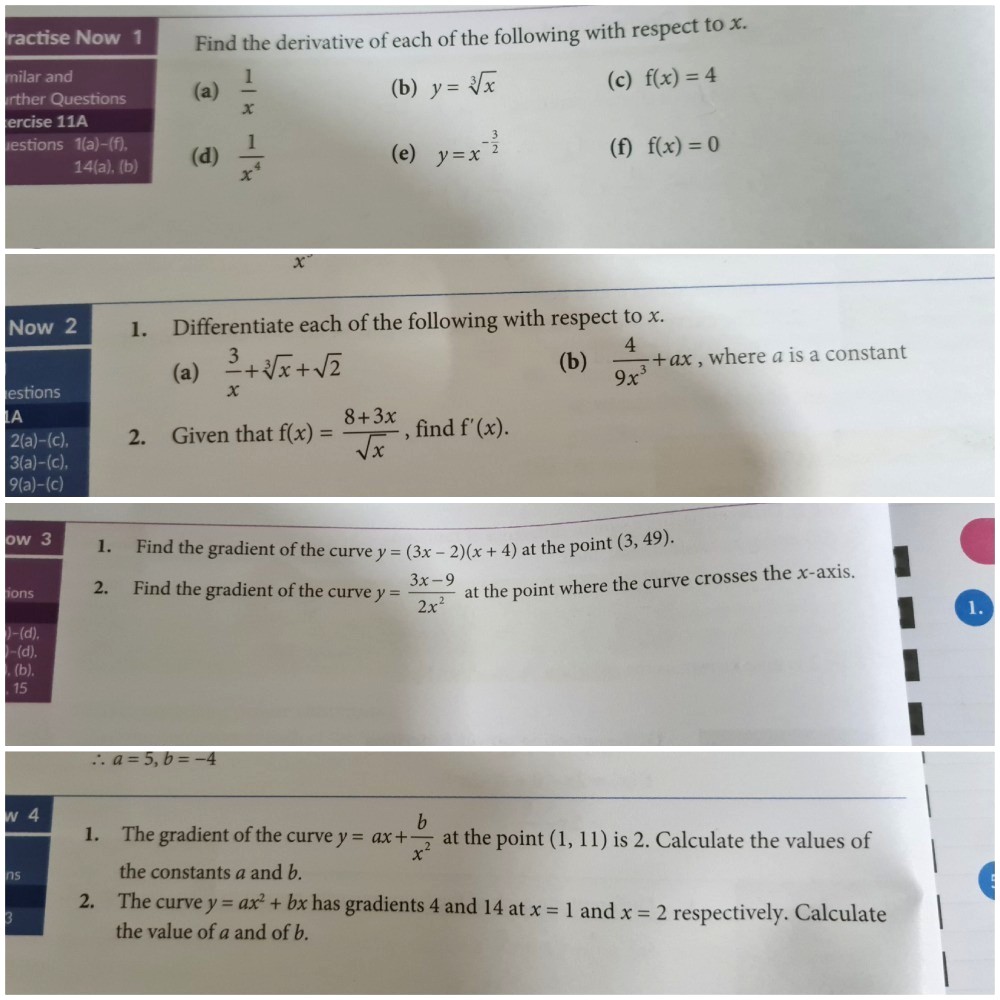
Question
secondary 4 | A Maths
No Answers Yet
Anyone can contribute an answer, even non-tutors.

need help with these qns, pls explain too
Date Posted: 5 years ago
Views: 506

We need to make the functions look nicer first before we proceed to perform the differentiation, I presume that you have yet to learn the chain rule, product rule and quotient rule at this stage.
yep i have not learn anything about this chapter yet...
In this chapter we learn how to differentiate a function.
Differentiation is the process of obtaining the derivative of a function f(x) with respect to x. That is, we are actually trying to find the gradient of a curve at a particular point on the curve.
The idea of differentiation involving gradient goes a long way involving the basic formula for the gradient of the curve, but it's long and complicated so I will skip the explanation.
The very first basic rule of differentiation states that for a function of the form
y = x^n,
its derivative function, represented as dy/dx (basically, difference of y divided by difference of x, which is your gradient!), is given by
dy/dx = n * x^(n - 1)
That is, we bring down the power and then we reduce the power of x by 1. This applies to all real powers of x, including zero, negative and fractional powers.
So for example, for a regular quadratic curve y = x², its gradient function is given by
dy/dx = 2x
This means that the gradient of the curve depends on the location of the point of the curve, which you would probably have noticed while learning curves. When x = 1, dy/dx = 2; this means that the gradient of the curve is 2 at the point when x = 1 (you can see this on Desmos by plotting the curve and drawing the line y = 2x; this line is parallel to the tangent line).
(Actually, if you have the point and the gradient ready, you can already form the equation of the tangent on your own using y = mx + c! But not to worry, this will be covered in the following chapter)
When x = 3 instead, dy/dx = 6; this indicates a greater steepness of the curve as expected of a quadratic curve.
Let's use the rule to do the questions in Practise Now 1.
Suppose we let y = 1/x.
We need to use the very first basic rule to differentiate this. Now, how do we differentiate the function?
We begin by writing dy/dx. Yes. But hold up. We learnt that y = x^n differentiates to dy/dx = n x^(n-1). But our function is of the form y = 1/x. So we need to convert this form first.
In converting this form, we have not differentiated the function yet, so we do not write dy/dx yet.
y
= 1/x
= x^-1
Using the first rule of differentiation, we bring down the power of -1 as a multiplier later on and then we reduce the power of x to -2.
dy/dx
= -1 times x^-2
= -1 / x²
And yes, you have completed your first question. Or at least part of a question.
If you do not wish to "let y = ...", we can also write out the derivative in an alternative form as
d/dx (1/x)
= d/dx (x^-1)
= -1 times x^-2
= -1 / x²
In converting the form, we retain the expression d/dx because we have yet to differentiate the expression. Once that is done in the following steps, the term "d/dx" disappears.
Note that we are not allowed to combine the two methods together to write
dy/dx (1/x)
= -1 / x²
This is because of reasons which become more obvious at higher levels later on (especially if you are going into JC or some maths-related poly courses).
Also, one point to note.
Remember our expression for y = 1 /x?
You might be thinking. Well...why not just differentiate the denominator alone?
Because differentiation does not work that way (this will be covered later on in Quotient Rule). So no, we are not allowed to differentiate the denominator alone in this case; we will get a different result from the correct version anyway.
For Q1b, we first need to convert the expression into a form x^n first. We cannot just retain the cube root there and differentiate the x inside alone.
Now we are automatically given the expression as "y = ...", so we follow up with "dy/dx = ...".
y
= cuberoot of x
= x^(1/3)
Differentiating,
dy/dx
= 1/3 times x^(-2/3)
= 1 / [3 times cuberoot of x²]
Now we are automatically given the expression as "y = ...", so we follow up with "dy/dx = ...".
y
= cuberoot of x
= x^(1/3)
Differentiating,
dy/dx
= 1/3 times x^(-2/3)
= 1 / [3 times cuberoot of x²]
Let's move on to Q1c.
f(x) = 4
Where is the x? (Not counting the one inside f(x)) How do we differentiate the expression when...
...there is no x in it???
Fret not. If you remember from the laws of indices that x^0 = 1, we can use this result to rewrite our expression for y as
y
= 4
= 4 times 1
= 4 times x^0
When we differentiate this expression, 4 is a constant multiplier so it will remain a multiplier of 4 later on.
dy/dx
= 4 times 0 times x^-1
= 0
Oh, nice! dy/dx = 0, a nice number! This is always the case when differentiating a term independent of x. because when the power 0 goes down, it gets multiplied by everything else to become 0!
So, an important shortcut to remember is that when we differentiate constant terms, we get 0 as our answer. This is true in the gradient sense, because if we draw the horizontal line y = 4, there is no change in y at all no matter how much x changes, so its gradient is 0 as expected).
One more hack. Whenever y = ax (the power of 1), dy/dx = a. I leave it to you to figure out why this is so.
Now that you know better how to approach the very basic idea, I will run through the next three parts.
Q1d
Since there is no "y = ...", you can let the expression be "y = ...", or present it as follows.
d/dx (1/x^4)
= d/dx (x^-4)
= -4 times x^-5
= -4 divided by x^5
Note that d/dx must come with an expression, and d/dx is only dropped out of the expression when the process of differentiation is complete.
Q1e
y = x^(-3/2)
Differentiating,
dy/dx
= -3/2 times x^(-5/2)
= -3 divided by [2 times x^(5/2)]
Q1f
A third way to present this is when we are presented with the expression in the form "f(x) = ...". For our differentiation, we write "f'(x) = ..." where the apostrophe symbol in the "power" of f represents differentiation of the expression,
Since f(x) = 4 is a constant term (independent of x, we know that the derivative for this expression must be...
f'(x) = 0
Let's look at Practise Now 2.
Now it's the next level. What happens when we are presented with the sum of three terms? Does it mean that we differentiate each term separately and then add them up? Is it?
Well, fortunately, yes it is the case. Subtraction works in a similar way as well. Do note, however, that on the line we perform the differentiation, we must differentiate all the expressions in one go. In other words, we cannot omit the d/dx expression and differentiate the first term but forget to do so for the second term just to wait for the second term to be differentiated in the following step. Everything must be done in one go, unless you write d/dx over the second term.
So this is how it goes.
d/dx (3/x + cuberoot x + sqrt 2)
= d/dx [3 times x^-1 + x^(1/2) + sqrt 2]
= 3 times -1 times x^-2 + 1/2 times x^(-1/2) + 0
= -3/x² + 1 / [2 times sqrt x]
If for some reason you prefer to differentiate one by one, this is what you must do.
d/dx (3/x + cuberoot x + sqrt 2)
= d/dx [3 times x^-1 + x^(1/2) + sqrt 2]
= d/dx (3 times x^-1) + d/dx [x^(-1/2)] + d/dx (sqrt 2)
= ...
In this case we can differentiate each term separately. Remove the "d/dx" on the terms you are differentiating.
Also note that our starting presentation must have an overall bracket due to the rules of operations.
We cannot write
d/dx 3/x + cuberoot x + sqrt 2
because in this case d/dx acts only on the 3/x term.
Q1b
d/dx [4 / (9x³) + ax]
= d/dx [4/9 times x^-3 + ax]
= 4/9 times -3 times x^-4 + a
= -4 / [3 times x^4] + a
We cannot simplify the answer which will be in terms of a.
Q2
For this type, we have to simplify the expression first. As before, do not differentiate the numerator and denominator separately and then combine the result in a fraction!
f(x)
= (8 + 3x) / sqrt x
= 8 times x^(-1/2) + 3 times x^(1/2)
Here, it's ok to omit the brackets for the whole function as are not writing "d/dx ..."
f'(x)
= 8 times -1/2 times x^(-3/2) + 3 times 1/2 times x^(-1/2)
= -4 / sqrt of x³+ 3 / [2 times sqrt x]
Practise Now 3
Q1
Similarly, we cannot differentiate the 3x - 2 and x + 4 separately before multiplying the results. Differentiation does not work that way.
We must expand first before differentiating.
y = (3x - 2) (x + 4)
y = 3x² + 12x - 2x - 8
y = 3x² + 10x - 8
Differentiating,
dy/dx = 3 (2) (x) + 10 (1) x^0 - 0
dy/dx = 6x + 10
Observe that our differentiated expression contains x only (at your level, it will only contain x) so we only need the value of the x-coordinate later on.
At the point (3, 49), x = 3, so at this point,
dy/dx
= 6 (3) + 10
= 28
so the gradient of the curve at (3, 49) is 28.
BONUS: Are you able to form the equation of this tangent to the curve given (3, 49) and a gradient of 28?
Q2
y = (3x - 9) / 2x²
You know by now to not differentiate the numerator and denominator separately.
y = 3/2 times x^-1 - 9/2 times x^-2
Differentiating,
dy/dx
= 3/2 times -1 times x^-2 - 9/2 times -2 times x^-3
= -3 / [2x²] + 9 / x³
Now, we need to find the point where curve crosses the x-axis, or the line y = 0. So we do know the value of y. But our expression for dy/dx contains only x. Is this the end?
No. Let's not forget that dy/dx comes from the original expression y.
Of course, to obtain x, we need to sub y = 0 in the original equation to find a possible value for x.
(3x - 9) / 2x² = 0
3x - 9 = 0
x = 3
So the graph crosses the x-axis when x = 3, and at this point,
dy/dx
= -3 / [2 times 3²] + 9 / 3³
= 1/6
Practise Now 4
Q1
When you see two unknowns, simuls are expected.
y = ax + b/x²
At the point (1, 11),
11 = a (1) + b / 1²
11 = a + b
a = 11 - b
y = ax + b/x²
y = ax + b times x^-2
Differentiating,
dy/dx = a + b times -2 times x^-3
dy/dx = a - 2b / x³
Since the gradient at (1, 11) is 2, dy/dx = 2 when x = 1, so
2 = a - 2b / 1³
2 = a - 2b
2 = (11 - b) - 2b
2 = 11 - 3b
-9 = -3b
b = 3
a = 8
Q2
This time, the simuls come from two separate equations for dy/dx rather than one from y and one from dy/dx.
y = ax² + bx
Differentiating,
dy/dx = 2ax + b
Since the curve has a gradient of 4 at the point where x = 1, dy/dx = 4 when x = 1.
4 = 2a (1) + b
4 = 2a + b
b = 4 - 2a
Since the curve has a gradient of 14 at the point where x = 2, dy/dx = 14 when x = 2.
14 = 2a (2) + b
14 = 4a + b
14 = 4a + (4 - 2a)
14 = 2a + 4
10 = 2a
a = 5
b = -6
for the first rule, does that mean if dy/dx = 6x,
when x=1, the gradient will be 6?
if we want to find the gradient when x=2, we will just times 2 to dy/dx, which will make the gradient 12?
when x=1, the gradient will be 6?
if we want to find the gradient when x=2, we will just times 2 to dy/dx, which will make the gradient 12?
In this case dy/dx is a variable 6x, so it will have different values depending on the value of x. This is why you cannot just read off the gradient of a curve directly without drawing a tangent - the gradient is always changing.
for practice now 2 qn 2,why is it 3 times x^-1/2 and not 3x times x^-1/2?
also, why is one of the 1/2 positive and another one negative but not both negative as it has the same base
also, why is one of the 1/2 positive and another one negative but not both negative as it has the same base
for the bonus at practice now 3 qn 1, is it
y=28x+c
sub x=3 and y=49 into the equation
49=28(3)+c
c= - 35
ans : y=28x-35
y=28x+c
sub x=3 and y=49 into the equation
49=28(3)+c
c= - 35
ans : y=28x-35
Yes, and fortunately this will be covered in the next chapter on Equations of Tangent and Normal to a Curve.
When we differentiate
3 times x^1/2
We get
3 times 1/2 times x^-1/2 (since we bring down the power 1/2); x should not be brought down at all
3 times x^1/2
We get
3 times 1/2 times x^-1/2 (since we bring down the power 1/2); x should not be brought down at all
8 divided by square root x is 8 times x^-1/2. This is because we are dividing by a square root.
3x divided by sqrt x is 3 times x^1/2. This is because x^1 divided by x^1/2 is x^(1 - 1/2) = x^1/2 by the rules of indices. So the two expressions are different..
3x divided by sqrt x is 3 times x^1/2. This is because x^1 divided by x^1/2 is x^(1 - 1/2) = x^1/2 by the rules of indices. So the two expressions are different..
practice now 3 qn 2
does that mean if we only know the y value, we have to sub it into the original eqn to find the x value, then sub the x value into dy/dx to find the gradient
if we already know the x value we can just sub it into dy/dx to find the gradient?
does that mean if we only know the y value, we have to sub it into the original eqn to find the x value, then sub the x value into dy/dx to find the gradient
if we already know the x value we can just sub it into dy/dx to find the gradient?
Basically you need the value of x for the dy/dx expression.
If you are provided with the value of y instead, we need to extract the corresponding value of x from the original equation first.
Also note that you must differentiate a function before you sub in the x. Do not do the other way round.
If you are provided with the value of y instead, we need to extract the corresponding value of x from the original equation first.
Also note that you must differentiate a function before you sub in the x. Do not do the other way round.
ok thx for helping me :)
btw can you help me with chain, product, quotient rule and some other things when you are free? i've posted it just now, thx :)

 360 Tutoring Program