Ask Singapore Homework?
Upload a photo of a Singapore homework and someone will email you the solution for free.

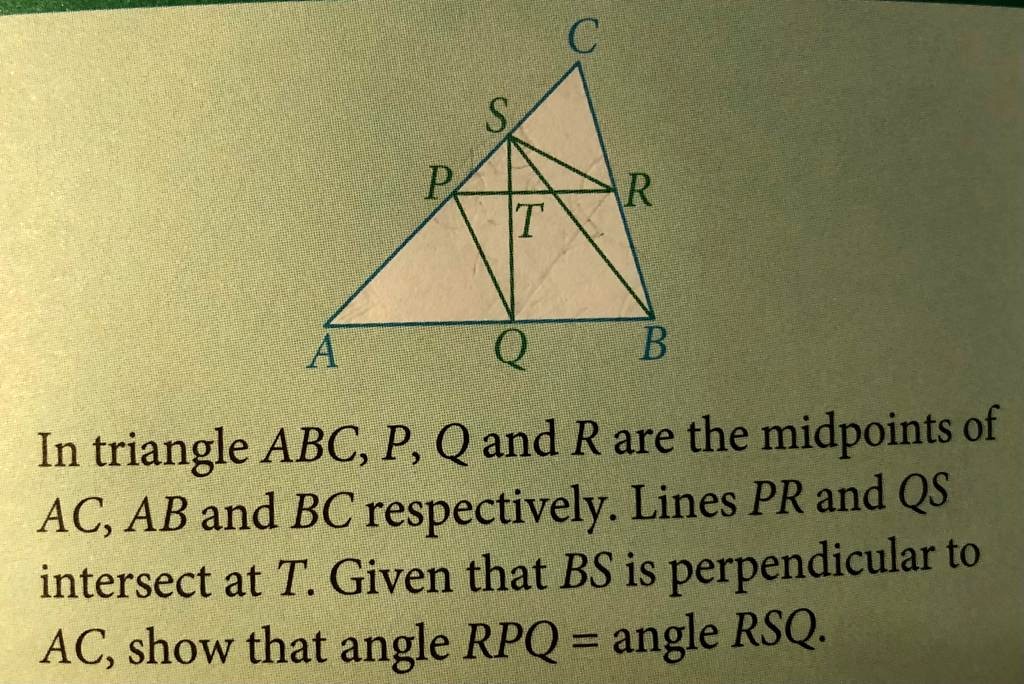
Question
secondary 4 | A Maths
One Answer Below
Anyone can contribute an answer, even non-tutors.

Good evening Mr Eric, could you help on this A math question please? Thanks :)
Date Posted: 5 years ago
Views: 661
Good evening Candice! I will have a look later when I am back at home.
Thanks Mr Eric !
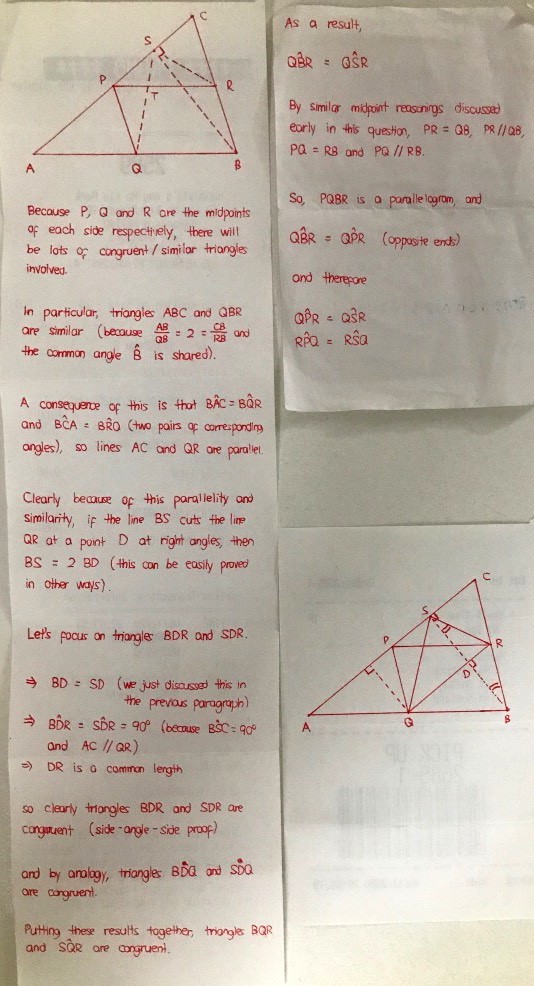
Candice, in this case I recommend you to redraw the diagram once again, but do not draw lines QP, PR, QS and SR for the time being.
Instead, we draw the line QR (which is not provided in the diagram) because the line of action BS passes through line QR.
Candice, also note that angle SQB is not necessarily 90 degrees and angle BSC is actually 90 degrees but the diagram seems to be misleading (which is why I drew my own diagram).
The idea, thereafter. is to somehow prove that angles QPR and QSR are equal. This is hard to prove unless you are really strong in congruency and similarity as well as some reasoning.
In summary, this is what I did for this question.
1. I draw line QR and labelled a new point D as the intersection of lines BS and QR.
2. With the midpoints being nicely placed, everything falls in place. AC is parallel to QR, AQ = QB, CR = RB, BD = DS etc. All these can be proven accordingly by similarity and congruency rules, or some other method (I'm pretty sure that if everything is placed at the midpoint, the diagrams will surely be symmetrical).
3. I can conclude, from point 2, that PQBR is a parallelogram so angles QPR and QBR are equal.
4. I proceed to prove that triangle BQR and SQR are congruent. This is because of the symmetries involved and the fact that I need to also prove that angles QBR and QSR are equal in order to conclude that QPR = QSR.

Your drawing of QR was correct!
Next :
①
Use midpoint theorem to show that AC // QR and QR = ½ AC
②
Since AC // QR , SC // QR as well since A,S and C are collinear.
Let the intersection point of BS and QR be X.
Since SC // QR , then SC // XR as well since Q,X and R are collinear.
And, CR = BR = ½ BC (since R is midpoint of BC)
Looking at △ BSC, use midpoint theorem again to justify that X is the midpoint of BS.
So BX = XS
③
Since BS is perpendicular to AC,
∠BSC = 90°
Since SC // XR, then ∠BXR = ∠BSC = 90° (corresponding angles)
∠SXR = 180° - ∠BXR = 180° - 90° = 90°
(Angle sum of a straight line = 180°)
Or
∠SXR = 180° - ∠BSC = 180° - 90° = 90°
(Interior angles between parallel lines(XR and SC) are supplementary (add up to 180°) )
So ∠SXR = ∠BXR
Since ∠SXR = ∠BXR , BX = XS, and XR is a common side, by the SAS congruency,
△BXR ≡ △SXR
④
Use midpoint theorem to show that PQ = ½ BC
Since ½BC = CR = BR, then PQ = CR = BR
We've shown that△BXR ≡ △SXR.
So BR = SR and △BRS is isosceles.
Since BR = PQ , then SR = PQ
PS // QR since A,P,S,C are collinear and AC //QR
Since PS//QR and SR = PQ, PQRS is an isosceles trapezium.
The diagonlas of an isosceles trapezium are equal in length so PR = QS.
Since PR = QS, QR is common and SR = PQ, by SSS congruency,
△PQR ≡ SRQ
∴ ∠RSQ = ∠RPQ (they are a corresponding pair of identical angles from the congruent triangles.
Alternative to ④'s isosceles trapezium method :
CR = BR and BR = SR .
So CR = SR and △RSC is isosceles.
∠RCS = ∠RSC (base angles of isosceles △)
Now ∠RSC = ∠QRS
(alternate angles, SC//QR)
PQ = CR
(method shown in previous comment)
So PQ = SR since CR = SR
Using midpoint theorem,
QR = ½AC
But P is midpoint of AC so AP = PC = ½ AC
This means that QR = PC
Since QR = PC and PQ = CR,
PQRC is a parallelogram.
∠PQR = ∠RCP (opposite angles of a parallelogram are equal in measure)
∠RCP and ∠RCS are equal since P,S and C are collinear. So ∠RCS = ∠PQR
We've shown that ∠RSC = ∠RCS and ∠RSC = ∠QRS
So we can say that ∠PQR = ∠QRS
Based on this and that:
QR is common side
PQ = SR
By SAS congruency, △PQR ≡△SRQ
∴ ∠RPQ = ∠QSR (which is actually ∠RSQ)
Good morning Mr Eric! Thank you so much for your detailed explanation. Really appreciated your help.
Thanks again :)
Thanks again :)
Good morning Mr J! Thank you very much for explaining in details to help me to understand this question which I have been struggling yesterday :)
Thank you.
Thank you.
Welcome.
Tip : when you see such a question with multiple midpoints within the same triangle, midpoint theorem should come to mind .
Also look for those triangles where the converse of the midpoint theorem works.
(In this question it was△BSC, which was not so obvious and quite hidden.
But once we knew QR // AC, it could be applied and we could use it to show △SXR ≡ △BXR
Also ,
If you choose to use Eric's method of proving △ BQR ≡ △ SQR,
it will not be sufficient to immediately state that △ BQR ≡ △ SQR right after proving that the two pairs of corresponding △s inside them are congruent, even though this seems immediately obvious.
There is a logical leap since these two pairs of congruent pairs could be placed separately and not necessarily mirror images as shown in the diagram. The previous proving does not demonstrate this mirror image.
You will have to show the congruency of △BQR and △SQR by quoting the relevant congruent sides/angles from that previous result
Oh, I see :)
Noted your advice with thanks Mr J.
Thank you :D
Noted your advice with thanks Mr J.
Thank you :D
See 1 Answer
done
{{ upvoteCount }} Upvotes
clear
{{ downvoteCount * -1 }} Downvotes
Good morning Candice! Here are my workings for this question. I know this question is tough for you, so you can follow my workings one step at a time.
Date Posted:
5 years ago
Yes Mr Eric. I have to say this question is indeed challenging to me coz I have been struggling on it yesterday until I "gave up" and have to seek for help :(
I am on my way rushing to school now. I will run through your advised solutions again more thoroughly when I board the bus.
Thanks again and I hope you have a great day ahead :)
I am on my way rushing to school now. I will run through your advised solutions again more thoroughly when I board the bus.
Thanks again and I hope you have a great day ahead :)


 360 Tutoring Program