Ask Singapore Homework?
Upload a photo of a Singapore homework and someone will email you the solution for free.


Question
secondary 3 | A Maths
One Answer Below
Anyone can contribute an answer, even non-tutors.

Need help
Date Posted: 5 years ago
Views: 687

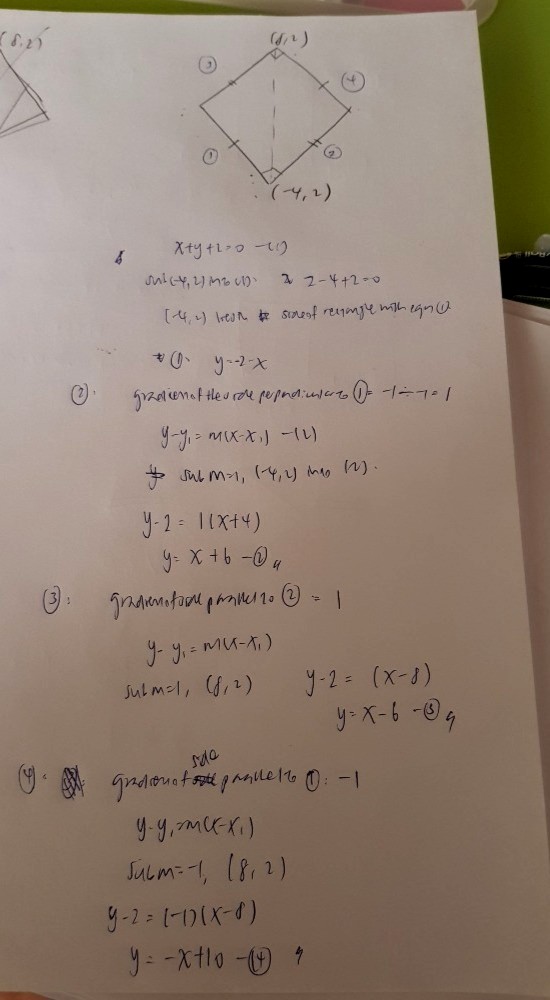
The line connecting (-4, 2) and (8, 2) is clearly a horizontal line, so it cannot be the equation x + y + 2 = 0.
The two points must have been on opposite ends.
The line x + y + 2 = 0, which transforms into y = -x - 2, has a gradient of -1, and this is basically one of its sides.
Since rectangles have lines meeting at right angles, the other line must have a gradient of -1 / -1 = 1.
Upon inspection, (-4, 2) is one of the points on the line y = -x - 2.
A line perpendicular to this has gradient 1 as explained earlier. One of the sides of the rectangle, passing through the other point (8, 2), has a equation given by
y = mx + c
2 = 1 (8) + c
-6 = c
y = x - 6
The two lines above (y = -x - 2 and y = x - 6) will meet at a third corner on the rectangle, since the two points earlier are not on adjacent sides of the rectangle (they are opposite ends).
Solving the two equations to find the third point,
x - 6 = -x - 2
2x = 4
x = 2
and y = 2 - 6 = -4
so a third point on the rectangle is (2, -4).
The three points are (-4, 2), (2, -4) and (8, 2).
The midpoint of the rectangle, which must be (2, 2) must be a shared midpoint between the two diagonals of the rectangle.
So, the midpoint of (2, -4) and the fourth vertex must be (2, 2).
The fourth point is (2, 8).
In fact, the rectangle is a square.
Updated
See 1 Answer
done
{{ upvoteCount }} Upvotes
clear
{{ downvoteCount * -1 }} Downvotes

Hope this helps
Date Posted:
5 years ago


 360 Tutoring Program