Ask Singapore Homework?
Upload a photo of a Singapore homework and someone will email you the solution for free.

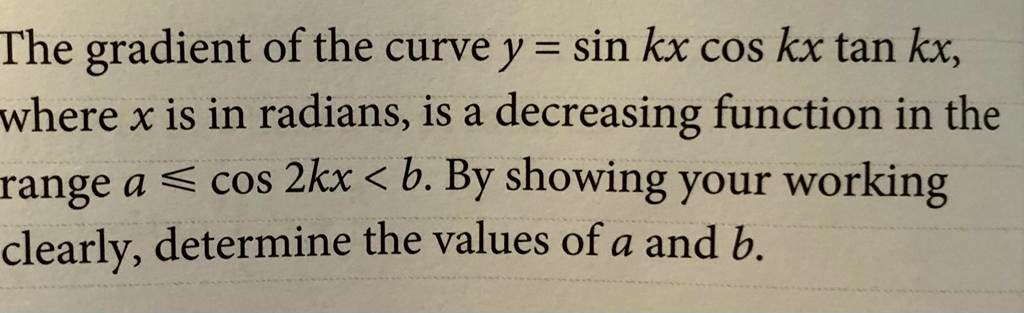
Question
secondary 4 | A Maths
2 Answers Below
Anyone can contribute an answer, even non-tutors.

Hi Mr Eric, could you please help to explain to me on this A maths question? Though I am able to derive the same answer (as the model answer) but I don't know how to explain which show that my concept is weak, hence, I really need help :(
Date Posted: 5 years ago
Views: 748

Good afternoon Candice! I will look at this at night once my classes end, but if I can find a break time in between I will have a look at it
Candice, we can simplify
y = sin kx cos kx tan kx
into
y = (sin kx)^2
with a lowest possible value of 0 and a highest possible value of 1.
We just have to be careful not to let cos kx = 0 because tan is sine divided by cosine and denominators cannot be made to equal zero for a defined value.
I will look at this later...
y = sin kx cos kx tan kx
into
y = (sin kx)^2
with a lowest possible value of 0 and a highest possible value of 1.
We just have to be careful not to let cos kx = 0 because tan is sine divided by cosine and denominators cannot be made to equal zero for a defined value.
I will look at this later...
So basically the entire function is true for all cos kx within -1 and 1, with the exception of zero.
[Recall that -1 <= cos anything <= 1]
Because the invalid “0” breaks this sequence, we can only say
-1 <= cos kx < 0
or
0 < cos kx <= 1.
So, we can say that
-1 <= cos kx <= 0
for the purposes of this question.
[Recall that -1 <= cos anything <= 1]
Because the invalid “0” breaks this sequence, we can only say
-1 <= cos kx < 0
or
0 < cos kx <= 1.
So, we can say that
-1 <= cos kx <= 0
for the purposes of this question.
Will write this on paper later.
Very sorry for the late response to you as I was away from home just now and I am so sorry to trouble you.
Thanks for taking time to explain to me :)
Thanks for taking time to explain to me :)
See 2 Answers
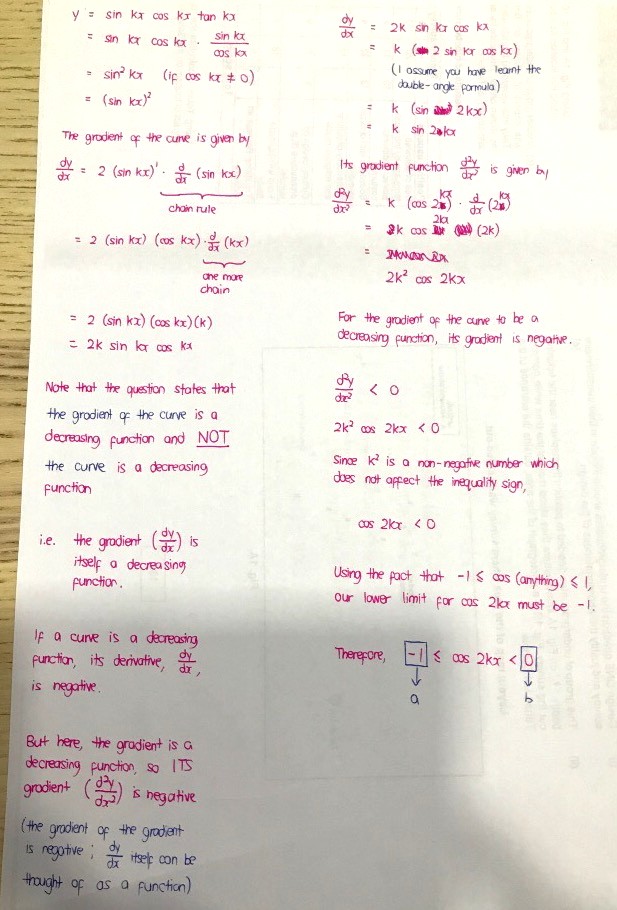
y = sin kx cos kx tan kx
= sin kx cos kx (sin kx / cos kx)
= sin² kx
dy/dx = 2 sin kx (cos kx)(k) = k(2sin kx cos kx) = k sin 2kx
d²y/dx² = k cos 2kx (2k) = 2k² cos 2kx
Since the gradient of the curve (dy/dx) is a decreasing function, dy/dx decreases as x increases.
This means that the gradient of dy/dx is negative (< 0)
Since the gradient of dy/dx is equivalent to d/dx (dy/dx) = d²y/dx² , d²y/dx² < 0 .
So 2k² cos 2kx < 0 ①
Now k cannot ≠ 0 since that would mean 2k² cos 2kx = 0, which does not satisfy the inequality.
So k is either positive or negative. This means that 2k² is a positive constant since the square of any positive or negative real number k is always positive.
Since 2k² > 0, then for ① to hold true, cos 2kx < 0 ②
Now it is given that a ≤ cos 2kx < b
Comparing this to ② , we deduce that b = 0
Lastly, since we know that for any general cosine function cos θ , -1 ≤ cosθ ≤ 1 for all real θ,
then similarly, , -1 ≤ cos 2kx ≤ 1 for all real 2kx.
So the minimum value of cos 2kx is -1. Comparing this our range given, we deduce that a = -1
Thanks for your detailed explanation Mr J. It's really awesome as I can see your effort in making it as clear as possible. I can understand better now. Thanks again.
And I hope you have a great weekend.
And I hope you have a great weekend.
I had given this question some thought and realised something.
Now, the starting expression is
y = sin kx cos kx tan kx.
Even though this expression simplifies to
y = sin² kx,
the fact that the starting equation is presented as y = sin kx cos kx tan kx suggests that cos kx, which is present in the denominator (since tan kx = sin kx / cos kx), cannot be made to equal zero if the values of y are to be real.
Now, supposing cos kx is really equal to zero, we will realise that
cos kx = 0
leads to
2 cos² kx - 1 = -1
followed by
cos 2kx = -1
So, the curve is not defined when cos 2kx = -1.
This means that within the range -1 ≤ cos 2kx < 0, the value -1 is invalid to begin with.
The correct range should be
-1 < cos 2kx < 0
rather than
-1 ≤ cos 2kx < 0
so this question is, in my opinion, actually flawed.

I don't think there's a flaw. The expression was meant to be simplified. If common terms can be cancelled out, it should be done so as to prevent redundancy.
y = sin kx cos kx tan kx would just be another way to write y = sin² kx
sin kx → opp/hyp
cos kx → adj/hyp
tan kx → opp/adj
sin kx cos kx tan kx → opp/hyp × adj/hyp × opp/adj → opp² / hyp² → sin² kx
If one had the function y = x² for example, it would be ridiculous to plot/see it as y = x³/x and then claim that it is undefined for x = 0 just because the denominator is 0. When it can be simplified in the first place.
I see similarities in this question with the concept of rewriting the terms for limits questions when the denominator is 0
done
{{ upvoteCount }} Upvotes
clear
{{ downvoteCount * -1 }} Downvotes
Good evening Candice! I rushed the question earlier and did not read the words “gradient” and “decreasing”.
Date Posted:
5 years ago
Yes Mr Eric, your explanation is superb. They are extremely helpful in giving me a thorough understanding, and they cleared the earlier confusion I had. Thank you so much for taking time to work this out for me.
Again, I am so sorry to disturb you in between your classes.
I hope you have a good day and take care :)
Again, I am so sorry to disturb you in between your classes.
I hope you have a good day and take care :)


 360 Tutoring Program