Ask Singapore Homework?
Upload a photo of a Singapore homework and someone will email you the solution for free.

Question
secondary 4 | A Maths
One Answer Below
Anyone can contribute an answer, even non-tutors.

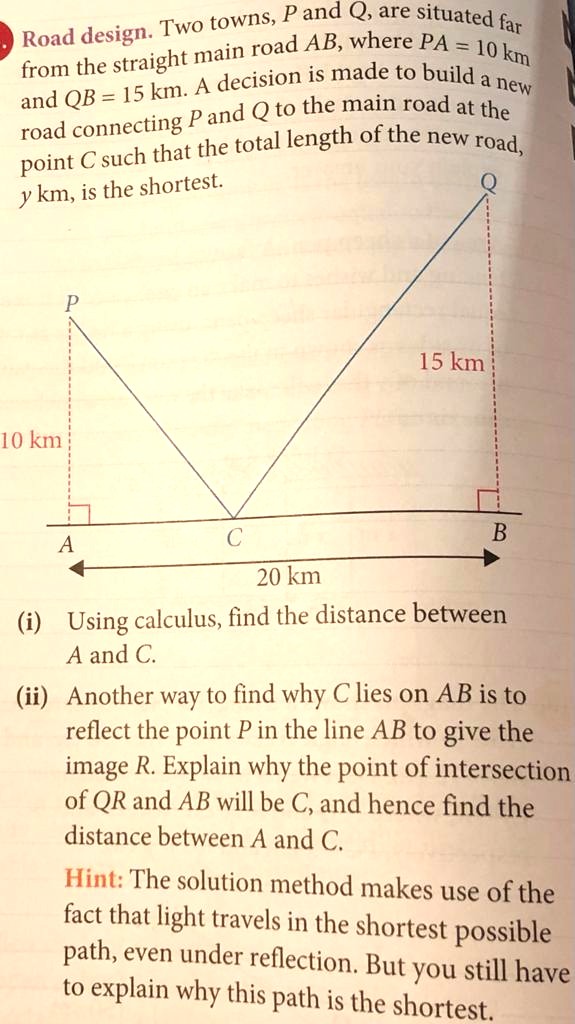
Hi, could you kindly advise the working solution for part ii? Thank you :)
Date Posted: 5 years ago
Views: 667

Good evening Candice! I look at this when I am free later
Good evening to you too Mr Eric! Thank you so much for coming to my aid :)
I hope I am not asking for too much but I do have 1 more question to ask after this one. Really hope you can help to advise the solution for it as well...many thanks !
I hope I am not asking for too much but I do have 1 more question to ask after this one. Really hope you can help to advise the solution for it as well...many thanks !
Attempting
thank you...thank you :)
See 1 Answer
done
{{ upvoteCount }} Upvotes
clear
{{ downvoteCount * -1 }} Downvotes
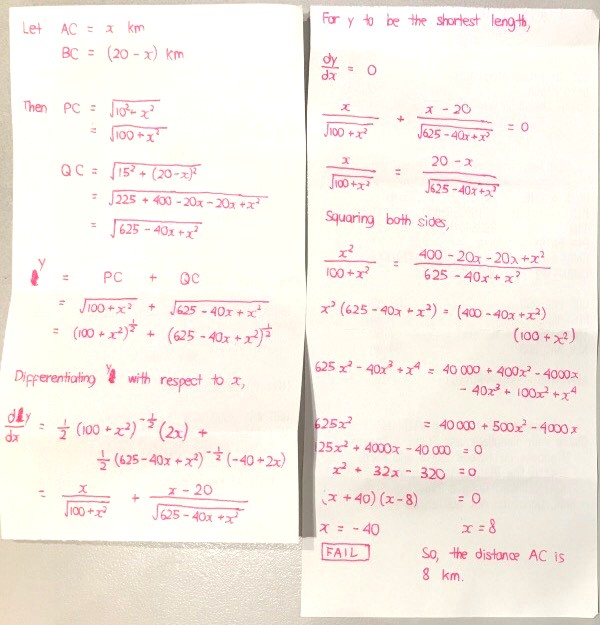
Good evening Candice! Here are my workings for the first part. I will look at part two later.
For the value x = 8, proving it to be minimum is easy via the first derivative test; you should obtain dy/dx < 0 for any value of x between 0 and 8 and dy/dx > 0 for any value of x above 8, proving that the distance is indeed the shortest.
For the value x = 8, proving it to be minimum is easy via the first derivative test; you should obtain dy/dx < 0 for any value of x between 0 and 8 and dy/dx > 0 for any value of x above 8, proving that the distance is indeed the shortest.
Date Posted:
5 years ago
Thanks Mr Eric!
Part ii is challenging and tedious, I'm really anxious to have your working solution coz I've been struggling on it for a long time this afternoon:(
Part ii is challenging and tedious, I'm really anxious to have your working solution coz I've been struggling on it for a long time this afternoon:(
The idea for part ii is not fully mathematical; it’s more of reasoning
We recall that the shortest distance between two points is a straight line joining the two ends
Supposing we reflect point P along line AC (so that the new point P’ is now 10 km south of AC), we then proceed to join Q with the new point P’. Now, the shortest distance between Q and P is the straight line which passes through C.
Triangles PAC and P’AC are obviously congruent since we are simply reflecting the point P into the new point P’. In fact, the three triangles PAC, P’AC and QBC are all similar to one another, with angles PCA, P’CA and QCB being all equal.
For that reason, the point along AB where the distance is shortest must be C (since the shortest distance between Q and P’ is the straight line cutting AB at C).
If instead we draw another path from Q to P’ (which avoids C completely), the length of this path will be longer than the length QP’.
Reflect the bottom half of the line upwards and we get the “actual path” connecting P and Q which will not touch AB at C. This length is of course the same as the path before this reflection which is not going to be the shortest distance.
Hence, this alternative path is not optimal.
C remains the point to make the path the shortest distance.
Thank you so much for your advice Mr Eric.
I learnt more and understand better now. Your reasoning is superb. Thanks again :)
I learnt more and understand better now. Your reasoning is superb. Thanks again :)


 360 Tutoring Program