Ask Singapore Homework?
Upload a photo of a Singapore homework and someone will email you the solution for free.

Question
secondary 4 | A Maths
One Answer Below
Anyone can contribute an answer, even non-tutors.

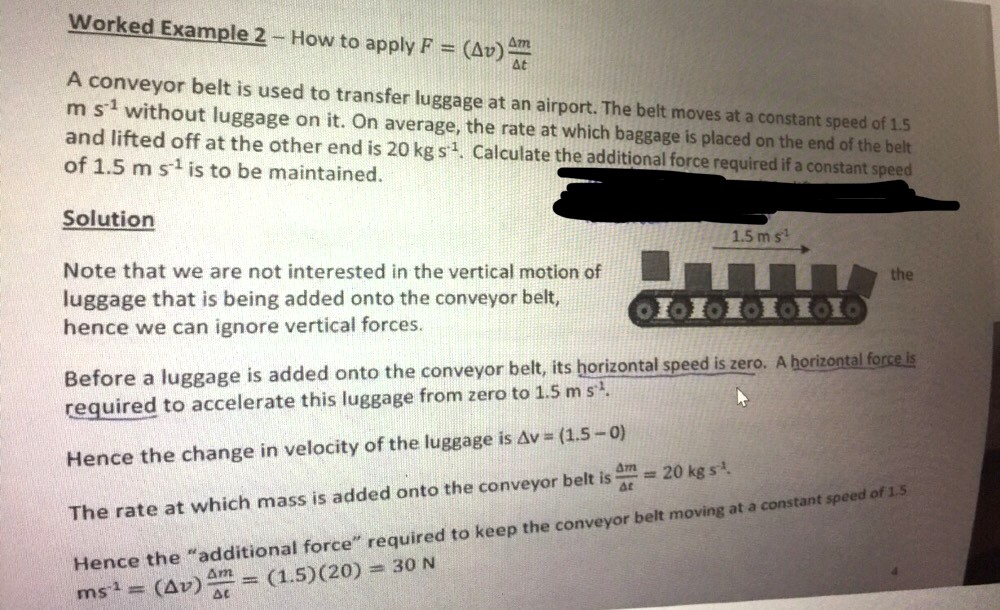
I don’t understand how the equation F=v(m/t) is derived from F=Ma=dP/dt and so I don’t understand how it’s applied too pls help asap!!
Date Posted: 5 years ago
Views: 243
See 1 Answer
Force = mass X acceleration
Acceleration is defined as the rate of change of velocity with respect to time:
a = (change in velocity)/(change in time)
= dv/dt
Since F = ma and a = v/t, f = m(v/t) = v(m/t)
The 'd' represents delta which is the same as the small triangle in the picture. Basically it refers to rate of change(final velocity minus initial velocity)
When subbing in values for v and t, you need to take note that the value you put is final value minus initial value
thank you!! Also, im still dont understand how impulse is related to momentum and what it is exactly ... will it be possible for you to explain what it is?

According to MOE physics A levels syllabus, they define impulse as the product of force and the time of impact:
J = F * dt
Basically impulse of an object is the amount of force applied over a certain period of time.
There is a theory called the impulse- momentum theory which is taught in A levels physics that states that the change in momentum of an object is equal to the impulse applied to it.
J = (final momentum - initial momentum)
= d(mv)
In A levels physics, Newton's second law is defined as: The resultant force acting on an object is directly proportional to the rate of change of momentum of the object.
F = (change in momentum)/time
= (Final momentum - initial momentum)/time
= d(mv)/t
Therefore to get equation 1 from 2 and 3:
Since d(mv) = J, F = J/t and thus J = F * t
These 3 formulas are used interchangeably depending on what values you have at hand.
Assuming you throw a 0.2kg ball at a wall in front of you in a vacuum at 5.0m/s. The ball touches the wall for 0.05s and rebounds back at you at 1.0m/s.
In this case, the impulse experienced by the ball is the net force applied on the ball in the period of 0.05s for it to experience a change in momentum.
If there's anything hard to understand please let me know


 360 Tutoring Program