Ask Singapore Homework?
Upload a photo of a Singapore homework and someone will email you the solution for free.

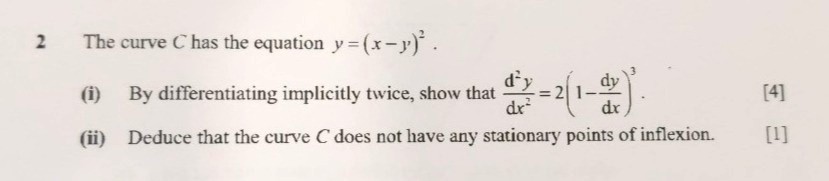
Question
junior college 1 | H2 Maths
One Answer Below
Anyone can contribute an answer, even non-tutors.

hi can anyone help me with this ? thankss
Date Posted: 6 years ago
Views: 300
See 1 Answer
y = (x - y)²
Differentiate both sides with respect to x,
dy/dx = 2(x - y)(1 - dy/dx) ①
Differentiate again,
d²y/dx² = 2(1 - dy/dx)(1 - dy/dx) + 2(x - y)(-d²y/dx²)
d²y/dx² + 2(x - y)d²y/dx² = 2(1 - dy/dx)²
d²y/dx² (1 + 2(x - y)) = 2(1 - dy/dx)²
Multiply both sides by (1 - dy/dx),
d²y/dx² (1 + 2(x - y)) (1 - dy/dx) = 2(1 - dy/dx)² (1 - dy/dx)
d²y/dx² (1 - dy/dx + 2(x-y)(1 - dy/dx) = 2(1 - dy/dx)³
d²y/dx² (1 - dy/dx + dy/dx) = 2(1 - dy/dx)³
(Refer to ①)
d²y/dx² = 2(1 - dy/dx)³
(Shown)
For stationary points, dy/dx = 0
So d²y/dx² = 2(1 - 0)³ = 2 > 0
Since d²y/dx² > 0 for all real x, all the stationary points of curve C are minimum points. Therefore, C has no stationary points of inflexion.

Thanks!!
thank u !


 360 Tutoring Program