Ask Singapore Homework?
Upload a photo of a Singapore homework and someone will email you the solution for free.

Question
junior college 1 | H2 Maths
2 Answers Below
Anyone can contribute an answer, even non-tutors.

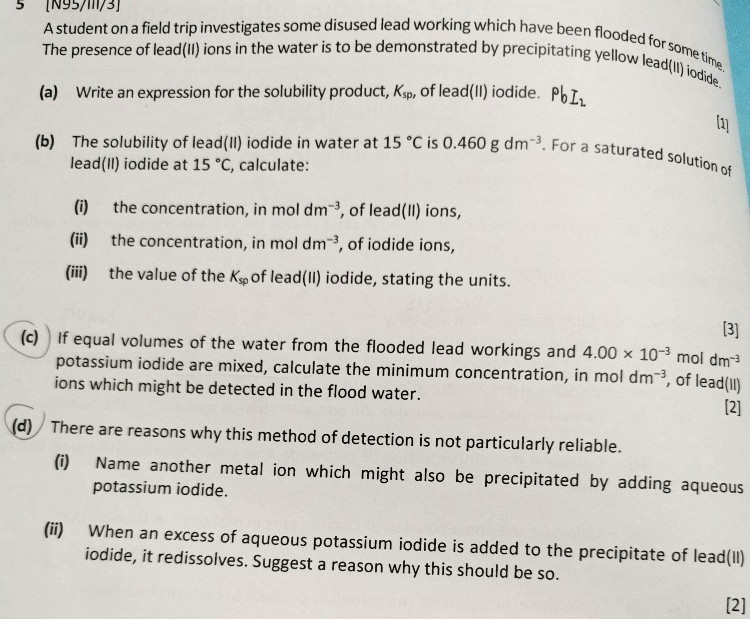
Chem question need help for (c) and (d)
Date Posted: 6 years ago
Views: 587

For c), equal volumes are mixed so the concentration of KI (and hence I-) is halved since the volume is now twice of before. It is now 2.00 x 10-³ mol dm-³
Use the approximation method as before.
Use the approximation method as before.
di)
silver(I) (Ag+) or mercury(II) (Hg2+) ion
silver(I) (Ag+) or mercury(II) (Hg2+) ion
dii)
With excess KI (and hence I- ions),
the sparingly soluble PbI2 (precipitate) reacts with the excess I- ions to form the tetraiodoplumbate(II) complex ion, which is colourless and soluble in water.
PbI2(s) + 2I-(aq) →[PbI4]²- (aq)
With excess KI (and hence I- ions),
the sparingly soluble PbI2 (precipitate) reacts with the excess I- ions to form the tetraiodoplumbate(II) complex ion, which is colourless and soluble in water.
PbI2(s) + 2I-(aq) →[PbI4]²- (aq)
still don't know (c). also next time would appreciate it if u would answer instead of commenting so that I can ask another question
Problem is, it is easier to type here than posting an answer since the picture would become very long due to the amount of text.
It is also not possible to edit or copy/paste on the app once a non-photo answer has been uploaded. (I don't use desktop version)
So I will either have to save all my working elsewhere or retype everything from scratch. The former is not feasible since that would mean saving every single working for every question helped.
So comments section is better.
I can post a blank answer if you need it to clear the question.
Mr of PbI2 = 207.2 + 2(126.9) = 461
Solubility of PbI2 in water at 15°C
= 0.460g dm-³ ÷ 461g mol-¹
≈ 9.978 x 10-⁴ mol dm-³
Let the solubility of PbI2 in water be s
PbI2 (s) → Pb²+ (aq) + 2I- (aq)
□s□□□□□□s□□□□□2s□□□□□
Ksp = [Pb][I]²
Ksp = s(2s)²
= 4s³
= 4(9.978 x 10-⁴)³
≈ 3.974 x 10^(-9) mol³ dm^(-9)
c)
KI(aq) → K+(aq) + F-(aq)
Since KI ≡ I- , [I-] = 4.00 x 10-³ mol dm-³
But equal volumes are added. So the [I-] is halved since volume is now double of original.
I.e [I-] from the KI in the mixture
= 2.00 x 10-³ mol dm-³
Let the solubility of PbI2 in the mixture be x mol dm-³
Ksp = [Pb²+][I-]²
3.974 x 10^(-9) = (x)(2x + 2.00x10-³)²
Since [I-] from KI ≫ [I-] from the water, by the approximation method,
2x + 2.00x10-³ ≈ 2.00 x 10-³
So 3.974 x 10^(-9) ≈ (x)(2.00x10-³)²
x ≈ 3.974 x 10^(-9) ÷ (2.00x10-³)²
x ≈ 9.935 x 10-⁴
So minimum solubility of PbI2 in this mixture = 9.935 x 10-⁴ mol dm-³ in order for precipitation to occur.
But this is only half since we mixed equal volumes of water and KI.
So in the original water sample,
minimum solubility of PbI2
= 9.935 x 10-⁴ mol dm-³ x 2
= 1.987 x 10-³ mol dm-³
Since Pb2+ ≡ PbI2, minimum concentration of Pb2+ ions
= 1.987 x 10-³ mol dm-³
The idea is to find the minimum solubility/concentration of PbI2 (and hence of Pb2+ ions) such that when the water is mixed with KO, the ionic product just equals and exceeds Ksp, to result in precipitation of PbI2.
See 2 Answers
Answer as per main comments section
Mr of PbI2 = 207.2 + 2(126.9) = 461
Solubility of PbI2 in water at 15°C
= 0.460g dm-³ ÷ 461g mol-¹
≈ 9.978 x 10-⁴ mol dm-³
Let the solubility of PbI2 in water be s
PbI2 (s) → Pb²+ (aq) + 2I- (aq)
□s□□□□□□s□□□□□2s□□□□□
Ksp = [Pb][I]²
Ksp = s(2s)²
= 4s³
= 4(9.978 x 10-⁴)³
≈ 3.974 x 10^(-9) mol³ dm^(-9)
c)
KI(aq) → K+(aq) + F-(aq)
Since KI ≡ I- , [I-] = 4.00 x 10-³ mol dm-³
But equal volumes are added. So the [I-] is halved since volume is now double of original.
I.e [I-] from the KI in the mixture
= 2.00 x 10-³ mol dm-³
Let the solubility of PbI2 in the mixture be x mol dm-³
Ksp = [Pb²+][I-]²
3.974 x 10^(-9) = (x)(2x + 2.00x10-³)²
Since [I-] from KI ≫ [I-] from the water, by the approximation method,
2x + 2.00x10-³ ≈ 2.00 x 10-³
So 3.974 x 10^(-9) ≈ (x)(2.00x10-³)²
x ≈ 3.974 x 10^(-9) ÷ (2.00x10-³)²
x ≈ 9.935 x 10-⁴
So minimum solubility of PbI2 in this mixture = 9.935 x 10-⁴ mol dm-³ in order for precipitation to occur.
But this is only half since we mixed equal volumes of water and KI.
So in the original water sample,
minimum solubility of PbI2
= 9.935 x 10-⁴ mol dm-³ x 2
= 1.987 x 10-³ mol dm-³
Since Pb2+ ≡ PbI2, minimum concentration of Pb2+ ions
= 1.987 x 10-³ mol dm-³
The idea is to find the minimum solubility/concentration of PbI2 (and hence of Pb2+ ions) such that when the water is mixed with KO, the ionic product just equals and exceeds Ksp, to result in precipitation of PbI2.
Solubility of PbI2 in water at 15°C
= 0.460g dm-³ ÷ 461g mol-¹
≈ 9.978 x 10-⁴ mol dm-³
Let the solubility of PbI2 in water be s
PbI2 (s) → Pb²+ (aq) + 2I- (aq)
□s□□□□□□s□□□□□2s□□□□□
Ksp = [Pb][I]²
Ksp = s(2s)²
= 4s³
= 4(9.978 x 10-⁴)³
≈ 3.974 x 10^(-9) mol³ dm^(-9)
c)
KI(aq) → K+(aq) + F-(aq)
Since KI ≡ I- , [I-] = 4.00 x 10-³ mol dm-³
But equal volumes are added. So the [I-] is halved since volume is now double of original.
I.e [I-] from the KI in the mixture
= 2.00 x 10-³ mol dm-³
Let the solubility of PbI2 in the mixture be x mol dm-³
Ksp = [Pb²+][I-]²
3.974 x 10^(-9) = (x)(2x + 2.00x10-³)²
Since [I-] from KI ≫ [I-] from the water, by the approximation method,
2x + 2.00x10-³ ≈ 2.00 x 10-³
So 3.974 x 10^(-9) ≈ (x)(2.00x10-³)²
x ≈ 3.974 x 10^(-9) ÷ (2.00x10-³)²
x ≈ 9.935 x 10-⁴
So minimum solubility of PbI2 in this mixture = 9.935 x 10-⁴ mol dm-³ in order for precipitation to occur.
But this is only half since we mixed equal volumes of water and KI.
So in the original water sample,
minimum solubility of PbI2
= 9.935 x 10-⁴ mol dm-³ x 2
= 1.987 x 10-³ mol dm-³
Since Pb2+ ≡ PbI2, minimum concentration of Pb2+ ions
= 1.987 x 10-³ mol dm-³
The idea is to find the minimum solubility/concentration of PbI2 (and hence of Pb2+ ions) such that when the water is mixed with KO, the ionic product just equals and exceeds Ksp, to result in precipitation of PbI2.


 360 Tutoring Program