Ask Singapore Homework?
Upload a photo of a Singapore homework and someone will email you the solution for free.


Question
primary 6 | Maths
| Geometry
One Answer Below
Anyone can contribute an answer, even non-tutors.

Please help
Date Posted: 6 years ago
Views: 299
See 1 Answer
done
{{ upvoteCount }} Upvotes
clear
{{ downvoteCount * -1 }} Downvotes

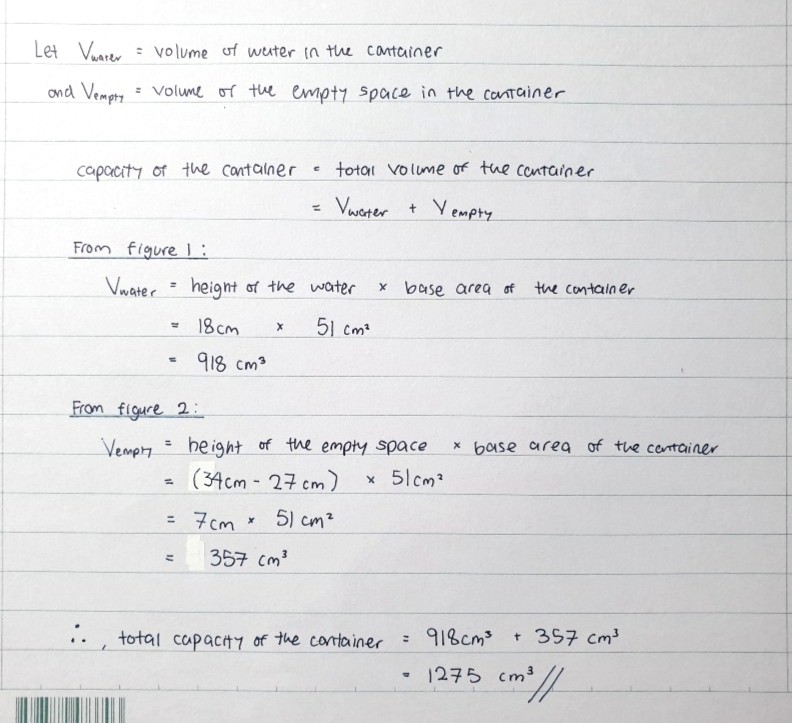
First you have to see that the capacity of the container is equal to the total volume of the container, which is the volume of the water plus the volume of the empty space.
To get the volume of the water and the empty space in the easiest way possible, we want them to occupy a cuboid space, so that we can just get the volume by multiplying base x width x height. Since we already know the base area (base x width), we just need to find out the height.
In figure 1, the water is occupying the botttom of the container, and it can be seen clearly from the figure that it is taking up a cuboid space. The height of the water is given to us, thus we just need to multiply that by the base area to get the volum of the water.
In figure 2, it is slightly more tricky. The empty space is at the top, and it can be seen that is is occupying a cuboid space. To get the height, we first need to subtract the height of the water from the total height of the container. After which, we can multiply that by the base area to get the volume of the empty space.
What's left is to just add these two volumes, to get the total volume i.e capacity of the container
Date Posted:
6 years ago


 360 Tutoring Program