Ask Singapore Homework?
Upload a photo of a Singapore homework and someone will email you the solution for free.

Question
secondary 3 | E Maths
4 Answers Below
Anyone can contribute an answer, even non-tutors.

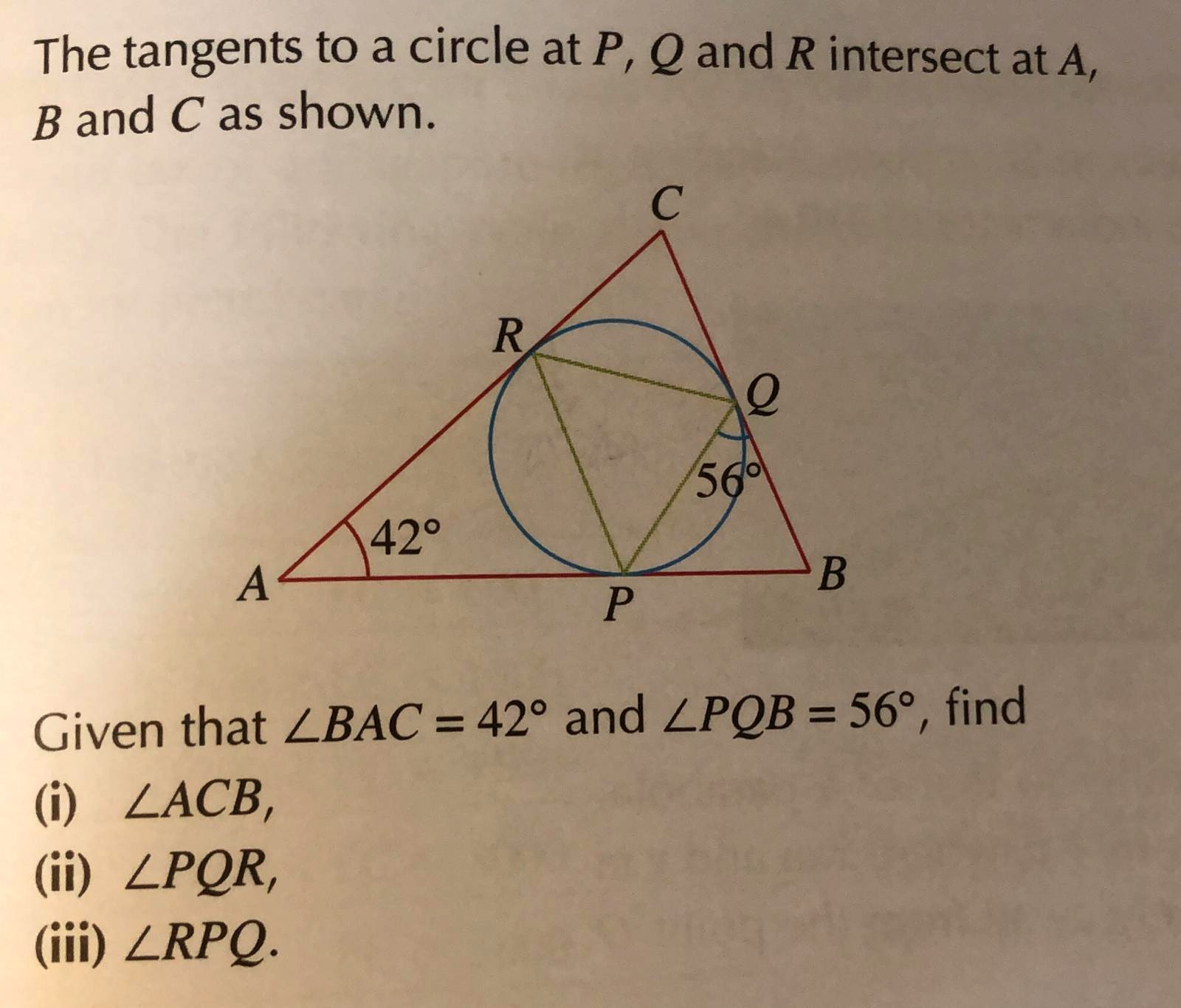
Hi Mr Eric, could you kindly advise me the working solution for this question? Thanks a lot :)
Date Posted: 6 years ago
Views: 354

Good evening Candice! There is one more useful theorem for you to know, but it's in A Maths in Sec 4. That property may, however, be useful here. It's called the tangent chord theorem or alternate segment theorem. I will look at the question in the meantime.
Noted with thanks, Mr Eric. I really appreciate your advice.

Clue :
a)
use tangents from external point to show that triangle ARP, PBQ and RCQ are isosceles triangles.
Then find the top angle PBQ by subtracting the 2 base angles BPQ and BQP (56° each) from the angle sum 180°.
Then use the angle sum of △ACB to find ACB.
a)
use tangents from external point to show that triangle ARP, PBQ and RCQ are isosceles triangles.
Then find the top angle PBQ by subtracting the 2 base angles BPQ and BQP (56° each) from the angle sum 180°.
Then use the angle sum of △ACB to find ACB.
oic, thanks Mr J. I will try to work on it again.
Edited
PQR and RPQ can be found based on the property 'angles on a straight line add up to 180°'
This question is apparently rich in alternate segment theorem.
APR = 69
By the alternate segment theorem,
PQR = 69
Also, PQB = 56
By the alternate segment theorem,
PRQ = 56
APR = 69
By the alternate segment theorem,
PQR = 69
Also, PQB = 56
By the alternate segment theorem,
PRQ = 56
Candice, I will explain what the alternate segment theorem later. This has nothing to do with “alternate angles” and “angles in the same segment”.
Thank you so much, Mr Eric !
Yes, alternate segment theorem you mentioned is totally new to me. I really appreciate your explanation and that you are willing to share this theorem with me :)
I would love to learn more from you...
Yes, alternate segment theorem you mentioned is totally new to me. I really appreciate your explanation and that you are willing to share this theorem with me :)
I would love to learn more from you...
Do you take A Math? If yes, this will be covered by your teachers. As to whether you're allowed to use it in E Math...
Some of my students have already told me that A Maths technique is now allowed in E Maths, which I find it unbelievable as A Maths only techniques are not permitted in E Maths papers during my years.
Now I just realised that my syllabus in A Maths last time did not even have circles in it and the E Maths version did not even have alternate segment. I forgot which year I learnt it, but somehow I learnt it.
Now I just realised that my syllabus in A Maths last time did not even have circles in it and the E Maths version did not even have alternate segment. I forgot which year I learnt it, but somehow I learnt it.
Yes Mr J, I am sec 3 this year. Both A maths and E maths are compulsory subjects. I have not learnt about Alternate Segment Theorem which Mr Eric has advised me that it is A maths theorem in Sec 4.
You've point out a valid point if A maths only technique can be used to solve in E maths question. I will verify with my school teacher once school re-opens in June. Thanks :)
You've point out a valid point if A maths only technique can be used to solve in E maths question. I will verify with my school teacher once school re-opens in June. Thanks :)
E Math doesn't have alternate segment theorem as of later 2000s.
But A Math did. Alternate segment theorem was not allowed in E Math among other things like dy/dx.
There was also the tangent-secant theorem and intersecting chords theorem, which are absent in the current syllabus 4047
But A Math did. Alternate segment theorem was not allowed in E Math among other things like dy/dx.
There was also the tangent-secant theorem and intersecting chords theorem, which are absent in the current syllabus 4047
I think the year after mine had circles in their syllabus, because I remembered a major change in the syllabus after mine. Mine was 4037 I think. That was when things like permutations and combinations, small approximation changes delta y / delta x and relative velocity were still in syllabus.
The current syllabus for Sec 4 students is 4047 and that for Sec 3 students is 4049.
The current syllabus for Sec 4 students is 4047 and that for Sec 3 students is 4049.
Good morning Mr Eric, fyi. I have verbally confirmed with my school teacher that A maths technique can indeed be used to solve E maths question and vice versa, like what some of your students had said.
Thanks and pls take care :)
Thanks and pls take care :)
See 4 Answers
done
{{ upvoteCount }} Upvotes
clear
{{ downvoteCount * -1 }} Downvotes
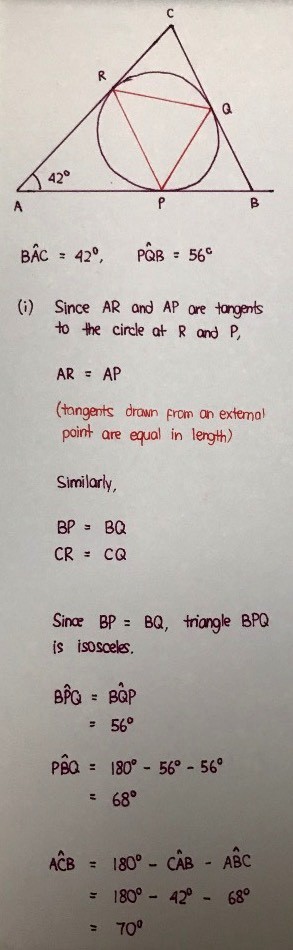
Good evening Candice! Here are my workings for the first part. I may be a little slow for the second and third parts as I’m currently multitasking with my online class.
Date Posted:
6 years ago
Thank you for helping me and I am so sorry to disturb you while you are having your class now.
No worries Candice, it’s not disturbing my class at all. Do not feel bad at all; I am able to multitask the questions as my students spend a lot of their time doing writing so I am able to spare the time to do writing. You can send in the next question if you have any! I will look at the new question later if any.
If you need me to explain the alternate segment theorem, let me know as well.
If you need me to explain the alternate segment theorem, let me know as well.
You are the best, Mr Eric! Thanks !!!
done
{{ upvoteCount }} Upvotes
clear
{{ downvoteCount * -1 }} Downvotes
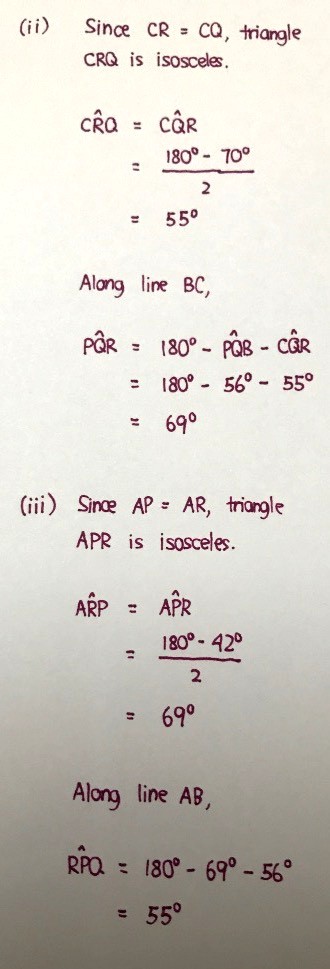
Good evening Candice! Here are my workings for parts ii and iii.
Date Posted:
6 years ago
Wow ! I am totally impressed by your multitasking ability. Thumbs up!
Thanks a lot, Mr Eric!
Have a good evening :)
Thanks a lot, Mr Eric!
Have a good evening :)
done
{{ upvoteCount }} Upvotes
clear
{{ downvoteCount * -1 }} Downvotes
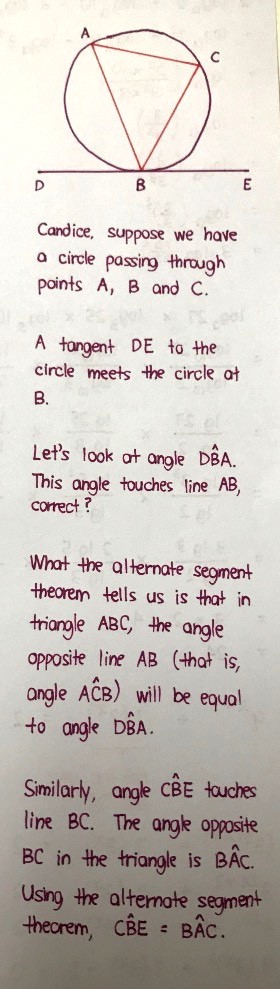
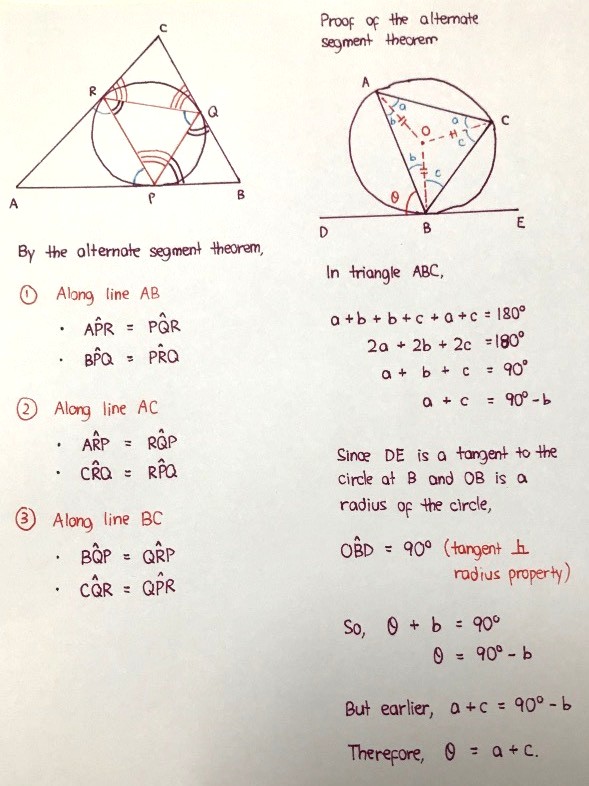
Good evening Candice! This is an A Maths property of circle which you will need to know in A Maths, called the alternate segment theorem. This property is very commonly used in the circles questions in A Maths where we are proving, rather than evaluating, angles.
Date Posted:
6 years ago
Yes, I've learnt something new ! Thank you so much Mr Eric and I hope you have a good evening :)
done
{{ upvoteCount }} Upvotes
clear
{{ downvoteCount * -1 }} Downvotes
Good evening Candice! On the left side I show you how to identify these alternate segment theorem angles within a circle, a radius and a tangent. On the right side, I have included a proof as to why this theorem holds.
Date Posted:
6 years ago
Thank you very very much, Mr Eric :)
I have learnt more from you again.
I have learnt more from you again.


 360 Tutoring Program