Ask Singapore Homework?
Upload a photo of a Singapore homework and someone will email you the solution for free.

Question
secondary 4 | A Maths
2 Answers Below
Anyone can contribute an answer, even non-tutors.

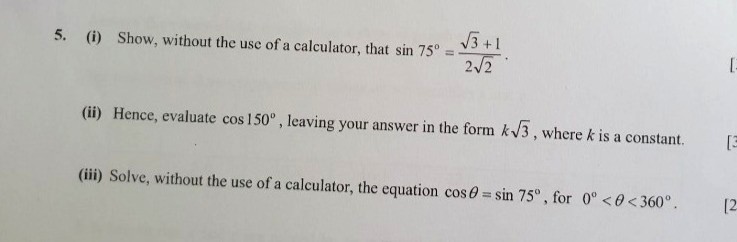
Help to solve part(iii)
Date Posted: 6 years ago
Views: 309

cos x = sin 75
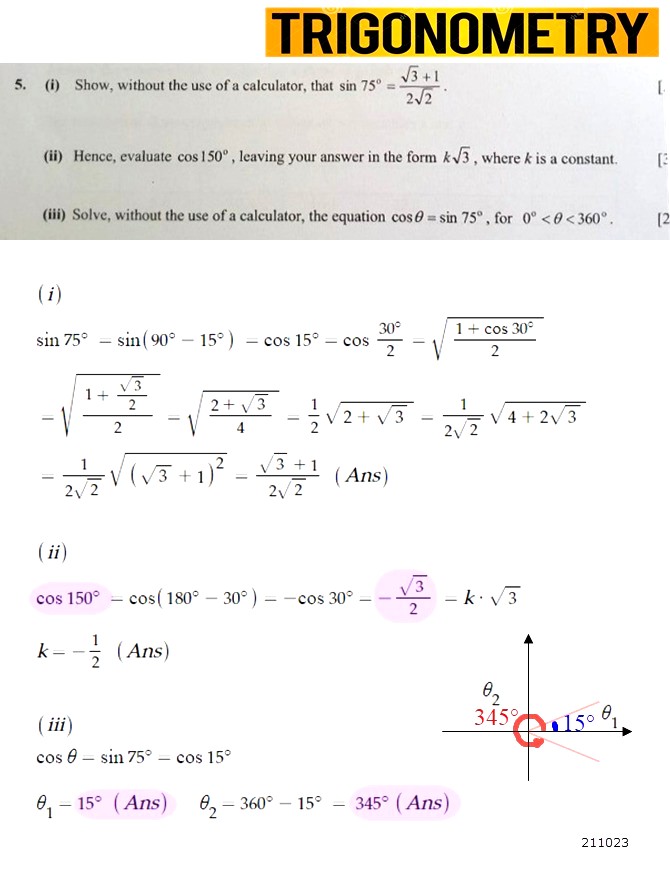
There are few days of doing this, one of which is using the complementary angle rule
sin 75
= sin (90 - 15)
= cos 15
[sin (90 - x) = cos x]
cos x = cos 15
Basic angle is 15, so x can be 15 or 345.
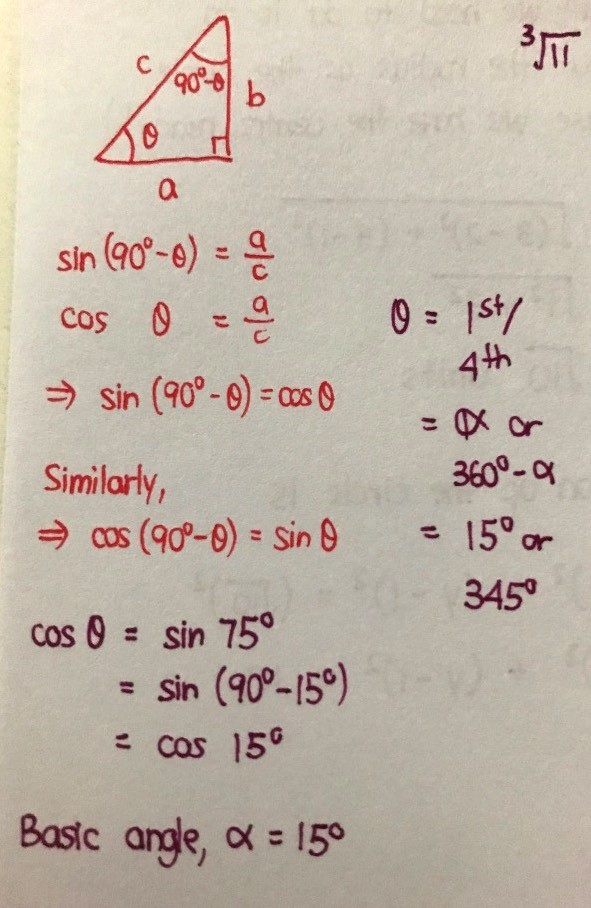
There are few days of doing this, one of which is using the complementary angle rule
sin 75
= sin (90 - 15)
= cos 15
[sin (90 - x) = cos x]
cos x = cos 15
Basic angle is 15, so x can be 15 or 345.
See 2 Answers
done
{{ upvoteCount }} Upvotes
clear
{{ downvoteCount * -1 }} Downvotes
An idea. Ignore the cube root 11.
Date Posted:
6 years ago
Thank you sir
Sir how to convert the equation y=p(1+x)^q into a straight line
y = p (1 + x)^q
This would have been a straight line form had q not been in the power. This is because values of (1 + x)^q are unable to be computed from raw data values of x and y all because of that q, rendering the graph to be plotted undrawable.
But then, how do we remove q from the power? We take logs as these are capable of bringing down the power.
Taking ln (lg is also fine),
ln y = ln p (1 + x)^q
ln y = ln p + ln (1 + x)^q
ln y = ln p + q ln (1 + x)
ln y = q ln (1 + x) + ln p
Now this is a straight line form with gradients q and vertical intercept ln p, because we are able to compute values of ln (1 + x) and the corresponding values of ln y from the raw data values of x and y.
OK sir . I will try the graph


 360 Tutoring Program