Ask Singapore Homework?
Upload a photo of a Singapore homework and someone will email you the solution for free.


Question
secondary 3 | A Maths
2 Answers Below
Anyone can contribute an answer, even non-tutors.

need help w part b and qn2,, pls explain too :)
Date Posted: 6 years ago
Views: 517

Wait
See 2 Answers
done
{{ upvoteCount }} Upvotes
clear
{{ downvoteCount * -1 }} Downvotes
I’m not as free today as yesterday as I have very late night classes today. Your later questions I may not see immediately.
Date Posted:
6 years ago
im still quite confused for part b because of the 'passing through' thing tho
btw for the equation of circle (x-a)^2 + (y-b) ^2=r^2 must a and b be the coordinate of the centre of the circle?
btw for the equation of circle (x-a)^2 + (y-b) ^2=r^2 must a and b be the coordinate of the centre of the circle?
"Passes through" means on the circumference. Not inside. Not outside. But along the circle outline.
The distance between the centre of the circle and any point (x, y) on the circumference of the circle is basically your radius.
And yes, with respect to the equation (x - a)^2 + (y - b)^2, the centre of the circle is (a, b). It's opposite in sign to the bracketed (x - a)^2 and (y - b)^2 because essentially we are trying to solve (x - a) = 0 or (y - a) = 0.
if they give only 1 point on the circumference we can just minus the x axis of the centre of circle and the x axis on circumference
but if they give 2 different point on x axis we cannot just minus because the x axis on both point are different? then how to find the radius
but if they give 2 different point on x axis we cannot just minus because the x axis on both point are different? then how to find the radius
"if they give only 1 point on the circumference we can just minus the x axis of the centre of circle and the x axis on circumference
but if they give 2 different point on x axis we cannot just minus because the x axis on both point are different? then how to find the radius"
You mean the "x-coordinate".
Let me rephrase your question.
"if they give only 1 point on the circumference we can just minus the x coordinate of the centre of circle and the x coordinate on circumference
but if they give 2 different point on x axis we cannot just minus because the x axis on both point are different? then how to find the radius
If you have two points on the circle (if that's what you mean) you won't be able to find the equation of the circle unless the two points are on the exact opposite ends of the circle.
Given the centre of the circle and a point ON the circle, we would be able to find the radius of the circle using the Pythagoras' Theorem.
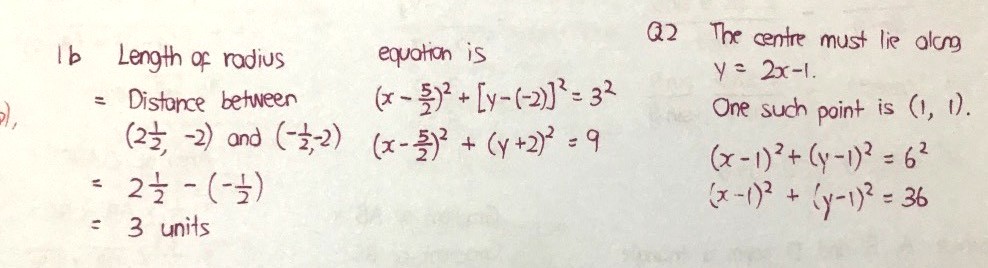
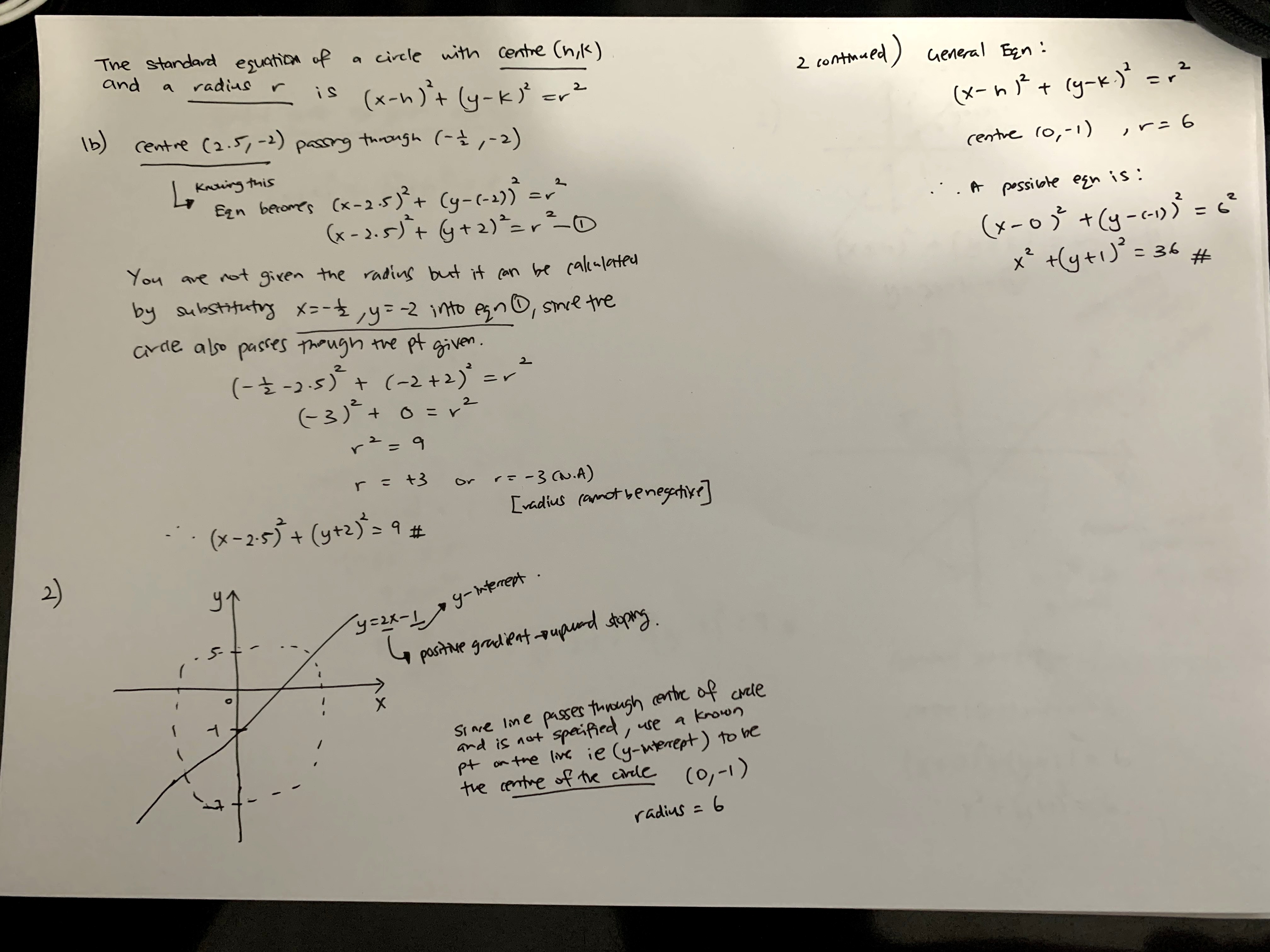
Of course, in Q1b, the y-coordinate of the centre of the circle AND the point on the circle happens to be the same, so the point on the circle must be directly to the left of the centre (at the leftmost point), so there is no y-difference between the centre and the point.
You can still use the length formula as usual, but I saw that the y-coordinates do not change, so I skip the usual steps and simply talk about the x-difference.
So here, if you use the length formula, you will obtain the same thing.
Length
= square root of [(2.5 - (-0.5))^2 + (-2 - (-2))^2]
= square root of [3^2 + 0^2]
= 3
of which we can see that we can simply talk about the x-difference between the points.
Length
= square root of [(2.5 - (-0.5))^2 + (-2 - (-2))^2]
= square root of [3^2 + 0^2]
= 3
of which we can see that we can simply talk about the x-difference between the points.
So the things you need to have for the equation of the circle are
- the centre and
- the radius.
The radius is found by finding the length (Pythagoras' Theorem) between the centre and a point ON the circumference of the circle, unless the radius has already been known.
- the centre and
- the radius.
The radius is found by finding the length (Pythagoras' Theorem) between the centre and a point ON the circumference of the circle, unless the radius has already been known.
thx for explaining to me :)



 360 Tutoring Program