Ask Singapore Homework?
Upload a photo of a Singapore homework and someone will email you the solution for free.

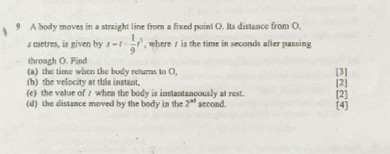
Question
secondary 4 | A Maths
One Answer Below
Anyone can contribute an answer, even non-tutors.

Pls help as soon as possible
Date Posted: 6 years ago
Views: 669
See 1 Answer
done
{{ upvoteCount }} Upvotes
clear
{{ downvoteCount * -1 }} Downvotes

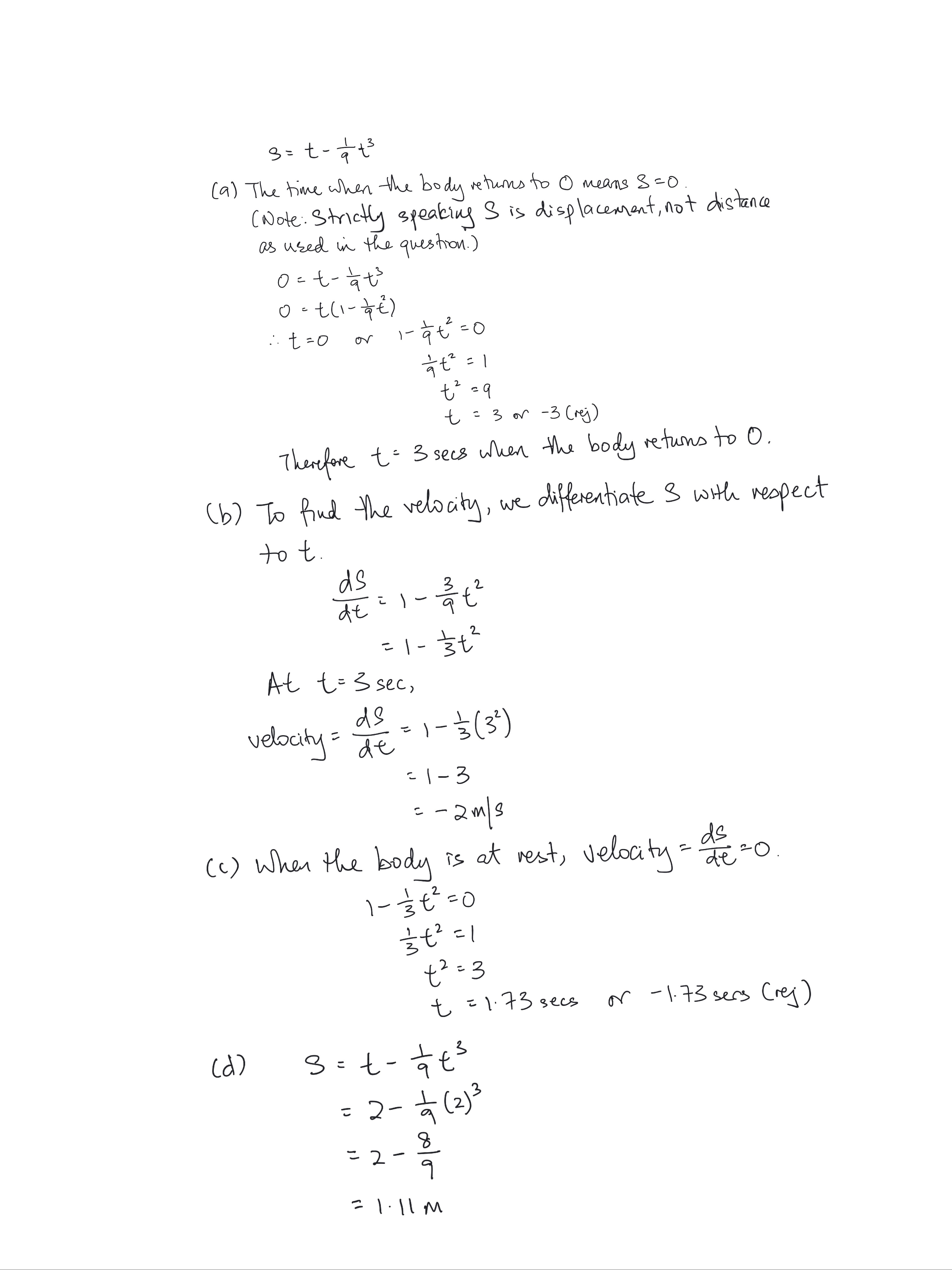
Hello Tarah, there you go. Note: the use of “distance” to describe s in my opinion is inappropriate. The correct term should be displacement.
Date Posted:
6 years ago

The word distance is ok.
Because displacement is “distance in a specified direction from a point”.
Displacement measures the straight line distance from the starting point to the ending point, which is what the story is about.
Because displacement is “distance in a specified direction from a point”.
Displacement measures the straight line distance from the starting point to the ending point, which is what the story is about.
I beg to differ. If s is distance, then we cannot let s be 0 in part (a). In fact, based on your definition, s is indeed displacement since the body moves from O and returns to O. So the displacement is 0 but the distance is not.
The thing is, in part A, when the object returns to O, it is "0 metres away from O", because it is back at the original point.
This definition, however, only tells us that the point is "0 m from O", as per the story line. It does not tell us that the object has travelled a distance.
When I talk about displacement, this is what runs in my mind.
The starting point is at O.
The ending point is at O.
The straight-line distance between the starting point and the ending point is zero, because O is no distance away from O.
Here, the "distance from O" is actually referring to its displacement. It's a common phrase used, but displacement would indeed cause less confusion.
Usually I tell my students that to distinguish distance from displacement, we see whether the word "travelled" or "moved" is attached to the word distance or not. The absence of these two key words would mean that the question is asking for the displacement.
In short, "distance travelled" really means the total physical movement of the object, that is, if I walk 5 m forward and 2 m backward, I have moved a distance of 5 m plus 2 m in any case.
"Distance from O", without the word travelled, means displacement.
That being said, I prefer to see the word displacement as it causes less ambiguities.
"Distance from O", without the word travelled, means displacement.
That being said, I prefer to see the word displacement as it causes less ambiguities.
Part d is not as straightforward as subbing in t = 2. The question is really talking about distance travelled/moved.
Distance travelled in the 2nd second (lol, 2nd second sounds weird)
= Total distance moved from t = 1 to t = 2
= Total distance moved from t = 1 to t = 1.73 PLUS total distance moved from t = 1.73 to t = 2, due to a mid-flight change of direction
Distance travelled in the 2nd second (lol, 2nd second sounds weird)
= Total distance moved from t = 1 to t = 2
= Total distance moved from t = 1 to t = 1.73 PLUS total distance moved from t = 1.73 to t = 2, due to a mid-flight change of direction
The word “return” already clearly shows that the body has moved beyond O and then came back, hence “return”, to O.
For part (d), the distance travelled in second sec is valid and you are right. However, because s, in my opinion is not distance but displacement, therefore, I have treated “distance moved in the second sec” as displacement at t=2 sec. I cannot treat s as displacement in (a) but distance in (d).
In fact, if you plot the graph of s against t, we realise that s is definitely displacement. No way we can describe it as distance, not even in this context. Part of the graph (after t=1.73 s) shows that the curve is a decreasing function. If s is distance, how can it be decreasing?
Anyway the question was badly phrased. Having said that, I hope this doesn’t appear in any weighted assessment.
The graphs for A Maths, sadly, are only for displacement time graphs. To find the distance, we need to sum up the areas above and below the x-axis, just as the usual area under the curve topic would be done in the same way.
Doubt this question is an O Level question...but I can't remember if O Level questions are phrased as such or not.
Doubt this question is an O Level question...but I can't remember if O Level questions are phrased as such or not.


 360 Tutoring Program