Ask Singapore Homework?
Upload a photo of a Singapore homework and someone will email you the solution for free.


Question
secondary 3 | A Maths
One Answer Below
Anyone can contribute an answer, even non-tutors.

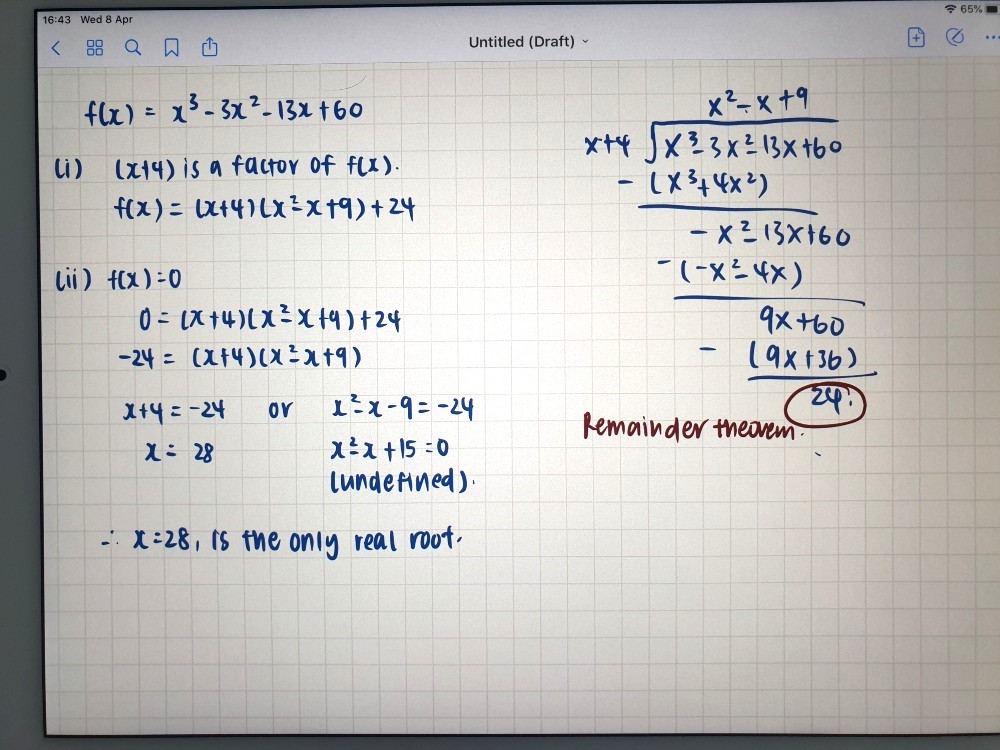
please help thank you
Date Posted: 6 years ago
Views: 302
See 1 Answer
done
{{ upvoteCount }} Upvotes
clear
{{ downvoteCount * -1 }} Downvotes
Hope this helps!
Date Posted:
6 years ago

Xy, please take note of the following :
i)
1.The above working is incomplete. For proper presentation, it is necessary to first show that f(-4) = 0
i.e sub x = -4,
f(-4)
= (-4)³ - 3(-4)² - 13(-4) + 60
= -64 - 48 + 52 + 60
= 0
Then state the following :
Since f(-4) = 0, by the Factor Theorem, (x + 4) is a factor of f(x)
2. The long division has been performed incorrectly.
f(x) is exactly divisible by (x + 4).
f(x) = x³ - 3x² - 13x + 60
= (x + 4)(x² - 7x + 15)
The poster made the mistake of adding back 4x² in the first step instead of subtracting 4x².
The correct expression would give a remainder of -7x² - 13x + 60.
The next quotient would then be -7x.
-7x² - 13x + 60 - (-7x)(x + 4)
= -7x² - 13x + 60 + 7x² + 28x
= 15x + 60
The last quotient is 15.
15x + 60 - 15(x + 4)
15x + 60 - 15x - 60
= 0
There is no remainder.
ii)
The posters's working of :
-24 = (x + 4)(x² - x + 9)
(x + 4) = -24 or x² - x + 9 = -24
The second step is incorrect as it is not necessarily the case that either factor must equal -24.
eg. It is possible to have -6 x 4 = -24
Or -3 x 8 = -24
Or -2 x 12 = -24
etc.
The second step only works when the product of the factors is 0.
i.e correct working would be :
(x + 4)(x² - 7x + 15) = 0
Since the product is 0, then either of the factors must equal 0 for this equation to hold, since the product of 0 can only be obtained when one of the components of is 0.
Eg. 0 x 5 = 0
10 x 0 = 0
There is no other way to get 0 as a product of 2 values other than multiplying a non-zero value by 0 or multiplying 0 by 0 .
So ,
(x + 4)(x² - 7x + 15) = 0
x + 4 = 0 or x² - 7x + 15 = 0
x = -4
Now for x² - 7x + 15 = 0, we do not simply state (undefined).
There are 2 ways to show why there are no real roots for this .
①
discriminant (b² - 4ac)
= (-7)² - 4(1)(15)
= 49 - 60
= -11
Since discriminant < 0, there are no real roots of x for x² - 7x + 15 = 0
②
x² - 7x + 15
= x² - 2(7/2) x + (7/2)² - (7/2)² + 15
= (x - 7/2)² - 49/4 + 15
= (x - 7/2)² + 11/4
= (x - 7/2)² + 2¾
Now, (x - 7/2)² ≥ 0 for all real values of x.
Because the square of a real value, be it negative, 0 or positive , will always equal 0 or a positive value.
Eg.
0 x 0 = 0² = 0
5 x 5 = 5² = 25
(-5) x (-5) = (-5)² = 25
So,
(x - 7/2)² + 2¾ ≥ 2¾ > 0 for all real x
Therefore
(x - 7/2)² + 2¾ > 0 for all real x
It can never equal 0 so there are no real roots for x² - 7x + 15 = 0
Therefore , the only real root is x = -4
thank you


 360 Tutoring Program