Ask Singapore Homework?
Upload a photo of a Singapore homework and someone will email you the solution for free.

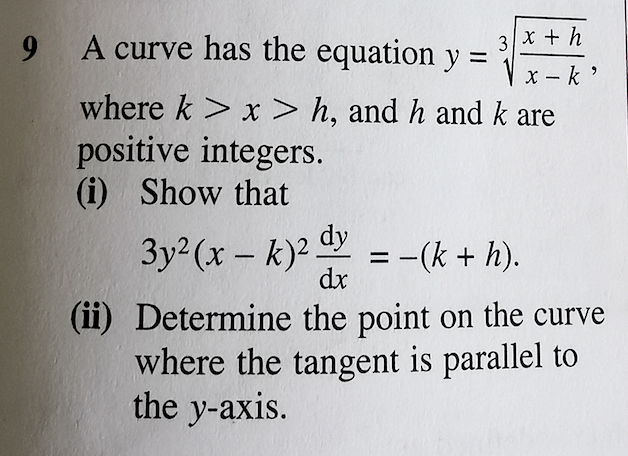
Question
secondary 4 | A Maths
No Answers Yet
Anyone can contribute an answer, even non-tutors.

TYIA.
Date Posted: 6 years ago
Views: 227

y = ³√(x + h)/(x - k) = ³√(x + h) / ³√(x - k)
= (x + h)^⅓ / (x - k)⅓
dy/dx = [ (x - k)¹⁄³ (⅓(x + h)-²⁄³)(1) ) - (x + h)¹⁄³ (⅓(x -k)-²⁄³(1) ) ] / (x - k)²⁄³
(x - k)²⁄³ dy/dx = ⅓(x - k)¹⁄³ (x + h)-²⁄³ - ⅓(x + h)¹⁄³ (x - k)-²⁄³
3(x - k)⁴⁄³ dy/dx = (x - k) (x + h)-²⁄³ - (x + h)¹⁄³
3(x - k)⁴⁄³ (x + h)²⁄³ dy/dx = (x - k) - (x + h)
3(x - k)² (x - k)-²⁄³(x + h)²⁄³ dy/dx = - k - h
3 [(x + h)¹⁄³ / (x - k)¹⁄³]² (x - k)² dy/dx = - (k + h)
3y² (x - k)² dy/dx = - (k + h)
Or :
y = ³√(x + h)/(x - k)
y³ = (x + h)/(x - k)
Implicit differentiation :
Differentiate both sides with respect to x,
3y² dy/dx = [ (x - k)(1) - (1)(x + h) ] / (x - k)²
3y² dy/dx = (-k - h)/(x - k)²
3y² (x - k)² dy/dx = -(k + h)
Tangent parallel to y - axis means dy/dx is undefined.
So the denominator of dy/dx is 0.
Now 3y² (x - k)² dy/dx = -(k + h)
dy/dx = -(k + h) / ( 3y² (x - k)² )
So 3y²(x - k)² = 0 since denominator has to be 0.
Since k > x , x - k < 0
So (x - k)² > 0 since the square of a negative value is always positive.
So y² = 0 since the other terms are non-zero
Then y = 0
So y = ³√(x + h)/(x - k) = 0
(x + h)/(x - k) = 0³ = 0
Denominator cannot be 0, so x + h = 0
( (x - k) is negative as we have found earlier. )
x = -h
The point is (-h, 0)
There seems to be a error with the inequality.
It should be k > h > x
i would like to thank both lala and J. I think J's answer is more complete.
Welcome. The other answer is incorrect as the poster has misinterpreted the part on tangent being parallel to y-axis as dy/dx = 0 (that would be the case if it were parallel to the x-axis).
And for the showing part, the coefficient of y² was supposed to 3 and not 2(see my comments there)
Otherwise, good effort on his part
Thanks J, I have deleted my part. Your answer is correct. Lesson learnt :)

 360 Tutoring Program