Ask Singapore Homework?
Upload a photo of a Singapore homework and someone will email you the solution for free.

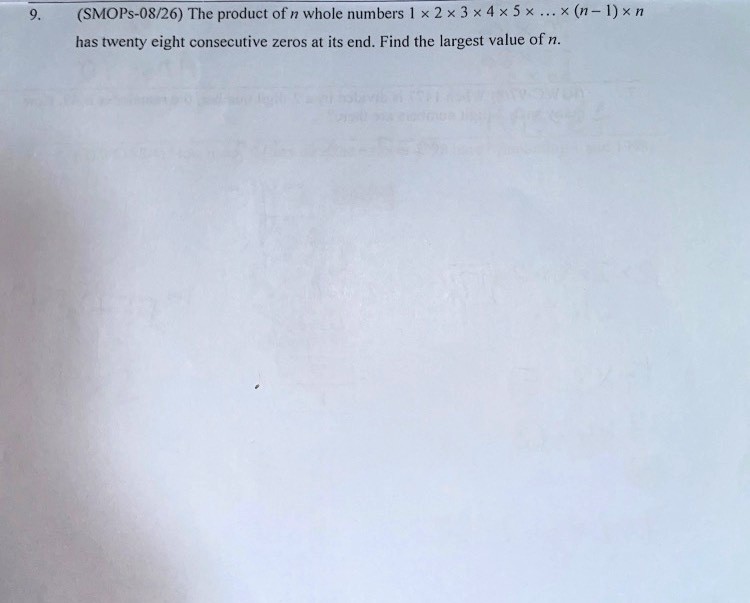
Question
primary 6 | Maths
| Data Analysis
No Answers Yet
Help Javier! Anyone can contribute an answer, even non-tutors.

Idk what subject this is...
Anyway pls help me with this question thanks to anyone that helps me.
Date Posted: 6 years ago
Views: 313

The zeroes come about because 10 is multiplied by 10 by 10 by 10...
And as we know it, each 10 is composed of 2 and 5.
In the list of numbers, there are much more “2”s than “5”s for obvious reasons (for example, 16 has four “2”s but 125 has only three “5”s). So, we narrow down to the number of “5”s present in the list.
There are 25 multiples of 5 in the first 125 numbers.
However, the first 5 multiples (5, 10, 15, 20, 25) contain six “5”s among them.
Likewise, the next 5 multiples (30, ..., 50) contain six “5”s among them.
The first 20 multiples contain twenty four “5”s amongst them.
The next four multiples (last being 120) will fill up four more “5”s.
Now, we have 28 zeroes altogether (because all the 28 “5”s get multiplied by “2”s to get a string of 28 zeroes).
The last number n can be 120, 121, 122, 123 or 124.
We can have n being 120.

Question asks for largest value of n so it's 124
Lol, as I typed out my answer I forgot that they asked for largest, not smallest
To add on,
As for why 124 is the largest value of n :
120! can be reexpressed as :
120! = A x 10^28 or A x 10 000 000 000 000 000 000 000 000 000 , where A is an even number that does not end with 0 or 5
(since all 5s and 0s have already been included into the result of 10^28)
A is an even number as it is the product of a group of numbers where at least one of them is even. As long as there is one even number the result of multiplication will always be even.
For every 10 numbers :
Eg. 1,2,3,4,5,6,7,8,9,10
Eg. 21,22,23,24,25,26,27,28,29,30
Eg. 41,42,43,44,45,46,47,48,49,50
There is only one or two factor 5s in each line of numbers (excluding the numbers that end with 0) but there are 4 even numbers that do not end with 0 (ends with 2,4,6,8).
This leaves you at least 2 even numbers per line, ensuring at least 1 even number in the product.
So A can only give a product ending with 0 when multiplied by 1 or more numbers if:
① At least one of the numbers is a multiple of 5 (ends with 0 or 5)
Now, we can multiply A by 121,122,123, or 124 as they are not multiples of 5. So no additional zeroes will result even if one does the following :
A x 121
A x 121 x 122
A x 121 x 122 x 123
A x 121 x 122 x 123 x 124
However, this we cannot continue to multiply by 125 as that will result in an additional 0. So the highest is 124.
Ok thanks J and Eric nicholas K
But btw can you guys answer instead of comment so I can get a new post of a question
You can just answer your own question with a blank page; I typed here as it is too troublesome to write in the main answer text

 360 Tutoring Program