Ask Singapore Homework?
Upload a photo of a Singapore homework and someone will email you the solution for free.


Question
secondary 4 | A Maths
One Answer Below
Anyone can contribute an answer, even non-tutors.

please help me
Date Posted: 6 years ago
Views: 475

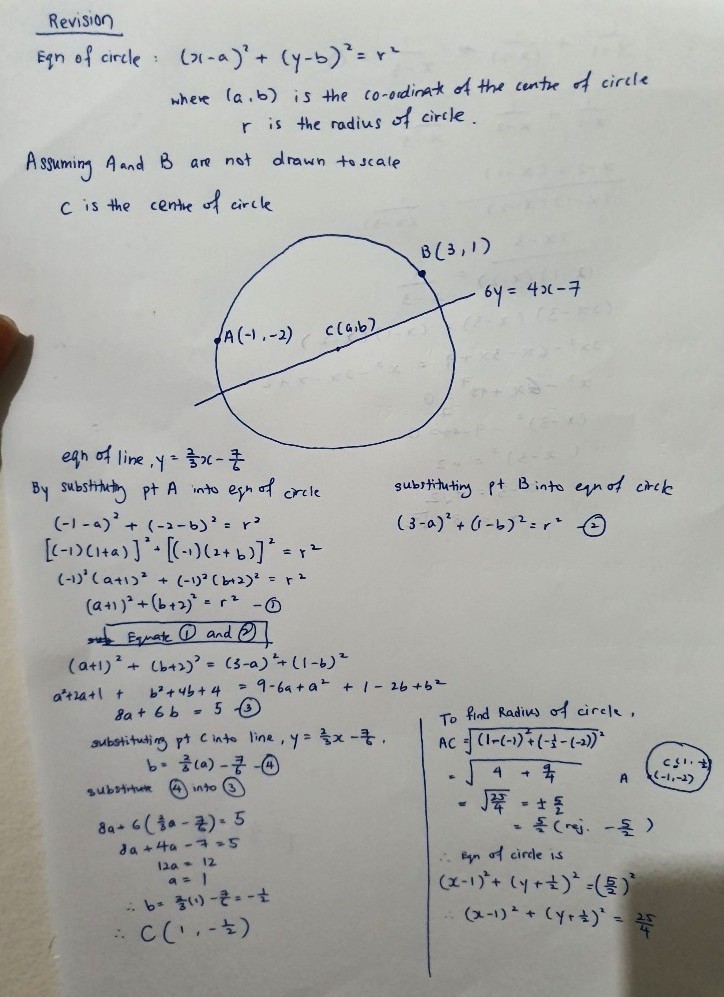
An alternative approach is this. I will just provide you with guidelines this time since I am too tired to write anything down on paper.
IMPORTANT!!!:
1. A line joining any two points along the circumference of a circle is called a chord.
2. The perpendicular bisector of any chord inside the circle passes through the centre of the circle.
3. Perpendicular bisector = a line which cuts the other line (in this case, chord) into two equal halves (so the bisector passes the midpoint of the chord) at 90 degrees (so the products of the gradients is -1).
With the above three pointers, you will need to obtain the equation of the PERPENDICULAR BISECTOR to this chord, which passes through the centre of the circle. This is equation 1.
The other given line which passes through the centre of the circle is equation 2.
Both equation 1 and equation 2 intersect at the centre of the circle. You will need to do a simul here to obtain the centre of the circle.
Finally, you will find the radius of the circle using the centre of the circle and either one of the two given points in the question.
See 1 Answer
done
{{ upvoteCount }} Upvotes
clear
{{ downvoteCount * -1 }} Downvotes

Draw a diagram to help you visualise better.
Familiarise yourself with the equation and understand what each unknown represent, eg a, b, r etc
Make sense of the simultaneous equations when forming them. Solving a math problem has a flow to it, as though revealing a story. Stick to the "storyline" and you should be able to form appropriate simultaneous equation.
Always jump back to the general equations
Date Posted:
6 years ago


 360 Tutoring Program