Ask Singapore Homework?
Upload a photo of a Singapore homework and someone will email you the solution for free.


Question
secondary 3 | A Maths
5 Answers Below
Anyone can contribute an answer, even non-tutors.

this is sec 3 chemistry but idh the premium so :/ pls help me w these qns , thank you ! :-)
Date Posted: 6 years ago
Views: 353
See 5 Answers
done
{{ upvoteCount }} Upvotes
clear
{{ downvoteCount * -1 }} Downvotes
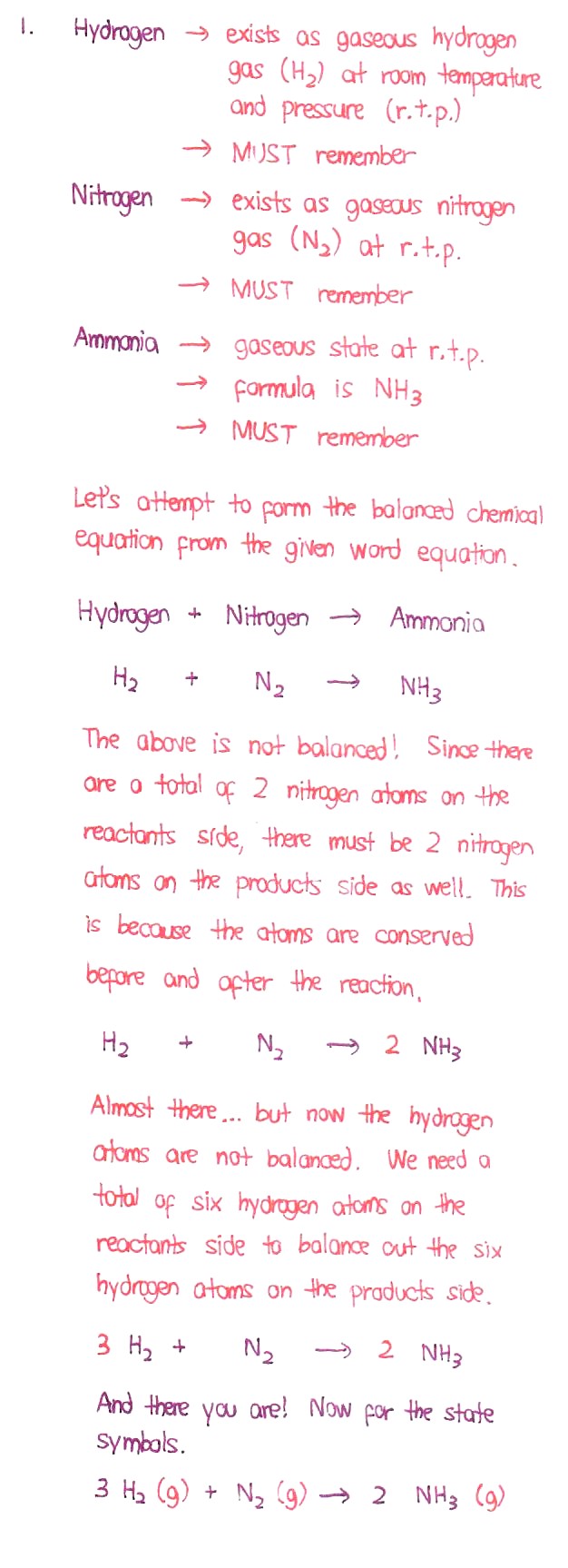
Something like this for Q1 would be good.
Note that we have to write H2 (H, subscript 2) and not 2 H because the hydrogen comes in pairs as a hydrogen gas diatomic molecule. Likewise, the same applies for N2 and NH3.
When we write 3 H2, we are referring to 3 molecules of hydrogen gas. This is considered fundamentally different from 6 H, which represents six isolated hydrogen atoms, or H6, which represents six hydrogen atoms in a molecule.
For the remaining four questions, I will do them another time when I am less tired.
Date Posted:
6 years ago
done
{{ upvoteCount }} Upvotes
clear
{{ downvoteCount * -1 }} Downvotes
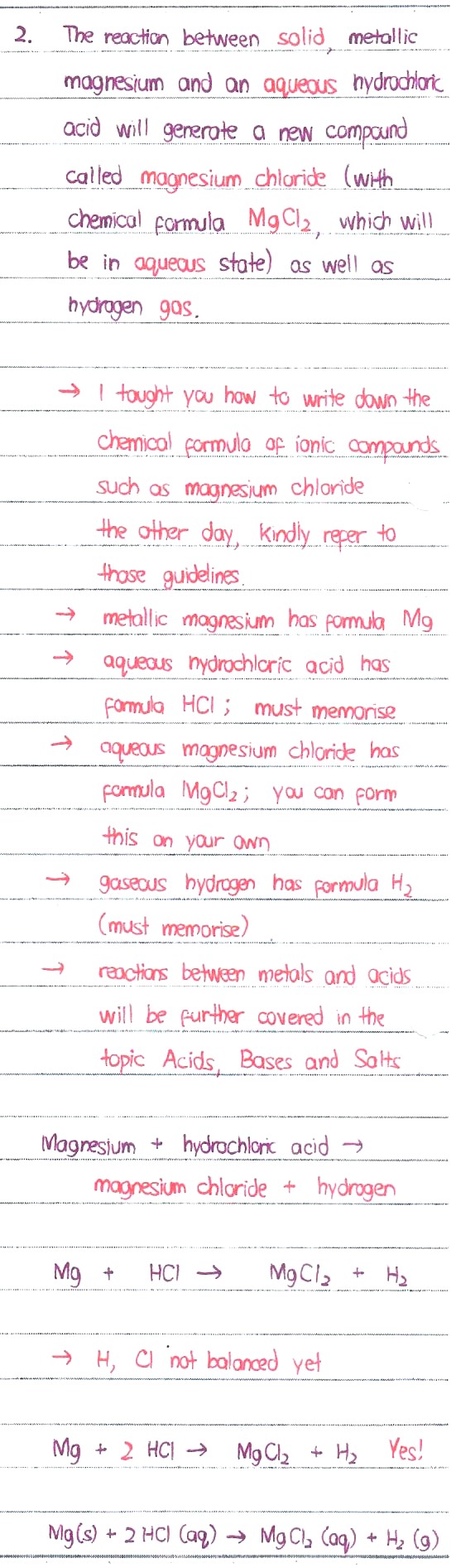
Q2
Meanwhile I write down my solutions for Q3, Q4 and Q5 in case I forget to return to this post the next time.
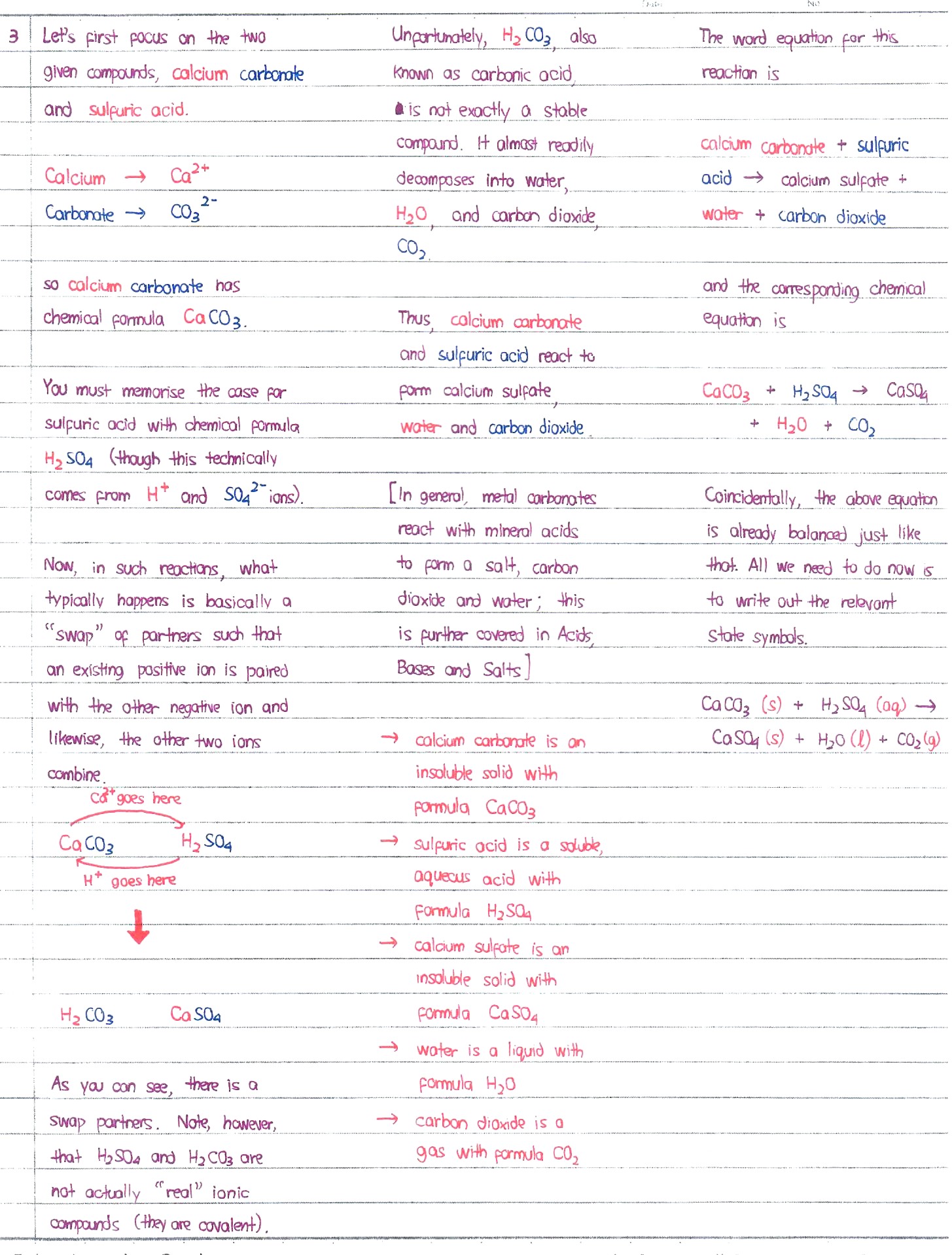
Q3 is as follows
CaCO3 (s) + H2SO4 (aq) --> CaSO4 (s) + CO2 (g) + H2O (l)
(which is already balanced on writing; those which I write as (s) are basically ionic compounds which are not soluble in water, while those which I write as (aq) are basically compounds which are soluble in water; there is a list of solubilities of ions somewhere which you must memorise, but water is strictly liquid and not aqueous)
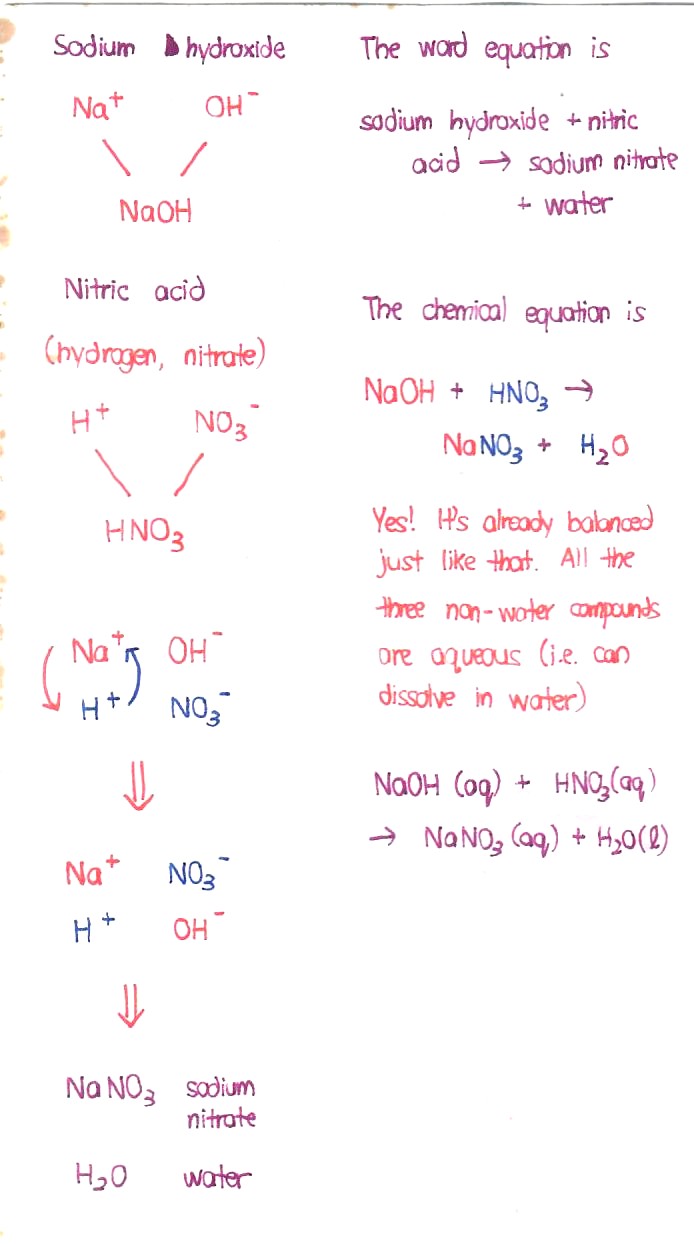
Q4 is as follows
NaOH (aq) + HNO3 (aq) --> NaNO3 (aq) + H2O (l)
(which is already balanced on writing)
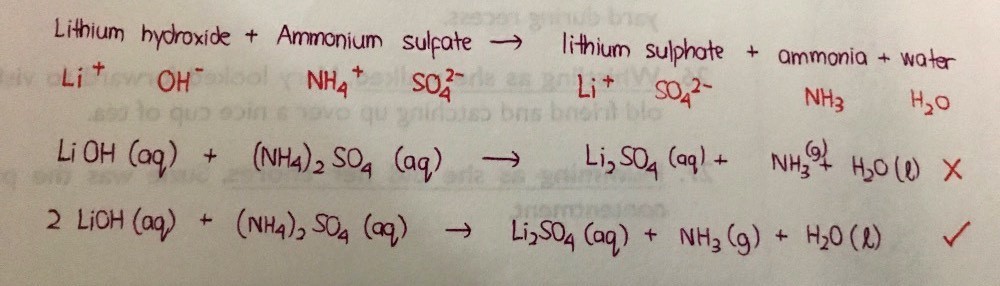
Q5 is as follows
2 LiOH (aq) + (NH4)2 SO4 (aq) --> Li2 SO4 (aq) + 2 NH3 (g) + H2O (l)
I am assuming that you have not learnt the topic on acids, bases and salts yet so you may have some difficulty with questions 2 to 5.
Will look at the rest another time if I can remember. I do forget these from time to time.
Date Posted:
6 years ago
done
{{ upvoteCount }} Upvotes
clear
{{ downvoteCount * -1 }} Downvotes
Q3
Will either do the rest some other time or let you try out the last two on your own. Perhaps you should try them out on your own first. Taking a break now.
Date Posted:
6 years ago
done
{{ upvoteCount }} Upvotes
clear
{{ downvoteCount * -1 }} Downvotes
Q4
Try the last one on your own first. Will look at Q5 another time.
Date Posted:
6 years ago
done
{{ upvoteCount }} Upvotes
clear
{{ downvoteCount * -1 }} Downvotes
Last one, but I do as a quick summary
Date Posted:
6 years ago


 360 Tutoring Program