Ask Singapore Homework?
Upload a photo of a Singapore homework and someone will email you the solution for free.

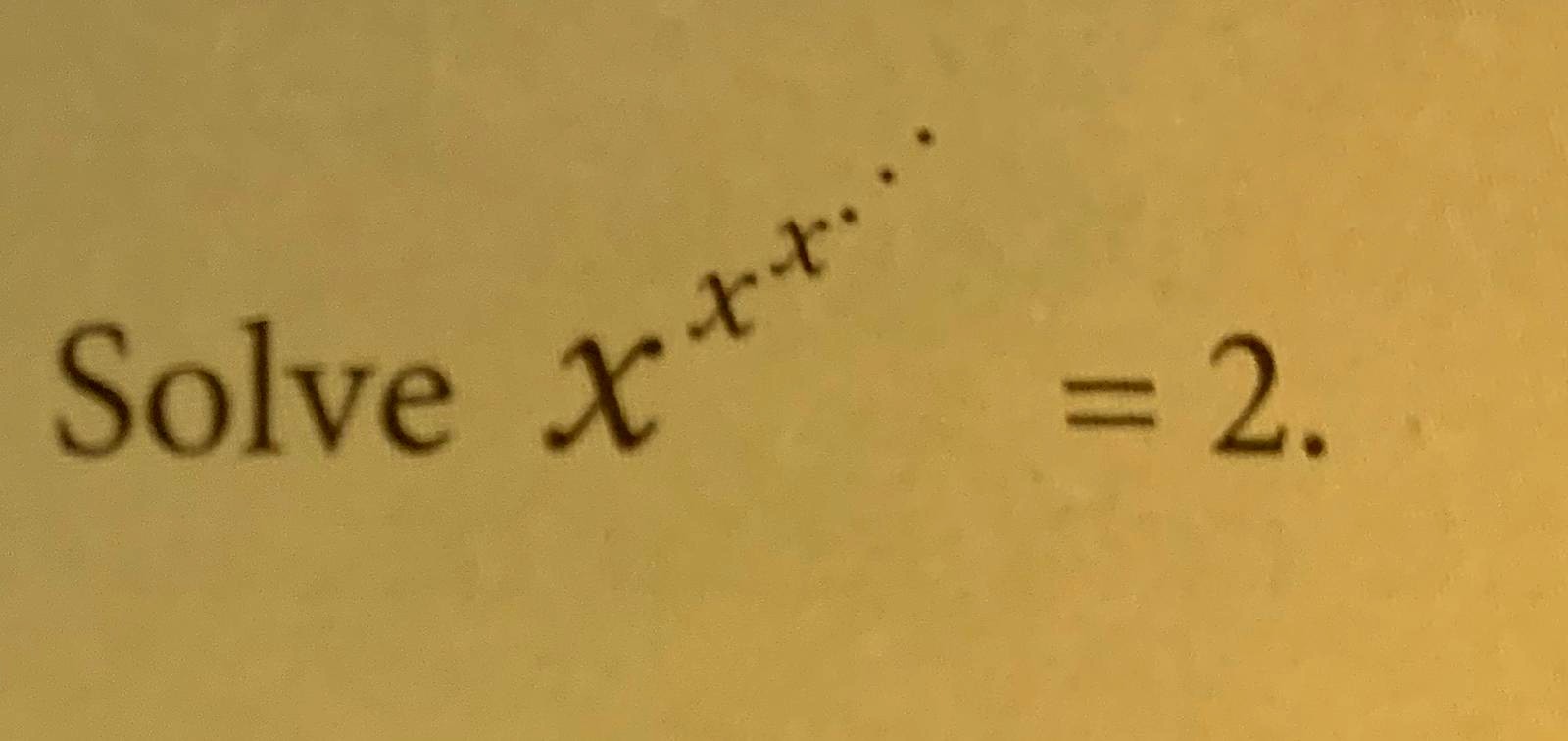
Question
secondary 3 | A Maths
One Answer Below
Anyone can contribute an answer, even non-tutors.

Hi, I don't understand this question, could you please explain to me? Thanks.
Date Posted: 6 years ago
Views: 581

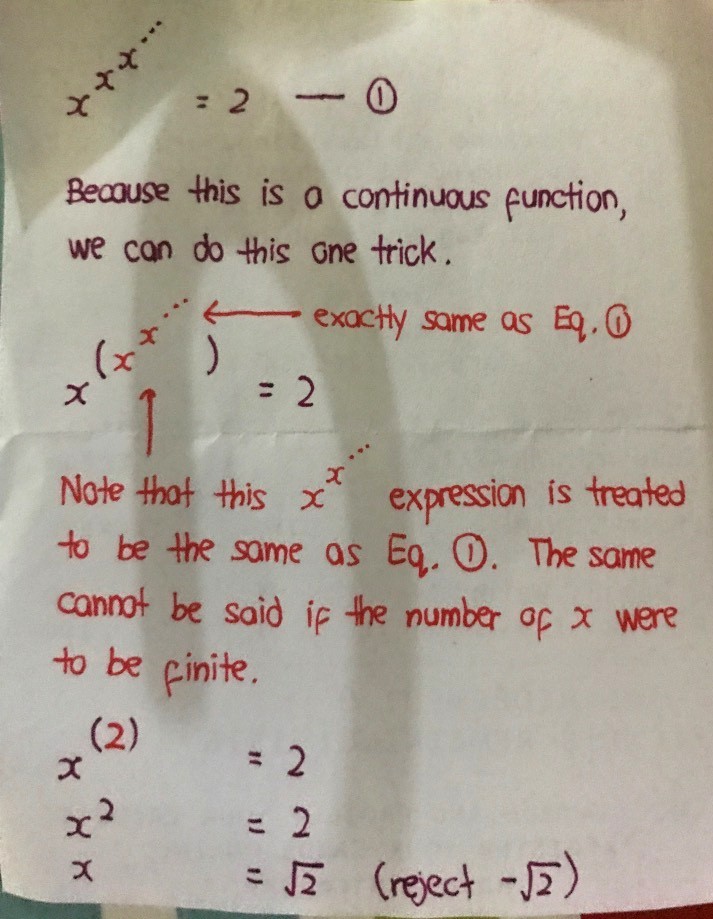
Good evening Candice!!! I will explain this to you again, but the “...” is crucial here. Without this ... (ie a truncation of x somewhere), this will not work.
Eventually this becomes
x2 = 2
so x = sq 2
The idea strongly resembles converting infinite decimals like 0.55555... into a fraction. For this fraction case, the “...” is also needed or this method will not work.
I attempt to explain it here.
Let x = 0.5555...
Then 10x = 5.555...
Now, had the decimal been 0.555 instead of 0.555..., then 10x = 5.55 and 10x - x will not equal to 5.
However, because the decimal is infinitely recurring, there is practically no end to the decimal, and thus there is practically no difference between x and 10x in terms of the recurring 555... decimal.
As such, if x = 0.555..., then 10x = 5.55... and the recurring digits after the decimal point is taken to be identical, so 10x - x = 5 and we have x = 5/9, representing the infinite fraction 0.555...
In this question, the principle works the same way.
Before I continue, for the purposes of this question, do note that 5^7^9 means 5^(7^9) and not (5^7)^9 which is a different number.
Let’s look at x^x^x^x...
Now, the fact that this is continuous means that removing the very first x (the very first base x) will not lead to any practical difference in expression, just like the 0.555... case.
As such,
x^x^x^x^x^x^... = 2 — Eq (1)
can be written as
x^ [x^x^x^x^x^...] = 2 — Eq (2)
as per my illustration with 5^(7^9).
But the term in brackets is taken to be identical to Eq 1, since there is no end. Note that had the powers truncated somewhere, this does not work since there will be one fewer base x.
Substituting Eq (1) into Eq (2),
x^ [2] = 2
x^2 = 2
and therefore x = sqrt 2.
I will pen this down when I return if necessary.
See 1 Answer
done
{{ upvoteCount }} Upvotes
clear
{{ downvoteCount * -1 }} Downvotes
Good evening Candice! Let me know if my workings or my explanations in the main question’s chat box is unclear and I will do my best to explain them again.
Date Posted:
6 years ago
sorry for the late response, Mr Eric. Very well explained steps, I can understand it almost instantly looking at your detailed explanation. Thumbs up! Thanks :)


 360 Tutoring Program