Ask Singapore Homework?
Upload a photo of a Singapore homework and someone will email you the solution for free.

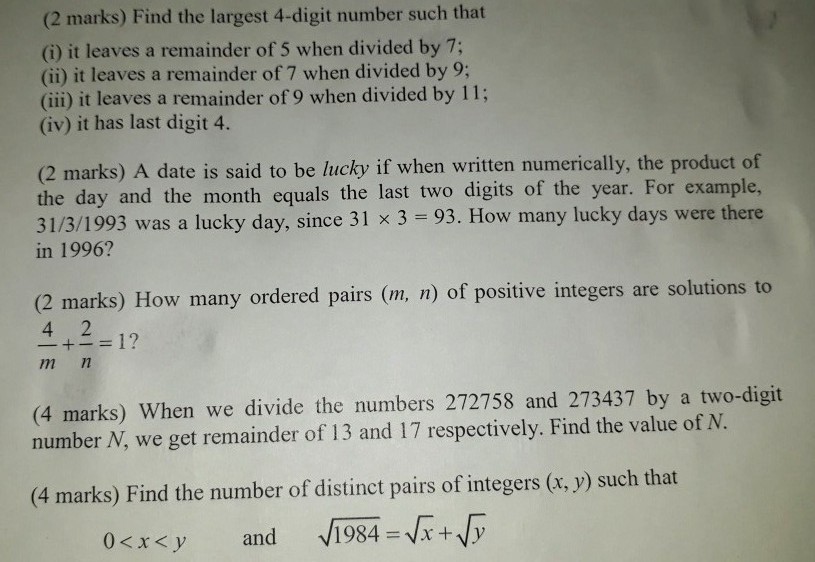
Question
Secondary 1 | Maths
No Answers Yet
Help :) Mathistillfun! Anyone can contribute an answer, even non-tutors.

Pls help thx
Date Posted: 7 years ago
Views: 352

Change username again? No more 'Mathsisfun'?
Largest 4-digit number = 9999
i)
largest 4-digit number that is divisible by 7 = 9996
(1428 x 7 = 9996)
The number can't be 9999,9998,9997 as they will only leave a remainder of 3,2, and 1 respectively.
So to find the number, subtract 2 from 9996
such that there's a remainder of 5.
9996 - 2 = 9994
ii) 9997
iii) also 9997
iv) 9994
Oh okay...I misread the question again haha...so I thought need to find a number that satisfies all such conditions
So now my question is ...is there such a 4 digit number that satisfies all such conditions? :)
Well if it were to fulfill all 4 conditions, the question wouldn't be split into 4 parts.
Might have, but will need to slowly check
Oh...really okay I will keep that in mind
Math is still fun but I changed it because I taught it has been a long time since I changed my username...sry..:(
No worries, no need to apologise! just asking haha. Anyway you have all rights to change your username at your own discretion.
If I find the answer that satisfies all 4 conditions I will post later.
If the setter really meant to ask to find a number that fulfills all 4 conditions, then I will say the layout of the question is poorly done.
So just in case it's asking for that, it's better have an answer for it
The largest 4 digit number that satisfies all 4 conditions is 8314.
How to understand this :
From condition ① , we can infer that adding 2 to the number makes it divisible by 7.
From condition ② , we can infer that adding 2 to the number makes it divisible by 9
From condition ③ , we can infer that adding 2 to the number makes it divisible by 11.
So we can conclude that if we just add 2 to the number, it will be divisible by 7,9, and 11.
So (number + 2) is a common multiple of 7,9, and 11.
Let's find the lowest common multiple of the 3 numbers first.
7 and 11 are prime numbers.
9 = 3²
Since there are no common factors among these 3 numbers,
The LCM = 7 x 9 x 11 = 693
So, this (number + 2) must be a multiple of 693 and ends with 4(to fulfill condition ④)
As 9999 is the largest 4 digit number, we divide 9999 by 693 to find the largest possible quotient first.
9999 ÷ 693 = 14 R 297
So largest possible 4 digit number that is a common multiple of 7,9,and 11
= 14 x 693
= 9702
If the last digit of the number is 4, then last digit of (number + 2) is 4 + 2 = 6
But 9702 doesn't end with 6. So we need to keep subtracting 693 until we reach a number with last digit 6.
9702 - 693 = 9009 (doesn't end with 6)
9009 - 693 = 8316 (ends with 6)
So (number + 2) = 8316
Number itself = 8316 - 2 = 8314
I will solve the rest later if I have time
Lucky date question :
96 = 2 x 2 x 2 x 2 x 2 x 3
Find 2 numbers whose product is 96 .
96 = 48 x 2 = 24 x 4 = 12 x 8 = 6 x 16 = 32 x 3
Now the possible numbers for months are
① 2
② 4
③ 8
④ 3
⑤ 6
⑥ 12
For ① , there are no possible numbers for the day since 96 ÷ 2 = 48, and there are no months with 48 days.
For ② , possible numbers for the day are
96 ÷ 4 = 24
(Date is 24/4/1996)
For ③, possible numbers for the day are 96 ÷ 8 = 12
(Date is 12/8/1996)
For ④ , there are no possible numbers for the day since 96 ÷ 3 = 32, and there are no months with 32 days.
For ⑤, possible numbers for the day are 96 ÷ 6 = 16
(Date is 16/6/1996)
For ⑥, possible numbers for the day are 96 ÷ 12 = 8
(Date is 8/12/1996)
So there are 4 lucky dates in that year
4/m + 2/n = 1
Ordered pairs (m,n), where m and n are positive integers
(4n + 2m)/mn = 1
4n + 2m = mn
4n = mn - 2m
4n = m(n - 2)
m = 4n/(n - 2)
Or
2m = mn - 4n = n(m - 4)
n = 2m/(m - 4)
This means that n ≠ 2, m ≠ 4 as denominator cannot be 0.
In addition, m > 4 and n > 2 as 4/m + 2/n cannot exceed 1.
4n + 2m = mn
n = 4n/m + 2m/m = 4n/m + 2
m = 4n/n + 2m/n = 4 + 2m/n
Since n and m are positive integers,
Then 4n/m and 2m/n are positive integers.
4n/m = k1 for some positive integer k1
2m/n = k2 for some positive integer k2
k1 x k2 = 4n/m x 2m/n = 8
Possible values of k1 and k2 such that their product is 8 :
① k1 = 1, k2 = 8
So n = 1 + 2 = 3, m = 4 + 8 = 12
② k1 = 2, k2 = 4
So n = 2 + 2 = 4, m = 4 + 4 = 8
③ k1 = 4, k2 = 2
So n = 2 + 4 = 6, m = 4 + 2 = 6
④ k1 = 8, k2 = 1
So n = 2 + 8 = 10, m = 4 + 1 = 5
Your possible pairings are :
(5,10)
(6,6)
(8,4)
(12,3)
272758, 273437 divided by two-digit N
13 and 17 remainder respectively.
This means that N is bigger than both of the remainders, so N > 17
273437 - 272758 = 679
To continue to leave a remainder of 13, we subtract 4 from 273437
272758 - 4 = 272754
679 - 4 = 675
So 675 is divisible by N
Now break 675 down into its prime factors.
675 ÷ 3 = 225
225 ÷ 3 = 75
75 ÷ 3 = 25
25 ÷ 5 = 5
So 675 = 3 x 3 x 3 x 5 x 5
Possible 2 digit numbers bigger than 17 :
①5 x 5 = 25
②5 x 5 x 3 = 75
③3 x 3 x 3 = 27
④3 x 3 x 5 = 45
272758 - 13 = 272745, which is divisible by N.
273437 - 17 = 273420, which is divisible by N.
Looking at 272745, we can tell that the number is not divisible by 27 as :
272745 = 270000 + 2700 + 45
270000 and 2700 is divisible but 45 is not. So N cannot be 27.
Now if the numbers were to be divisible by 75, they would be have to be divisible by 25 first. Because ÷ 75 is the same as ÷ 25 ÷ 3
But we also can tell that 272745 is not divisible by 25 as :
25 x 4 = 100
So all multiples of 100 are divisible by 25.
Now 270000 and 2700 are multiples of 100 so they are divisible by 25. But 45 isn't divisible by 25
So N cannot be 25, which in turn means N cannot be 75 as well.
That leaves us with N = 45
Check :
272758 ÷ 45 = 6061 R 13
273437 ÷ 45 = 6076 R 17
√1984 = √x + √y
1984 = (√x + √y)² = x + 2√x√y + y
= x + y + 2 √xy
x = 1984 - y - 2√xy ①
Since 0 < x < y, 2√xy is always positive.
x and y are positive integers. This means 2√xy is a positive integer as well since the three terms add up to an integer 1984
From starting equation,
√x = √1984 - √y
x = (√1984 - √y)² = 1984 - 2√1984y + y ②
① = ②
1984 - y - 2√xy = 1984 - 2√1984y + y
2y = 2√1984y - 2√xy
Since both y and 2√xy are positive integers, 2√1984y is a positive integer as well since it's the sum of the two.
Prime factorisation of 1984 :
1984 = 64 × 31 = 2^6 × 31
2√1984y = √(2²) √(2^6 × 31 × y)
= √(2² × 2^6 × 31 × y)
= √(2^8 × 31 × y)
In order for 2√1984y to be an integer,
(2^8 × 31)y must be a perfect square
2^8 × 31 = (2⁴)² × 31 = 16² × 31
So y = 31k² , where k is a non-zero integer
This would make 2√1984y = 16² × 31² × k²
= (16 x 31 x k)² = (496k)²
Then x = 1984 - 496k + 31k²
= 1984 - 496k + 31k²
Since x < y,
1984 - 496k + 31k² < 31k²
1984 - 496k < 0
1984 < 496k
k > 4
Since 0 < x ,
Then 31k² - 496k + 1984 > 0
k² - 16k + 64 > 0
(k - 8)² > 0
This means |k - 8| > 0
k - 8 > 0 or k - 8 < 0
k > 8 or k < 8
However, if k > 8, then k² > 64
31k² > 1984
y > 1984
Then x = 1984 - y - 2√xy < 0
This implies x < 0, which contradicts the given information and makes √x undefined for real values of x.
Furthermore, y > 1984 means √y > √1984. Then √x = √1984 - √y < 0
This implies √x < 0 , which is not possible for real values of x
So we reject k > 8
Combining the two results,
4 < k < 8
Since k is an integer, k = 5 , 6 or 7
As there are 3 distinct possible values of k,
There will be 3 distinct pairs of integers (x,y)
When k = 5,
y = 31(5²) = 775
x = 1984 - 496(5) + 775 = 279
When k = 6,
y = 31(6²) = 1116
x = 1984 - 496(6) + 1116 = 124
When k = 7,
y = 31(7²) = 1519
x = 1984 - 496(7) + 1519 = 31
So the pairs are (279,775), (124,1116) and (31,1519)
Thank you so much for your kind help and time..I really appreciate it!! :))
Question 6 ws supposed to be only one number that satisfies all conditions..I emailed the teacher to ask..
Thank you so much once again:)♧
Yea I figured it as well. To answer each part with a different number was too easy for such Olympiad questions... Welcome anyway

 360 Tutoring Program