Ask Singapore Homework?
Upload a photo of a Singapore homework and someone will email you the solution for free.

Question
secondary 2 | Maths
3 Answers Below
Anyone can contribute an answer, even non-tutors.

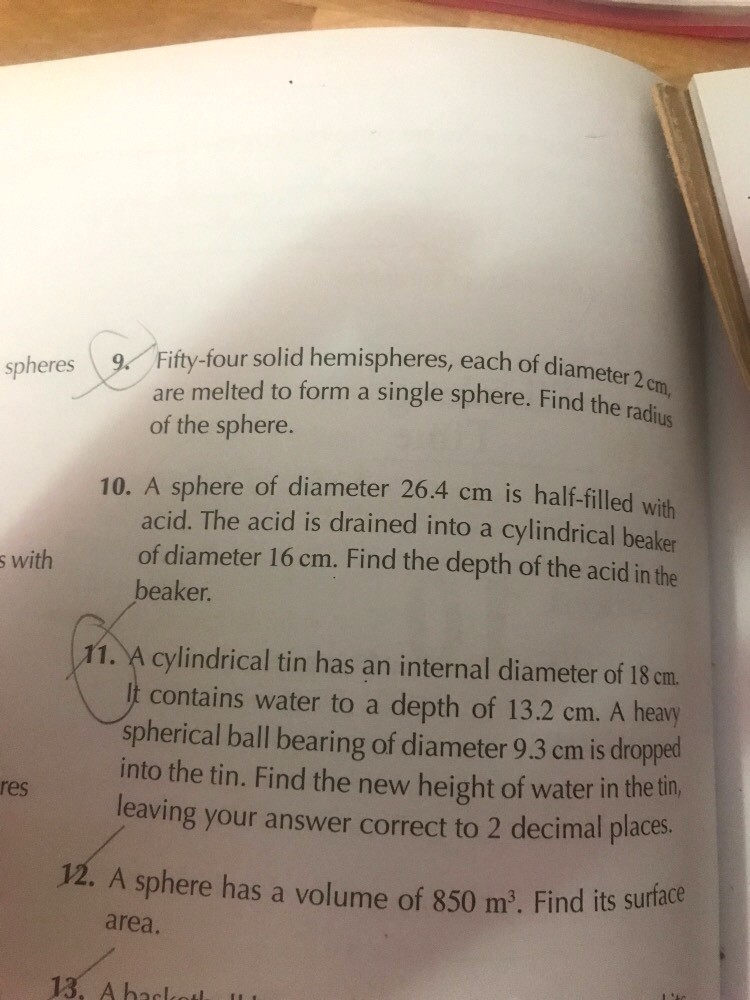
Please help with 9 and 11. Thank you
Date Posted: 7 years ago
Views: 296

There are 54 hemispheres of diameter 2 cm (equivalent to radius 1 cm) to be melted into a single sphere.
What remains the same while being melted is the total volume.
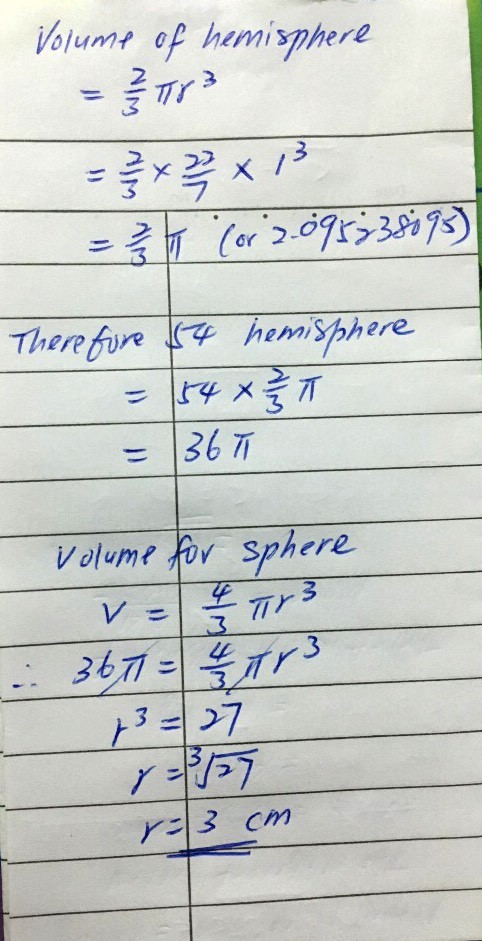
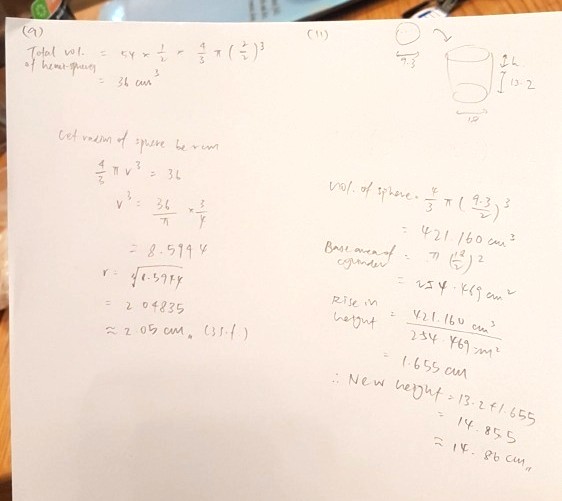
The formula for the volume of a sphere is 4/3 * # * r^3, where # is my pi symbol and r is the radius of the sphere. So for a hemisphere, its volume is 2/3 * # * r^3, and therefore for 54 hemispheres of radius 1 cm, their total volume is
V
= 54 * (2/3 * # * 1^3)
= 36# cm^3
This is also the volume of the single sphere with volume 4/3 * # * r^3, where r here is different from that for the 54 hemispheres. So,
4/3 * # * r^3 = 36 * #
4/3 * r^3 = 36
r^3 = 27
r = 3
So the radius of the sphere is 3 cm.
Q11 requires the science idea that adding a sphere into the water means displacing the water, so the water level rises. The overall volume in the container is the sum of volumes of the water and the sphere.
Cylindrical tin has a diameter of 18 cm (or radius of 9 cm) and contains water to a depth of 13.2 cm. Then, a heavy spherical ball of diameter 9.3 cm (or radius 4.65 cm) is immersed in the water.
The word “heavy” is nothing more than to displace the water (if the object has low density, it will not sink into the water and will therefore not displace the water.
What will increase as a result of placing the sphere into the water is the volume, and correspondingly along with it, the height of the water level.
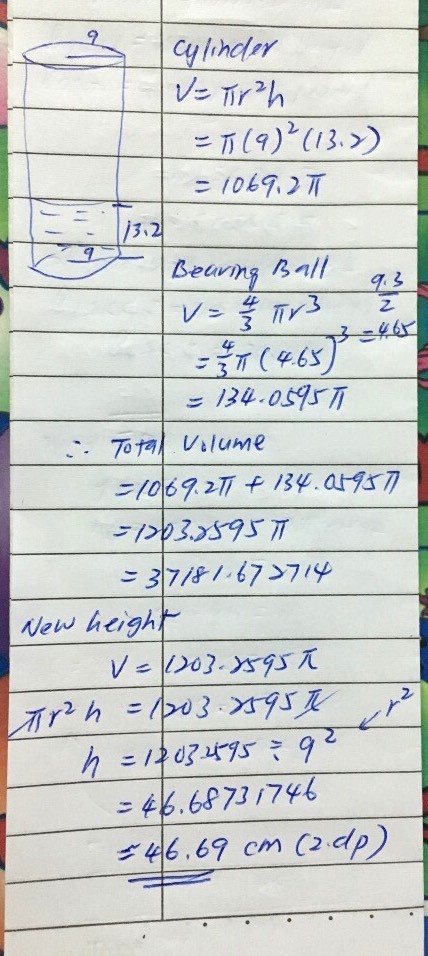
Volume of water in cylindrical tin
= # * r^2 * h
= # * 9^2 * 13.2
= 1069.2 * # cm^3
Volume of sphere
= 4/3 * # * r^3
= 4/3 * # * 4.65^3
= 134.0595 * # cm^3
We then add the volume of water together to obtain
Overall volume
= 1069.2 * # + 134.0595 * #
= 1203.2595 * # cm^3
Since all these are still contained within the cylindrical tin of radius 9 cm, new height of the water level
= Volume / Base Area
= 1203.2595 * # / (# * 9^2)
= 1203.2595 / 81
= 14.85505556
~ 14.85 cm
See 3 Answers
done
{{ upvoteCount }} Upvotes
clear
{{ downvoteCount * -1 }} Downvotes

Q9. Hope this helps
Date Posted:
7 years ago
done
{{ upvoteCount }} Upvotes
clear
{{ downvoteCount * -1 }} Downvotes
Q11. Hope this helps
Date Posted:
7 years ago



 360 Tutoring Program