Ask Singapore Homework?
Upload a photo of a Singapore homework and someone will email you the solution for free.

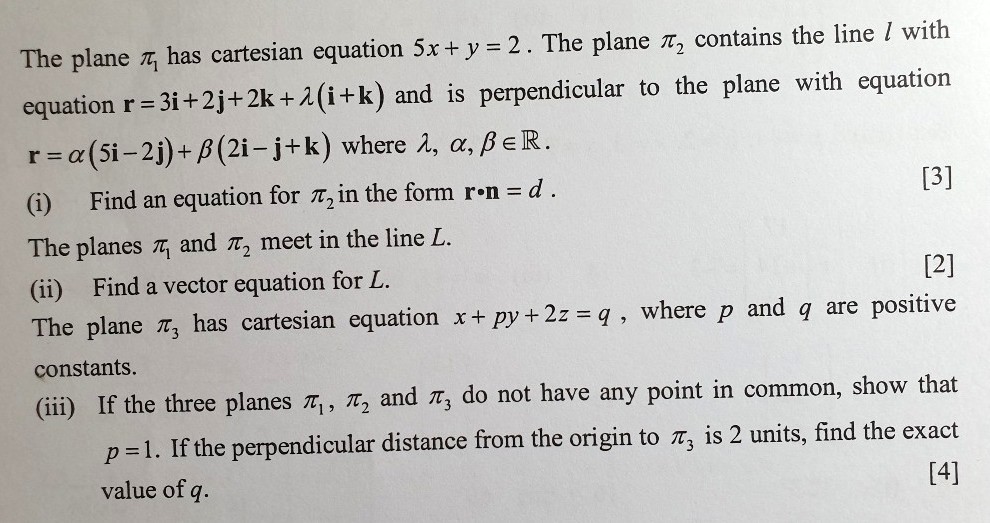
Question
junior college 2 | H2 Maths
One Answer Below
Anyone can contribute an answer, even non-tutors.

Pls help me with part (i). Thanks!
Date Posted: 7 years ago
Views: 338

The 3rd plane contains the origin
What do you mean?
You might want to read these to get a better understanding of the given equations :
https://math.stackexchange.com/questions/81608/finding-equation-of-plane-given-vector-of-point-and-line
https://math.stackexchange.com/questions/85177/normal-form-vector-equation-for-plane-containing-a-2-1-5-and-textline
The idea of this question is to find the normal vector. This can be obtained by finding the cross product of two vectors parallel to the plane.
Since the line lies in π2, we can use the direction vector (i +k) as one of the vectors
The two direction vectors you see in the third plane's equation are parallel to it but not to each other.
Crossing these two vectors will give you a vector that is perpendicular to the third plane (and hence parallel to π2 since the two planes are perpendicular)
Once you obtain this vector, you can cross it with (i + k) to get your normal vector.
Alright. Thank you!
The problem is that we do not have a second known point on π2 (if not we can easily find our second vector) so the question expects you to use the third plane to find another vector parallel to π2
But the question at the top did not mention anything about using plane 3. So how do I know that I have to use plane 3 or are there any other ways?
The clue is to infer by looking at other parts of the question. There is no involvement of the third plane in those parts of the question.
If the question gave you a second point on the plane π2, it is easy already. But it didn't. So it expects you to use this seemingly extraneous/irrelevant info of the 3rd plane to solve it.
The question won't give unnecessary information. Another clue is that the third plane is perpendicular to π2. So it expects you make the inference that the cross product of the vectors on the third plane is also parallel to π2
Oh I see
See 1 Answer

done
{{ upvoteCount }} Upvotes
clear
{{ downvoteCount * -1 }} Downvotes

Not sure if I got the correct answer. Please kindly check also. Thanks and happy learning. Please feel free to comment. :)
Date Posted:
7 years ago
The answer key is r•(-5,1,5)=-3. So are both answers the same?
Yes they are the same. Just a matter of the sign. So my 'normal' will be opposite of the answer key 'normal', but still essentially a 'normal' to the plane. Thanks.
May I ask another question? If the question states that a plane contains a line, does it mean that the whole line lies completely on it or the line is at an angle to the plane?
Completely lies on it. :)
Alright, thank you!
Alternatively, normal vector of third plane
= (5 -2 0) x (2 -1 1)
= ( -2 -5 - 1)
Since this normal vector is perpendicular to third plane and third plane is perpendicular to π2, this vector is parallel to π2.
n of π2 = cross product of (-2 - 5 - 1) and direction vector of line in π2 since both are parallel to π2
= (-2 -5 -1) x (1 0 1) = (-5 1 5)
Equation of plane π2 :
r.n = a.n = d
r.(-5 1 5) = (3 2 2).(-5 1 5) = -3
So r.(-5 1 5) = - 3
Oh okay
This method is basically what I've described in the comment section to you earlier. It saves time since you don't have to assign parameters to a normal vector and try to solve for them.
Ok I get it now
Thanks for all the comments and the alternative solution :) . Basically I miss out applying the concept of 'free' vector.


 360 Tutoring Program