Ask Singapore Homework?
Upload a photo of a Singapore homework and someone will email you the solution for free.

Question
secondary 3 | A Maths
One Answer Below
Anyone can contribute an answer, even non-tutors.

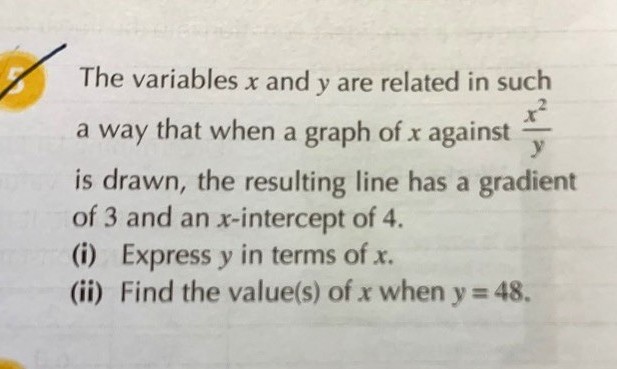
Hi could someone please help me with this, thanks!
Date Posted: 7 years ago
Views: 413
See 1 Answer
done
{{ upvoteCount }} Upvotes
clear
{{ downvoteCount * -1 }} Downvotes

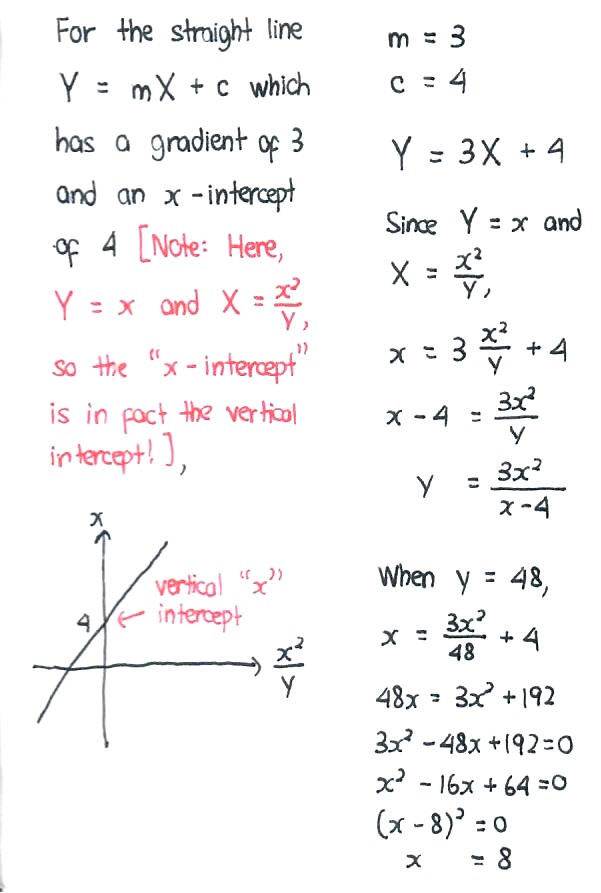
Usually when a question says "When a graph of A is plotted against B...", A is the vertical axis and B is the horizontal axis.
Ironically, for this question, the said "x-intercept" is in fact the vertical intercept, not the usual horizontal intercept, because the straight line drawn is a graph of x against (x^2)/y.
To do this type of question, we must obtain the gradient and vertical intercept of the equation Y = mX + c (where Y, m, X and c are variables to be determined) using the data provided. Here. they provide you with the data straight away. Sometimes, they can present the data as two coordinates where you have to use your basic coordinate geometry skills to obtain the gradient and the vertical intercept.
Once the gradient and the vertical intercept are found for the equation Y = mX + c, we proceed to convert back the Y and the X into their actual forms in x and/or y, since the original expression is actually not linear; the linear law only helps to transform the original expression into this new linear-like expression.
Date Posted:
7 years ago
Ahhh i see, thank you very much!
Thankss v much!


 360 Tutoring Program