Ask Singapore Homework?
Upload a photo of a Singapore homework and someone will email you the solution for free.


Question
junior college 2 | H2 Maths
One Answer Below
Anyone can contribute an answer, even non-tutors.

Ans: ii) 3tln(t+2/14)+k
iii) 1040 (3s.f) or 1041
Need help with iii)
Date Posted: 7 years ago
Views: 437
Your answer to (ii) is incorrect.

It's correct. He just didn't put the brackets properly.
Still need help with iii) >_<
When t is bigger than 0 but smaller than 12, 3tln((t + 2)/14) is negative. As t increases, it becomes more and more negative and reaches a minimum. It then becomes less and negative. This tells us that the population is actually slowly recovering back to k in the first 12 months.
What we don't want is for the y to go down to 0. Because then the species will be extinct and there's no hope of recovery.
So we find the minimum of the expression 3tln((t + 2)/14) and make sure k is always bigger than the absolute value of that. Since 3tln((t + 2)/14) will be negative in this range (when t is below 12), 3tln((t + 2)/14) + k should always be bigger than 0 and therefore y would be > 0 so the species won't go extinct.
Differentiate 3tln((t + 2)/14)). Equate this to 0, then solve for t.
From this, evaluate 3tln((t + 2)/14) (a negative value). 3tln((t + 2)/14) + k should be bigger than 0. So k should be bigger than -3tln((t + 2)/14)
Remember to multiply by 100 since it's in the hundreds. Round up to the nearest whole number since it's bees we're talking about.
Simply consider the minimum point of the graph when it's y = 3 t ln[(t+2) / 14]. You want y to never be negative, so k (equivalent to the starting population) has to be sufficiently positive to transform the graph upwards. +10.4, to be exact, which translates to 1040 bees (since it's in the hundreds).
y to never be negative isn't quite enough. It cannot be zero also.
Thanks for explanations. This is really helpful.
Welcome.
Do note that exactly +10.4 is incorrect.
k should be bigger than 10.40083256 (truncated) , so minimum number of bees would have to be the ceiling of 1040.083256 , which is 1041.
Actually even 1041 isn't a good answer, since it'll leave only 0.916 bees.
1043 would be a better answer, since it would leave about 2.916 bees (which would guarantee at least 2 bees surviving, where hopefully 1 is a queen bee and 1 is a drone,are needed for sexual reproduction)

Lol!
I have sent my version of the answers. Strictly speaking, 1040 should not be allowed. This is an instance where answers to 3 sf do not make realistic sense for this question.
I have sent my version of the answers. Strictly speaking, 1040 should not be allowed. This is an instance where answers to 3 sf do not make realistic sense for this question.
Yes, because that would result in a negative number for the bee population at the minimum point
For the third part, we can just draw the graph out. I tried dy/dt = 0 but got stuck for the exact value of t.
Agreed, entirely; thought of it as well, but figured they wouldn't do that to you in A levels, =_=, hence the solutions given (1040/1041). ¯\_(ツ)_/¯
I think they're expecting the students to plot using GC and then finding the minimum value based on the GC's computation
Thanks again. Makes a lot of sense now.
Yes, I believe that is indeed the case. That's why I told him to look at the minimum point of the graph. I don't believe they are required to solve for the minimum point computationally, since the question specifically pointed towards graphing.
My school’s answers were shown in graph done through GC. But J’s answers made 10x more sense. But next time will definitely do through GC
Besides, 2 marks is too few to justify spending so much time on solving for an answer via any means besides graphical.
It's actually almost impossible to solve for dy/dt = 0 by without the GC at A level. One will need higher level math or something like Wolfram Alpha to solve for exact values.
You can either plot y = 3tln((t+2)/14) directly into the GC, and find the minimum, or you can key in the expression for dy/dt and find when dy/dt
= 0. The former is faster
You can either plot y = 3tln((t+2)/14) directly into the GC, and find the minimum, or you can key in the expression for dy/dt and find when dy/dt
= 0. The former is faster
Does the Newton method for finding estimates work here?
Exact value, unlikely. Should be able to get a good estimate. With 1 iteration starting from t = 5, we can get t =1/9(10 + 49ln2) ≈ 4.88491243, which is close to the 4.886060536. Another iteration should suffice.
See 1 Answer
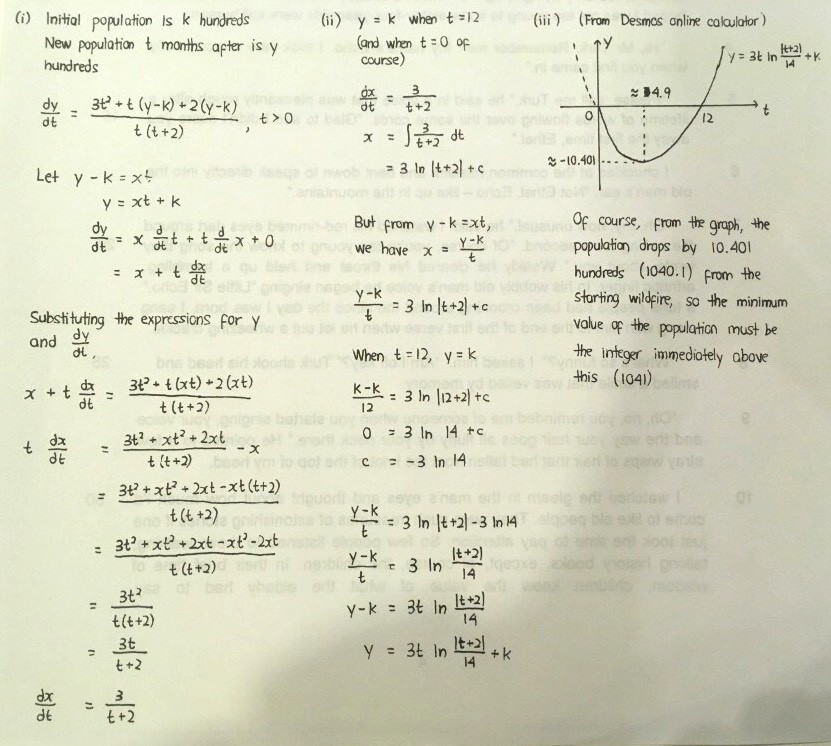
done
{{ upvoteCount }} Upvotes
clear
{{ downvoteCount * -1 }} Downvotes
Here
Date Posted:
7 years ago
The modulus brackets can be removed in view of the fact that t > 0.
Just needed iii) but thank you so much! Absolutely appreciate the clarity of this insanely clean handwritten answer.
Thks!


 360 Tutoring Program