Ask Singapore Homework?
Upload a photo of a Singapore homework and someone will email you the solution for free.


Question
secondary 4 | A Maths
6 Answers Below
Anyone can contribute an answer, even non-tutors.

Thank you
Date Posted: 7 years ago
Views: 245
Seen, just returned, will write up the answers once ready
Ok. Thanks
I sending differentiation qns
See 6 Answers
done
{{ upvoteCount }} Upvotes
clear
{{ downvoteCount * -1 }} Downvotes
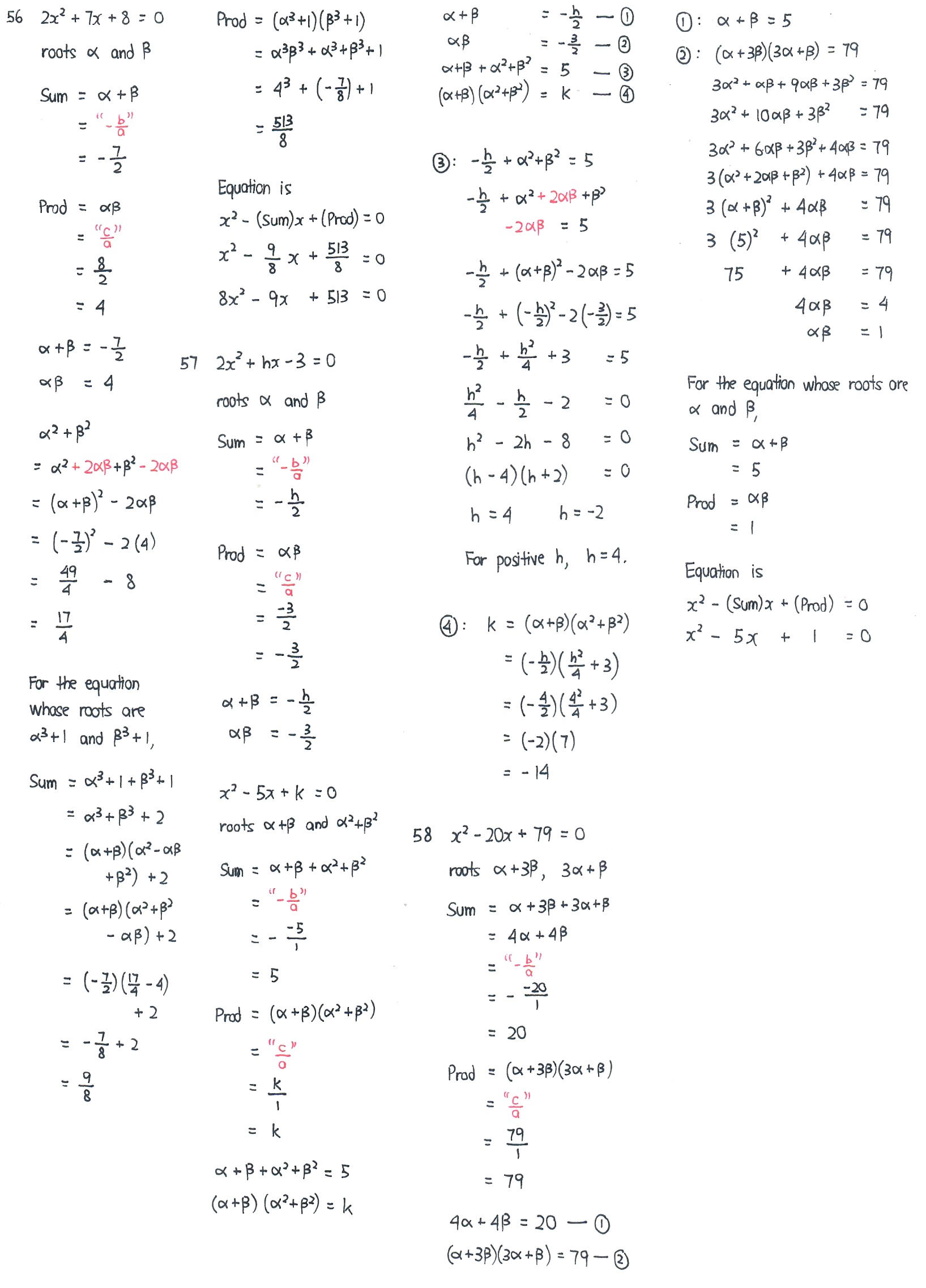
Q56, Q57, Q58
Date Posted:
7 years ago
I just post last two qns for this chapter
done
{{ upvoteCount }} Upvotes
clear
{{ downvoteCount * -1 }} Downvotes
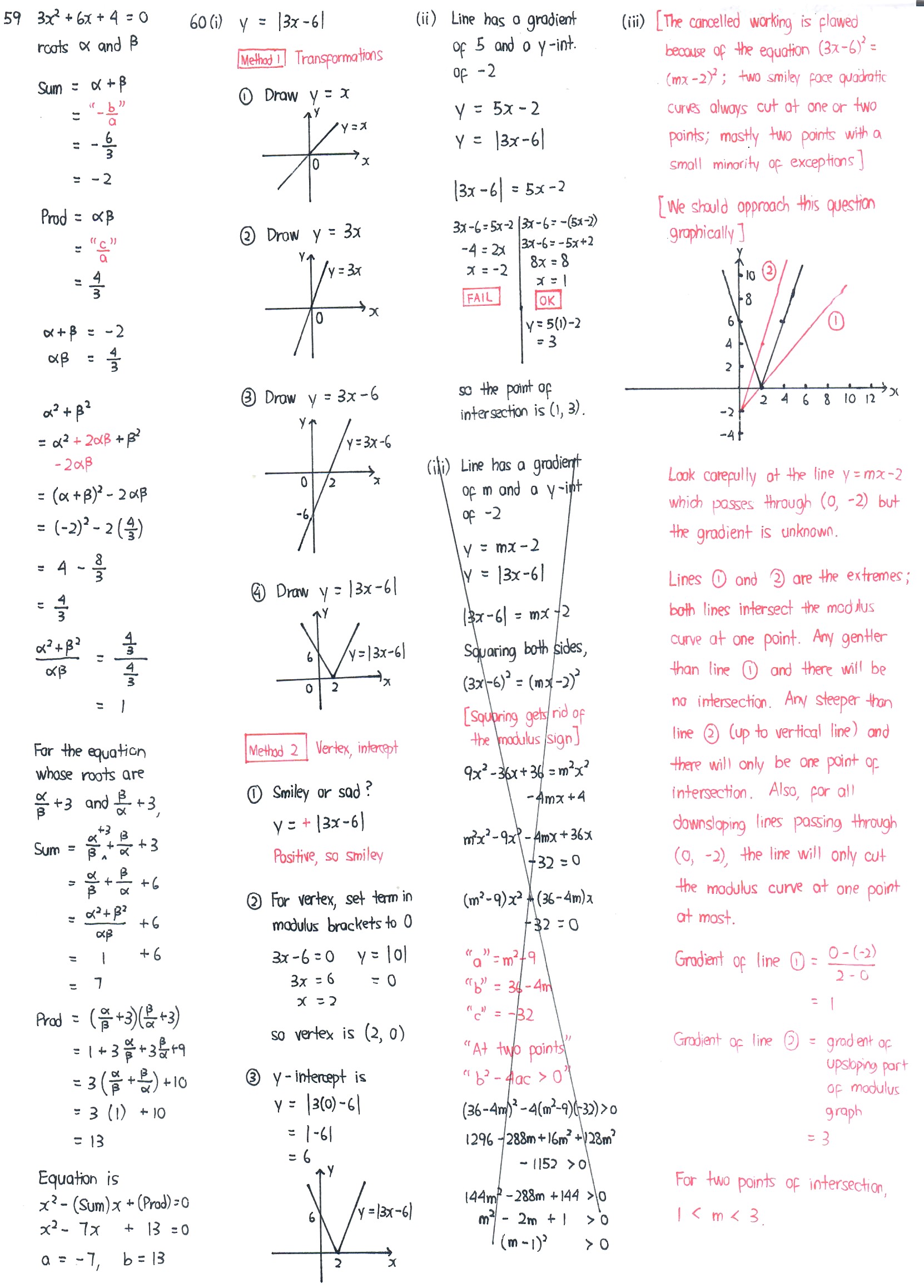
Q59, Q60
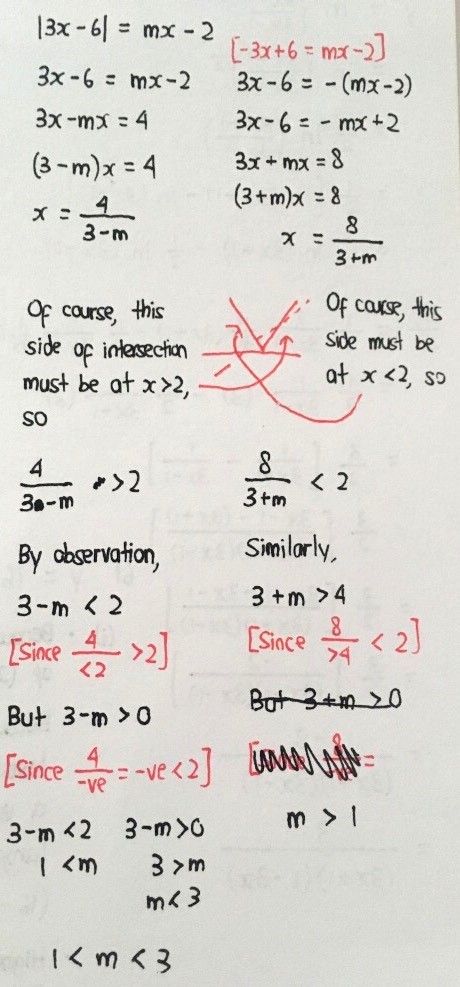
The entire cancellation of my working for Q60 (iii) shows that not all the time my concepts are correct. The cancelled approach, as it turns out, is not a valid approach to solve the question, even though I am not too sure why this is the case algebraically, at least for the time being.
Use my corrected approach in red which considers values of m graphically.
I am currently thinking whether an algebraic approach is possible for Q60 (iii), entirely using modulus only (without squaring, which I believe is the main cause of the misconception).
Date Posted:
7 years ago
I gave deep thought to the question but my ideas are mixed around, so I guess this question should be done graphically.
It's likely cus when you square both sides of an eqn you introduce extra solution(s)...
Eg. x = 4 only has one solution; squaring both sides gives x² = 16 which will yield two solutions.
I uploaded something you can go take a look.
Eg. x = 4 only has one solution; squaring both sides gives x² = 16 which will yield two solutions.
I uploaded something you can go take a look.
done
{{ upvoteCount }} Upvotes
clear
{{ downvoteCount * -1 }} Downvotes
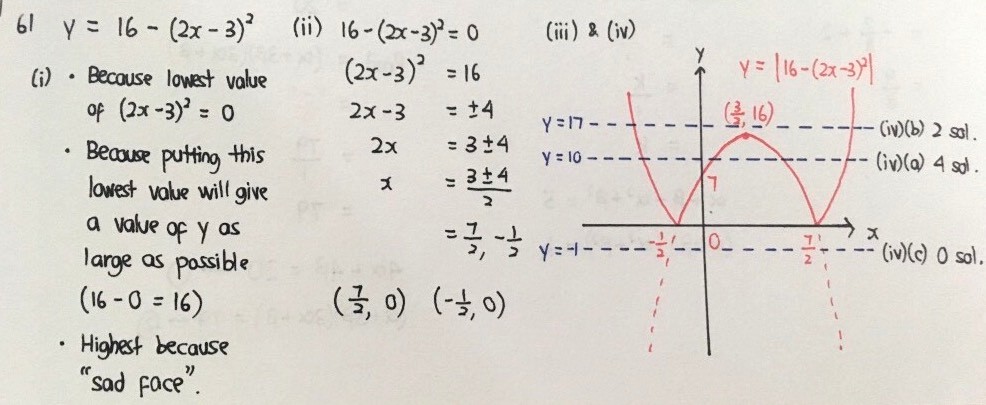
Q61
Date Posted:
7 years ago
done
{{ upvoteCount }} Upvotes
clear
{{ downvoteCount * -1 }} Downvotes
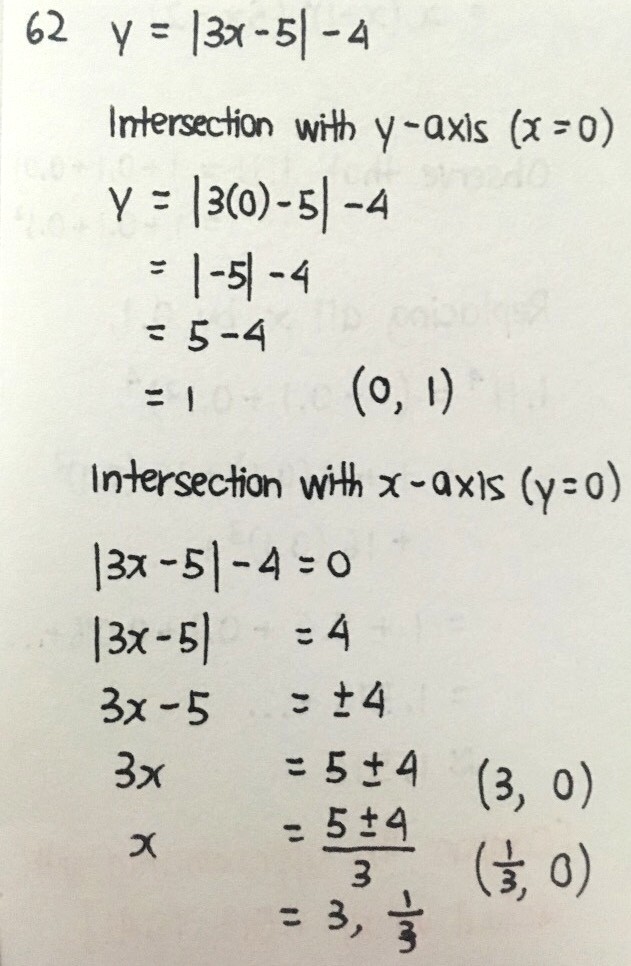
Q62
Date Posted:
7 years ago
done
{{ upvoteCount }} Upvotes
clear
{{ downvoteCount * -1 }} Downvotes
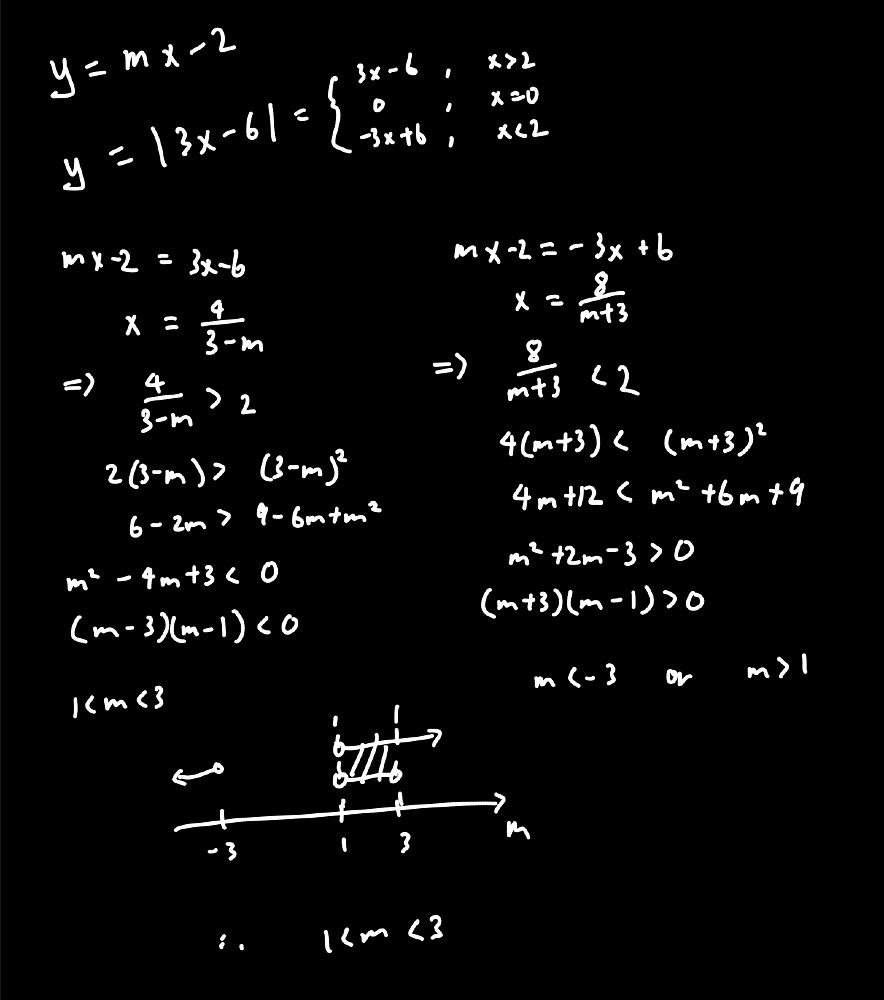
Here's another way you can approach 60iii but I definitely DO NOT recommend doing it this way.
Date Posted:
7 years ago
I did use this approach once up to the fraction x = 4 / (3 - m) but did not think of getting rid of the fraction by multiplying both sides by (3 - m)^2.
Yep you can't just bring (3 - m) over cus it's an inequality
I highly doubt this method is suitable for Sec 4 students as they would also not have thought of multiplying with (3 - m)^2. They will most likely multiply both sides with 3 - m because that appears to be the simplest and they have not learnt that multiplying with such linear terms is an incorrect approach mathematically.
Eh no, I just realised that my method works perfectly fine!
There is no need to multiply both sides by the square.
Will write up a new version of mine shortly. I missed one stupid detail in my working last night.
There is no need to multiply both sides by the square.
Will write up a new version of mine shortly. I missed one stupid detail in my working last night.
This method for this qn is not recommended cus it's too long and tedious.
Regarding the inequality part it's part of their syllabus. I've encountered it in some of their school papers.
Regarding the inequality part it's part of their syllabus. I've encountered it in some of their school papers.
Updated with a solution of mine which avoids cross multiplication of denominators fully.
done
{{ upvoteCount }} Upvotes
clear
{{ downvoteCount * -1 }} Downvotes
Here. Missed the one detail at the last part that “3 - m > 0”.
Date Posted:
7 years ago


 360 Tutoring Program