Ask Singapore Homework?
Upload a photo of a Singapore homework and someone will email you the solution for free.


Question
secondary 4 | A Maths
2 Answers Below
Anyone can contribute an answer, even non-tutors.

Thank you
Date Posted: 7 years ago
Views: 699

I will do up the modulus using the usual two methods I always draw, but only when I have time.
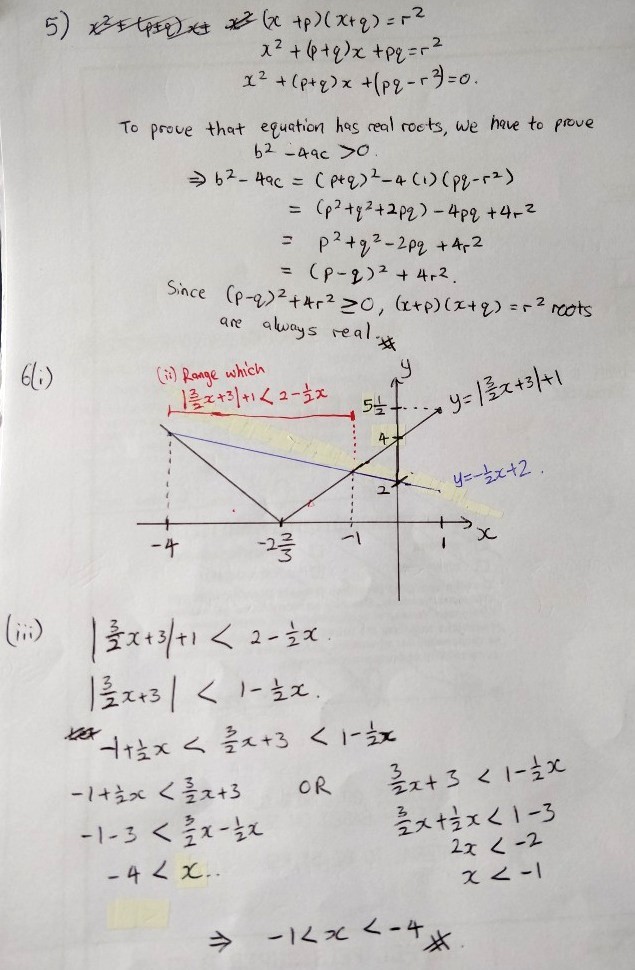
For Q5, one method has been done perfectly by the other tutor. We just prove that b2 - 4ac >= 0.
Another method, which is not in the A Maths syllabus but is of a geometrical nature, is this.
For an equation (x + p) (x + q) = 0, the solutions are x = -p and x = -q. Correct?
The fact that we can factorise a quadratic equation into two linear forms like this shows that we will have two solutions on the y-axis.
The shape of this graph is obviously smiley face. The fact that it cuts the x-axis at one or two points (at one point is only when p = q) shows that the curve will definitely cut the straight line y = k at two points for any positive value of k.
The straight line y = r2 achieves this since r2 is naturally non-negative. The zero case when r = 0 has been taken into factor in the equation (x + p) (x + q) = 0.
Hence, the roots are always real. Real and equal is only when r = 0 and p = q.
Only graphs which never cut the x-axis cannot ever be factorised into two linear forms.
See 2 Answers
done
{{ upvoteCount }} Upvotes
clear
{{ downvoteCount * -1 }} Downvotes

Feel free to ask if you have any questions
Date Posted:
7 years ago
The modulus one looks a bit off though. The +1 is outside the modulus, so the vertex is in fact (-2, 1).
Yes, you are right. Got distracted by the +1 on the outside which affected the whole grap, while trying to consider the y intercept. Please follow Nicholas's graph. The rest of the answers are still correct
done
{{ upvoteCount }} Upvotes
clear
{{ downvoteCount * -1 }} Downvotes
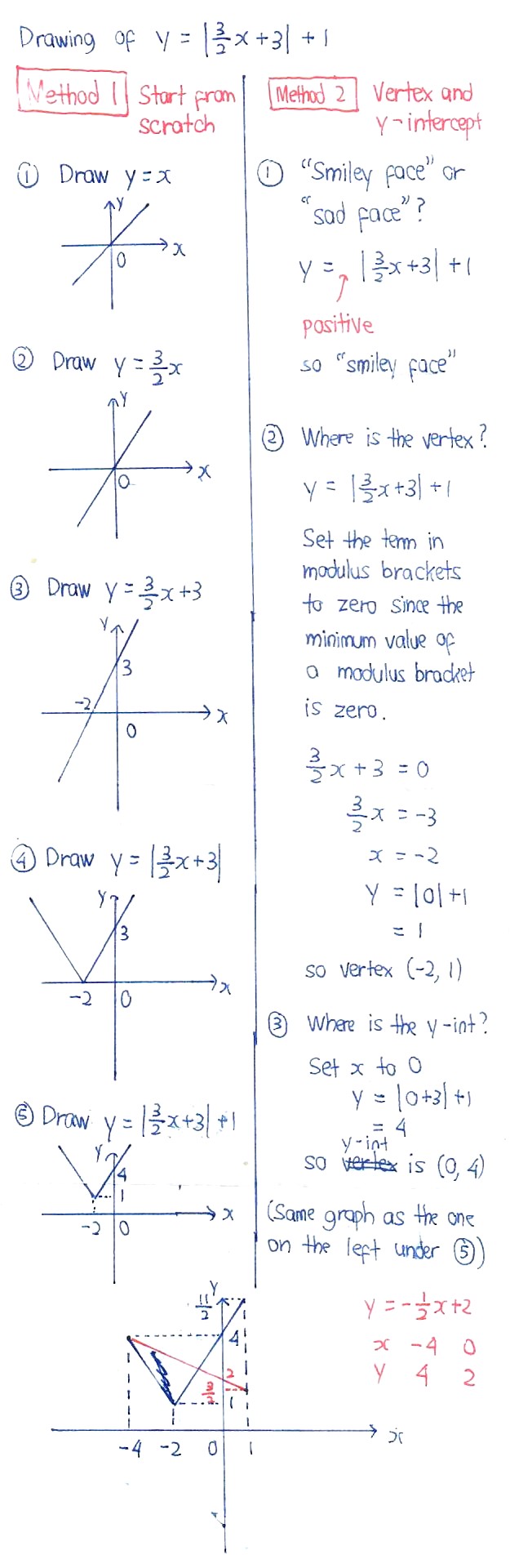
Here are the graphs for Q6. Remember these two methods and choose which one you prefer.
The first one is drawing by transformations.
1, Start with the base graph y = x.
2. Introduce the coefficient of x (y = mx).
3. Introduce the "+ c" (y = mx + c).
4. Modulus the line (y = |mx + c|).
5. Add the other constant "+ k" outside the modulus (y = |mx + c| + k).
The second one is very analogous to the sketching of a quadratic graph.
(For quadratic graph of quadratic equations in completed square form)
1. "Smiley or sad"?
2. Turning point coordinates, the x-coordinate is found by setting the term inside the completed square brackets to zero, the y-coordinate is the value "+ k" in the y = a (bx + c)^2 + k.
3. The y-intercept, found by setting x to 0.
(For modulus graph}
1. "Smiley or sad"?
2. Vertex coordinates (yes, it's called vertex, not turning point), the x-coordinate is found by setting the term inside the modulus brackets to zero, the y-coordinate is the value "+ k" in the y = a |bx + c| + k.
3. The y-intercept, found by setting x to 0.
Date Posted:
7 years ago


 360 Tutoring Program