Ask Singapore Homework?
Upload a photo of a Singapore homework and someone will email you the solution for free.


Question
secondary 2 | Maths
2 Answers Below
Anyone can contribute an answer, even non-tutors.

Pythagoras theorem
Date Posted: 7 years ago
Views: 742
See 2 Answers
done
{{ upvoteCount }} Upvotes
clear
{{ downvoteCount * -1 }} Downvotes

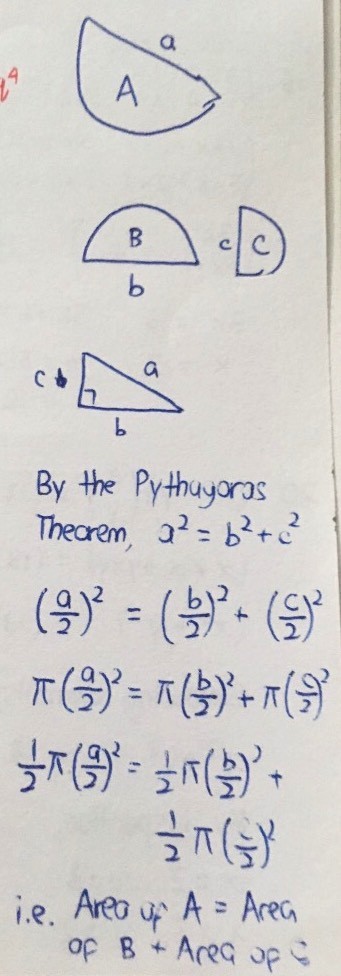
The labelling of the diagram by the author of this question seems poorly done. I have split the diagram into three semicircles and one right angled triangle in my diagrams.
You have learnt Pythagoras theorem right? Here, a2 = b2 + c2.
Since a, b and c are also the diameters of the three semicircles, it follows that the radii of the three semicircles must also follow the theorem (imagine sides 6, 8 and 10; half of it, namely 3, 4 and 5 will also follow the theorem).
It also follows from there that the areas must follow the Pythagoras Theorem.
Let me know if you need more explanations on this.
Date Posted:
7 years ago
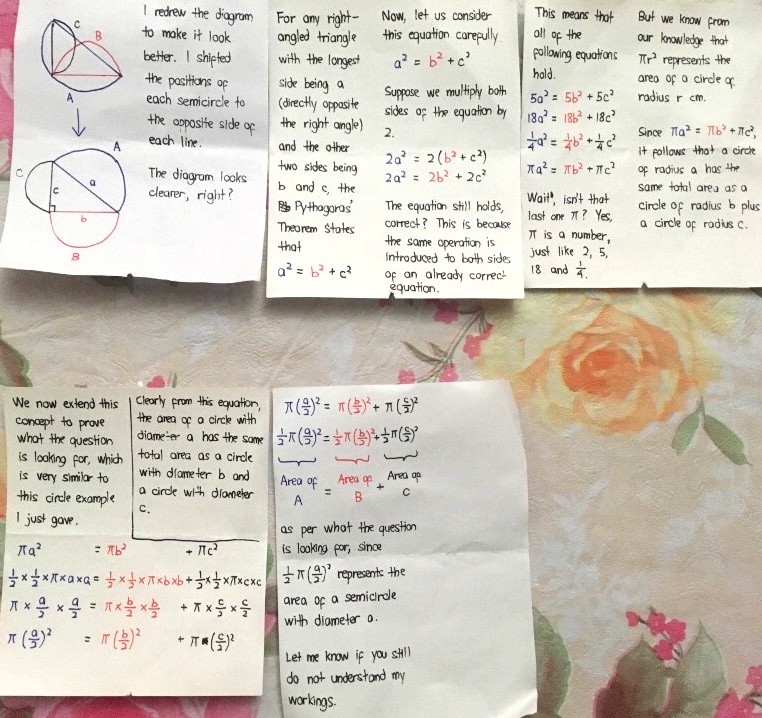
Mathematically speaking, when two sides of an equation are equal and you introduce the same operation to both sides of the equation (eg add 5 to both sides, or multiply both sides by -7 or square both sides etc), both sides will remain equal.
We make use of this fact to obtain the required answer.
a2 = b2 + (a/2)^2 = (b/2)^2 + (c/2)^2
[This, essentially, is obtained by multiplying both sides of the Pythagoras equation above by 0.25, which simply means in the context of this question that the radii of the circles also follow the Pythagoras theorem]
Multiplying both sides by # (I use # for pi),
# (a/2)^2 = # (b/2)^2 + # (c/2)^2
Multiplying both sides by 1/2,
0.5# (a/2)^2 = 0.5# (b/2)^2 + 0.5# (c/2)^2
But as we know it very well, the formula of a semicircle is 0.5#r2.
0.5# (a/2)^2 represents the area of semicircle A (similar reasonings apply for semicircles B and C)
Therefore, area of A = area of B + area of C.
Do you mimd sending me the entire thing woth the ans
Currently not free. Will send you only if I can remember and I have more time.
Will send you the diagrams and explanations latest by tmr 11 pm
Sent
done
{{ upvoteCount }} Upvotes
clear
{{ downvoteCount * -1 }} Downvotes
This question requires you to have good reasoning and a good understanding of how equations work. Knowledge in direct proportions also helps for this question.
Date Posted:
7 years ago


 360 Tutoring Program