Ask Singapore Homework?
Upload a photo of a Singapore homework and someone will email you the solution for free.

Question
junior college 1 | H2 Maths
No Answers Yet
Help Angel! Anyone can contribute an answer, even non-tutors.

Help asap ty
Date Posted: 1 year ago
Views: 229

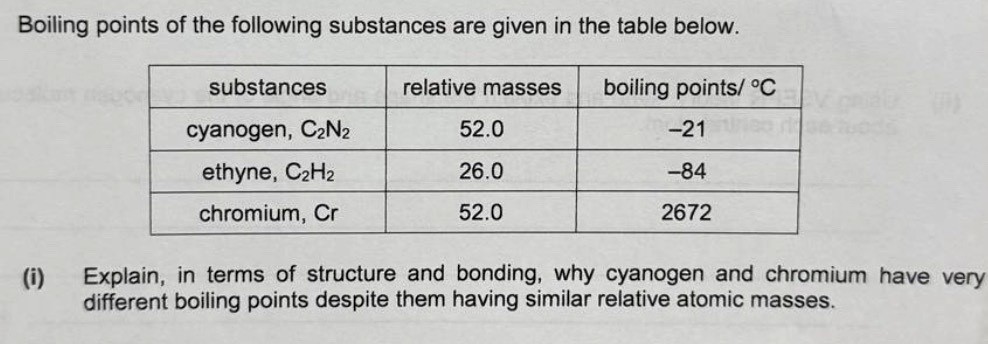
Hi I think it’s probably due to the bonding. The cyanogen consists of 2C and are usually connected by diatomic bond, somemore consists only covalent bond while chromium is held by metallic bond. This is just a simple guidance for you to answer, and please do your own research yourself for full solutions. Your answer should be supported by strong evidence leading to not only such high boiling point difference but also about why boiling points are so low and so high for cyanogen and chromium respectively whoch I believe you can find from your textbook.

Cyanogen is a carbon nitride and covalent compound. While the covalent bonds which hold the cyanogen molecule together are very strong, the intermolecular forces between individual cyanogen molecules are very weak, and require little energy to overcome. Cyanogen in particular is a symmetrical molecule, which means it is non-polar, and there are no dipole-dipole interactions (a type of intermolecular force) between them, which results in a relatively low boiling point. Since it boils at -21°C, it is a gas at normal room temperature and pressure.
Chromium, on the other hand, is a metal. Its ions are held together by metallic bonding, in which the metal cations are arranged in a lattice, and they are surrounded by a "sea" of delocalized electrons. These electrons are free to move throughout the entire piece of chromium. The result is an extremely strong attractive force between the metal ions and the disassociated electrons, which requires a large amount of energy to overcome.
Hence, although cyanogen and chromium have relatively similar atomic masses, they have incredibly different melting points.

 360 Tutoring Program