Ask Singapore Homework?
Upload a photo of a Singapore homework and someone will email you the solution for free.

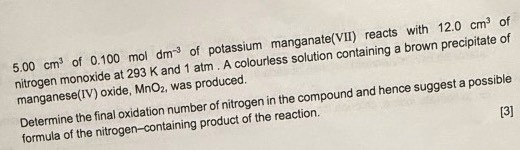
Question
junior college 1 | H2 Maths
One Answer Below
Anyone can contribute an answer, even non-tutors.

Pls help asap ty
Date Posted: 1 year ago
Views: 183
See 1 Answer
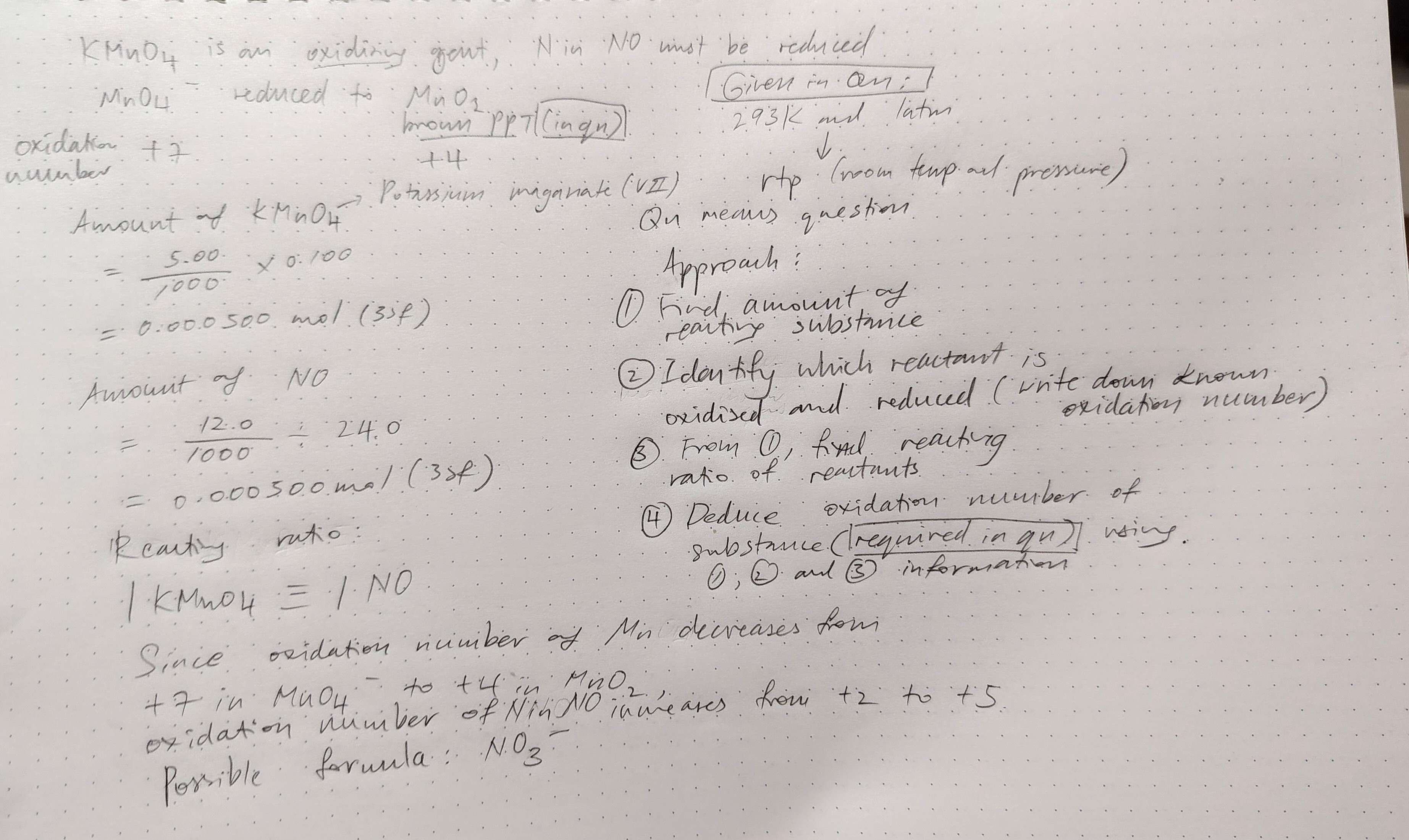
done
{{ upvoteCount }} Upvotes
clear
{{ downvoteCount * -1 }} Downvotes

I hope this solution helps!
Date Posted:
1 year ago
Thank you. How do you know its N that will be reduced and not O? And is the reduction half-equation not needed?
For this reaction, O is not reduced because it is already in oxidation state -2 which is quite stable. (For what you learn currently, usually oxidation state of O is either 0 or -2)
Usually for such common redox reaction we assume the other elements(not O) is the one that is being reduced or oxidised.
Additionally, the question says to "determine final oxidation number of N in the compound", so it is likely that N is reduced.
For whether reduction half-equation is needed or not, I did not write here because I already wrote that out in english. I think it is good if you write the half equation to show the marker your understanding of the reaction/remind yourself which element is the one being reduced. Whether it is compulsory or not depends on your school's marking sheet(you can ask your teacher in school about this) as this question did not explicitly require you to write.
I hope this answers your question! Apologies if it is quite long to read.
I see thank you so much! As the moles and mole ratio is the same that’s why we can compare the electrons gain/ lost is the same and find oxidation number of N right? Just to ask how to know if the ans is NO3- and not HNO3?
Yes, that is correct! If the mole ratio is not the same, electron gained or lost cannot be compared directly(must multiply number of electrons gained or lost by the appropriate ratio first before we compare. E.g. If the ratio is 2 to 1 instead of 1 to 1)
Thank you! Also dyk why we shld write NO3- instead of HNO3?


 360 Tutoring Program