Ask Singapore Homework?
Upload a photo of a Singapore homework and someone will email you the solution for free.

Question
secondary 2 | Maths
2 Answers Below
Anyone can contribute an answer, even non-tutors.

Need help for this qn
Date Posted: 3 years ago
Views: 266

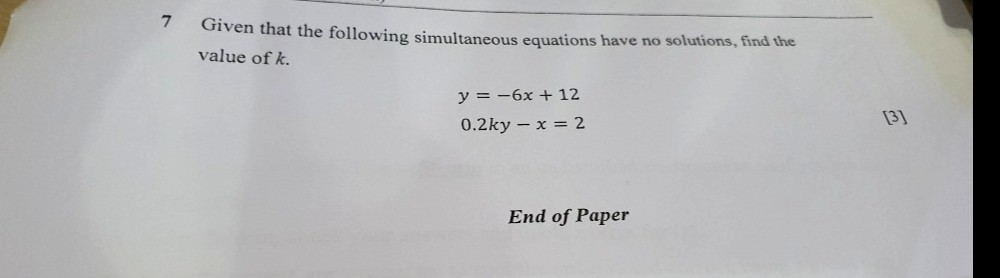
Given :
y = -6x + 12 ①
0.2ky - x = 2 ②
The idea is to try to solve as how you do normally first.
We notice that ① has -6x on the right, and ② has -x on the left.
They can be eliminated by addition of ① to ② such that we have negative x terms on both sides.
However, we have to multiply eqn throughout ② by 6 first in order to do so.
① + 6 × ②
Left side of eqn ① + 6 × left side of eqn ② = right side of eqn ① + 6 × right side of eqn ②
y + 6(0.2ky - x) = -6x + 12 + 6(2)
y + 1.2ky - 6x = -6x + 12 + 12
The -6x on both sides can be eliminated and the other terms can be simplified.
y(1 + 1.2k) = 24
y = 24 / (1 + 1.2k)
If the pair of simultaneous equations have no solutions, then y must be undefined.
For this to happen the denominator 1 + 1.2k will have to equal zero.
1 + 1.2k = 0
1.2k = -1
k = -1/1.2
k = - 5/6
Alternatively, we can do substitution.
y = -6x + 12 ①
0.2ky - x = 2 ②
From ②,
-x = 2 - 0.2ky
Sub into ②,
y = 6(2 - 0.2ky) + 12
y = 12 - 1.2ky + 12
y + 1.2ky = 24
y(1 + 1.2k) = 24
y = 24/(1 + 1.2k)
The rest is the same as before
y = -6x + 12 ①
0.2ky - x = 2 ②
From ②,
-x = 2 - 0.2ky
Sub into ②,
y = 6(2 - 0.2ky) + 12
y = 12 - 1.2ky + 12
y + 1.2ky = 24
y(1 + 1.2k) = 24
y = 24/(1 + 1.2k)
The rest is the same as before
Second alternative (solving for x first)
y = -6x + 12 ①
0.2ky - x = 2 ②
① × 0.2k
0.2ky = 0.2k(-6x + 12)
0.2ky = -1.2kx + 2.4k
Sub into ①,
-1.2kx + 2.4k - x = 2
-1.2kx - x = 2 - 2.4k
-x(1.2k + 1) = 2 - 2.4k
x = (2 - 2.4k) / -(1.2k + 1)
x = (2.4k - 2) / (1.2k + 1)
Using the same reasoning,
x is undefined when the denominator 1.2k + 1 = 0
1.2k = -1
k = -1/1.2 = -5/6
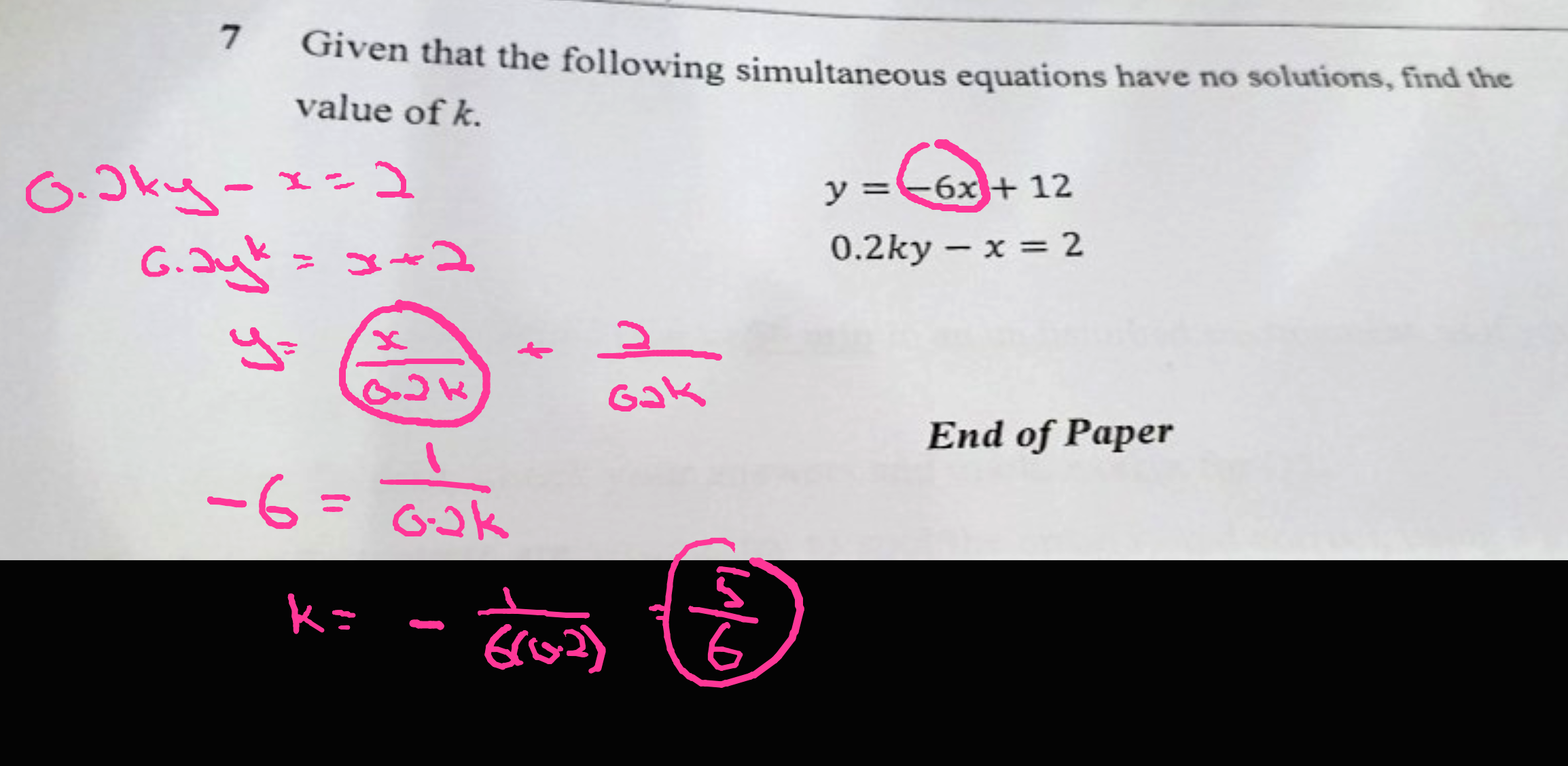
Third alternative : parallel lines, no solution.
The two equations are of straight lines. If the lines are parallel then they don't have any intersection and hence there will be no solutions.
(Note that parallel in this case doesn't include coincident lines whereby the two lines appear as a single line / lie or superimposed on each other)
Parallel lines have the same gradient and different y-intercepts so we should rewrite the two equations to find them first.
y = -6x + 12 ①
This in already in the form y = mx + c.
Gradient , m = -6
y-intercept = 12
0.2ky - x = 2 ②
0.2ky = x + 2
Multiply by 5,
ky = 5x + 10
y = (5/k) x + 10/k
Gradient = 5/k
y-intercept = 10/k
For the gradients to be the same,
5/k = -6
k = 5/-6
k = -5/6
Note that for the parallel lines approach, we can do a check on the side and realise that when k = -5/6, the y-intercept of the second line = 10/(-5/6) = -12
The two y-intercepts are the negatives of each other and not equal, which means we can be certain the two lines won't be coincident.
The two y-intercepts are the negatives of each other and not equal, which means we can be certain the two lines won't be coincident.
See 2 Answers
Refer to main comments section for answer, explanation and alternative approaches
Thank you so much!
done
{{ upvoteCount }} Upvotes
clear
{{ downvoteCount * -1 }} Downvotes

Parallel line
Date Posted:
3 years ago


 360 Tutoring Program