Ask Singapore Homework?
Upload a photo of a Singapore homework and someone will email you the solution for free.

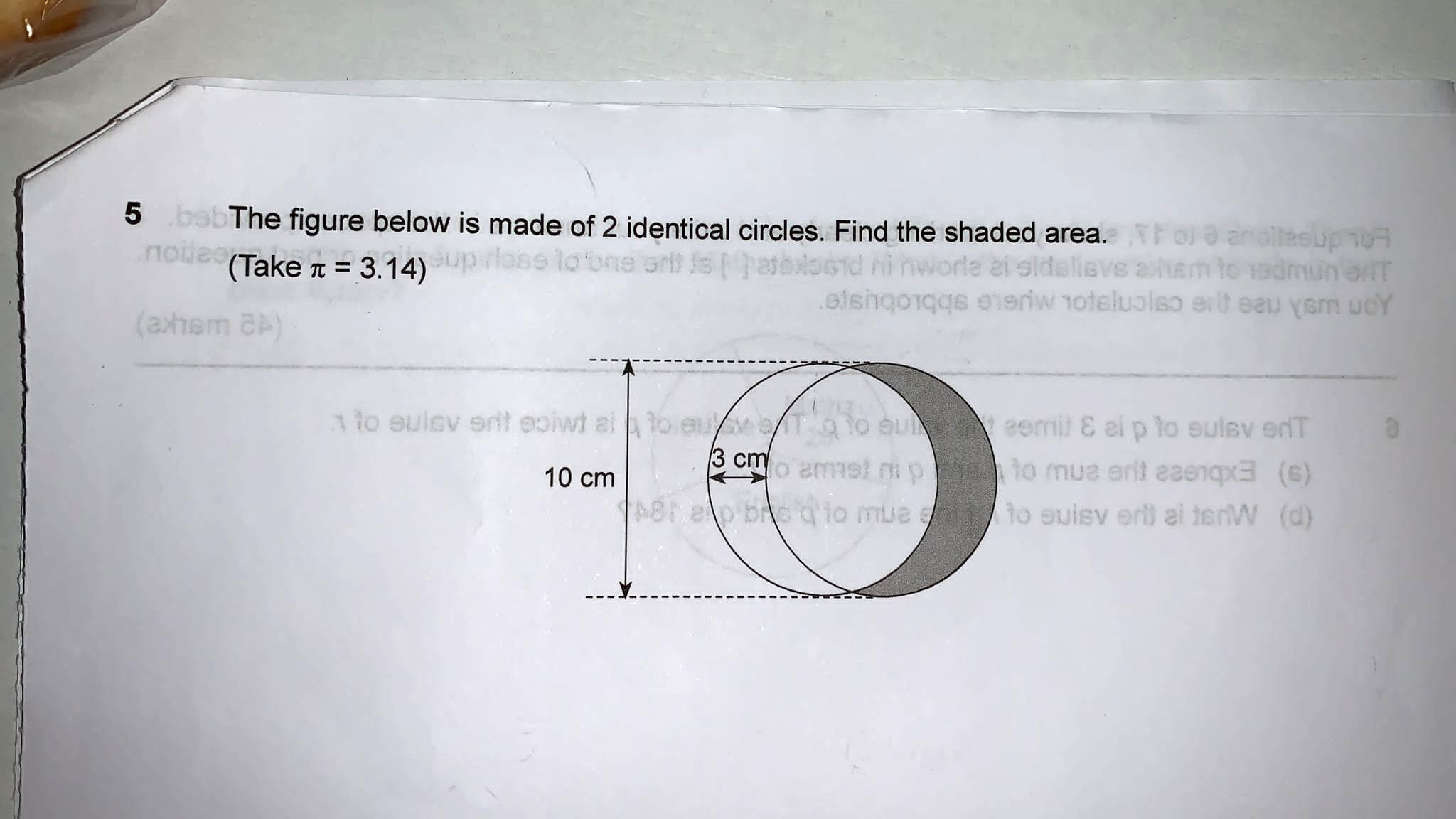
Question
primary 6 | Maths
One Answer Below
Anyone can contribute an answer, even non-tutors.

help pls been stuck for 2hrs
Date Posted: 4 years ago
Views: 542
See 1 Answer
done
{{ upvoteCount }} Upvotes
clear
{{ downvoteCount * -1 }} Downvotes

Can I confirm this is really a primary school question? If so which paper is it from?
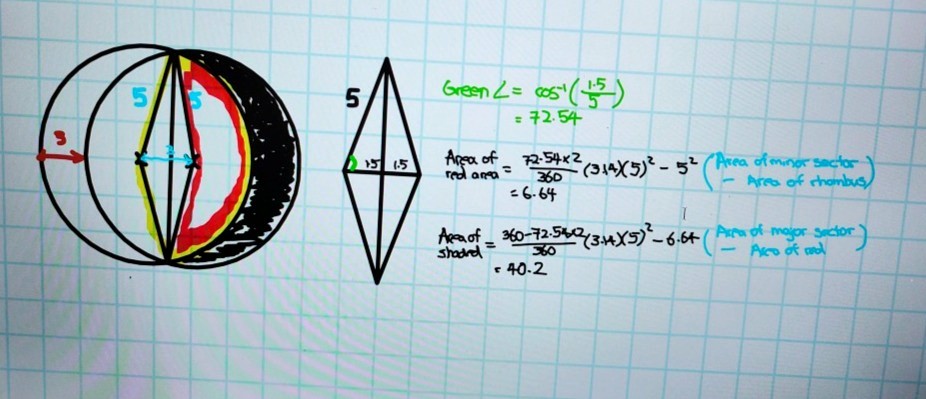
The only solution I can think of makes use of trigonometry which is not covered in primary school. Hmm if theres an actual simpler solution, do let me know!! Curious too haha.
Date Posted:
4 years ago
yes this qn really is from a pri 6 math paper.
apparently, this is the solution.
diameter of overlapping circles= 10+3=13cm
area of square enclosing both circles= 13 x 10= 130cm2
area of circle= 5 x 5 x 3.14= 78.5cm2
area of square enclosing a circle= 10 x 10= 100cm2
area of remaining parts in a square enclosing a circle= 100 - 78.5 =21.5cm2
area of the overlapping circles= 130 - 21.5= 108.5cm2
shaded area= 108.5- 78.5= 30cm2
ans is 30cm2
Have to say that this question is a rather bad & the model answer provided is also bad.
The method used in the model answer only gives an approximate answer, because it disregards 2 small areas at the top and bottom between the 2 circles. The wording is also confusing, for example, stating the total length of the 2 overlapping circle as a "diameter" and stating the 13x10 rectangle enclosing the 2 circles as a "square".
As Tseng Tzu En pointed out, for an exact answer, this requires secondary school maths. Unfortunately, there is an error in his working as the area of the rhombus is not 5^2.
Using the correct area of a rhombus, and calculating more precisely, the shaded area is 29.54372072 cm2. Although 30 cm2 is quite close, an inaccurate answer using an inaccurate method is as good as no answer.
Oh right area of rhombus should be (3x10)/2 = 15. Thanks for pointing out the mistake.
sorry, area of rhombus = 15 is still not right, because 5 is slant side, not vertical height.
by Pythagoras theorem,
height of rhombus
= 2 x sqrt[5^2-1.5^2]
= 9.53939
area of rhombus
= (3 x 9.53939)/2 = 14.30908
Area of rhombus = (pq)/2
Where p is the length of the diagonal,
And q is the length of another diagonal.
That is another way of finding the area.
I assumed the length of the vertical diagonal to be that of diameter of circle which is wrong haha
however the ans key is probably wrong as it doesn't take account for the peacock hair

I just come to see the answer. :) My answer 29.544cm². I hope to see P6 way of working or method for this question. (If it is overlapping 5cm, then can use P6 method).


 360 Tutoring Program