Ask Singapore Homework?
Upload a photo of a Singapore homework and someone will email you the solution for free.


Question
secondary 3 | A Maths
One Answer Below
Anyone can contribute an answer, even non-tutors.

Please help, thank you!
Date Posted: 4 years ago
Views: 211

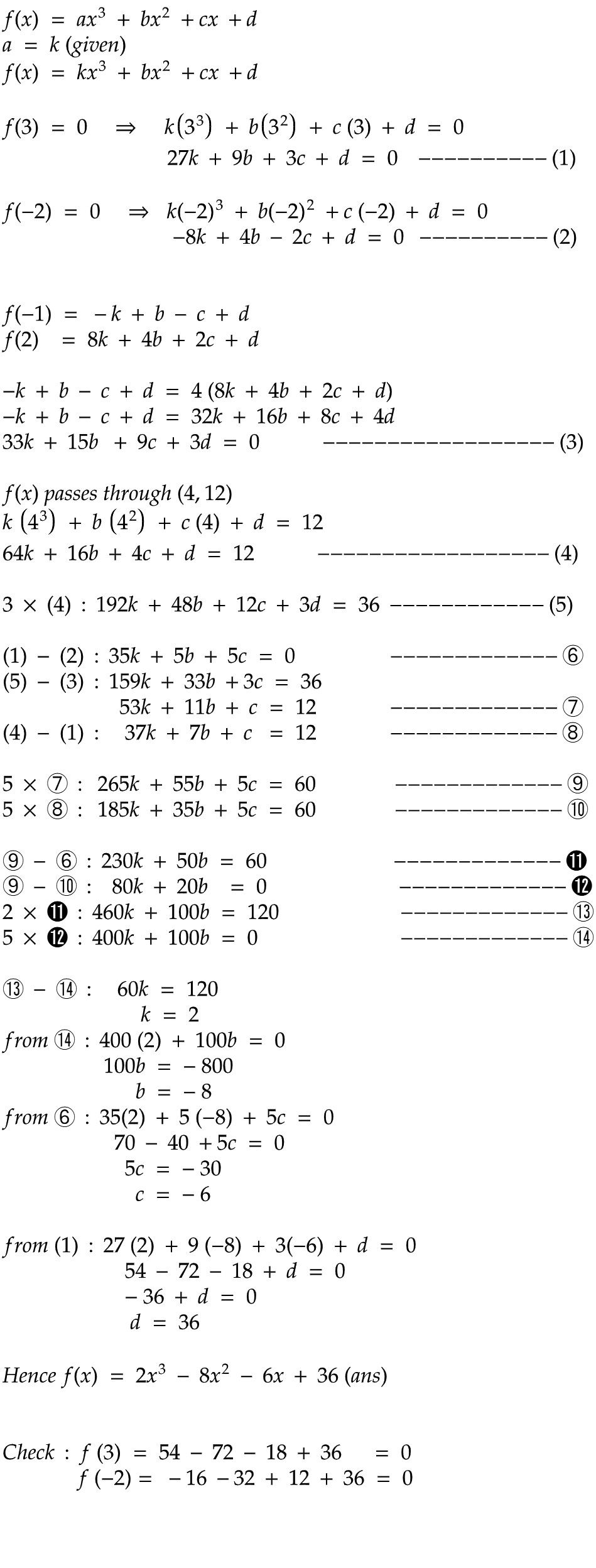
The tutor's workings is not ideal at your level. You are not expected to solve a system of four simultaneous equations at your level.
What I recommend is this.
Because f(x) is a cubic polynomial which has only two distinct roots, one of the two roots must be repeated.
Having x = 3 and x = -2 as roots implies that x - 3 = 0 and x + 2 = 0.
In other words,
(x - 3) (x + 2) (x + k) = 0
[k can be -3 or 2 and we will find this out later]
a (x - 3) (x + 2) (x + k) = 0
{This multiplier a is important as it gives us the infinitely many possible cubic curves with roots 3 and -2]
In other words,
f(x) = a (x - 3) (x + 2) (x + k)
By the remainder theorem, the remainder when f(x) is divided by (x + 1)
= f (-1)
= a (-1 - 3) (-1 + 2) (-1 + k)
= a (-4) (1) (-1 + k)
= -4a (-1 + k)
Similarly, the remainder when f(x) is divided by (x -2)
= f(2)
= a (2 - 3) (2 + 2) (2 + k)
= a (-1) (4) (2 + k)
= -4a (2 + k)
Because the remainder for the (x + 1) case is four times that of the (x - 2) case,
-4a (-1 + k) = (4) (-4a) (2 + k)
Note that a is going to be the coefficient of x³ and cannot be zero (else f(x) will not be cubic), so we can divide both sides by -4a safely.
-1 + k = 4 (2 + k)
-1 + k = 8 + 4k
-9 = 3k
-3 = k
f(x) = a (x - 3) (x + 2) (x -3)
f(x) = a (x + 2) (x - 3)²
[Now we know which root is repeated!]
Because the curve also passes through (4, 12),
12 = a (4 + 2) (4 - 3)²
12 = a (6) (1)²
12 = 6a
2 = a
[Many curves have intercepts -2 and 3, but only one of them will pass through (4, 12)
f(x) = 2 (x + 2) (x - 3)²
f(x) = 2 (x + 2) (x² - 3x - 3x + 9)
f(x) = 2 (x + 2) (x² - 6x + 9)
f(x) = 2 (x³ - 6x² + 9x + 2x² - 12x + 18)
f(x) = 2 (x³ - 4x² - 3x + 18)
f(x) = 2x³ - 8x² - 6x + 36
Thank you!
See 1 Answer
done
{{ upvoteCount }} Upvotes
clear
{{ downvoteCount * -1 }} Downvotes

See photo. Form 4 equations from conditions given.
Date Posted:
4 years ago
Thank you!


 360 Tutoring Program