Ask Singapore Homework?
Upload a photo of a Singapore homework and someone will email you the solution for free.

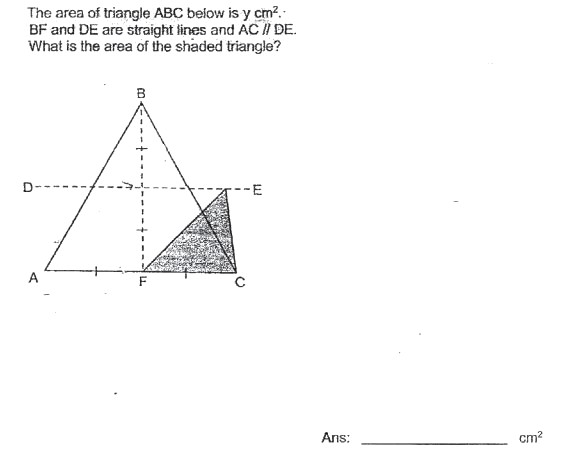
Question
primary 6 | Maths
2 Answers Below
Anyone can contribute an answer, even non-tutors.

Please help. Paper 1 Booklet B
Thanks in advance.
Date Posted: 5 years ago
Views: 360

Ans: (¼ y) cm²

¼y, not ¼y².
See 2 Answers
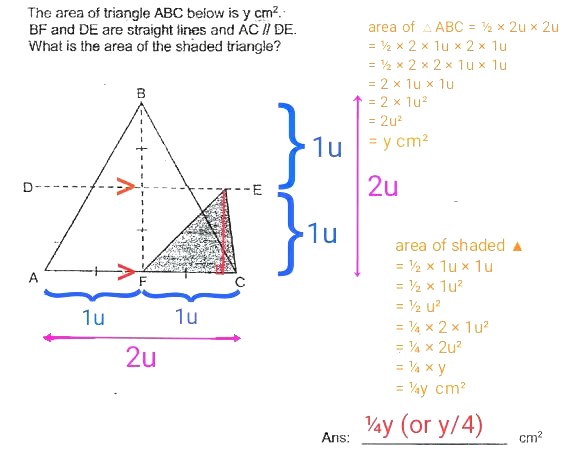
1.We can see that FC = ½ AC since AF = FC (as marked by the dashes)
So the shaded ▲has a base (FC) that is ½ of △ ABC's base (AC)
2.We can see that FB is divided by the line DE into two equal parts, and the height of the shaded ▲ is equal to one of those parts.
(DE is parallel to AC so this means the perpendicular height from a particular point of AC to that on DE doesn't change)
So the shaded ▲has ½ the height (FB) of △ ABC
Since the shaded ▲ has ½ the height and base of △ ABC, it has ½ × ½ of △ABC's area = ¼ of△ABC's area.
So the answer is ¼y cm²
Thanks J
done
{{ upvoteCount }} Upvotes
clear
{{ downvoteCount * -1 }} Downvotes
alternatively , area of shaded ▲ = ½ × (½ × 2u) × (½ × 2u)
= ½ × ½ × ½ × 2u × 2u
= ¼ × (½ × 2u × 2u)
= ¼ × area of △ABC
= ¼y cm²
Date Posted:
5 years ago


 360 Tutoring Program