Ask Singapore Homework?
Upload a photo of a Singapore homework and someone will email you the solution for free.

Question
primary 6 | Maths
| Geometry
3 Answers Below
Anyone can contribute an answer, even non-tutors.

Helpp
Date Posted: 5 years ago
Views: 401
See 3 Answers
360+10=370
370 divide 5 = 74
180-74=106
Ans: 1
370 divide 5 = 74
180-74=106
Ans: 1

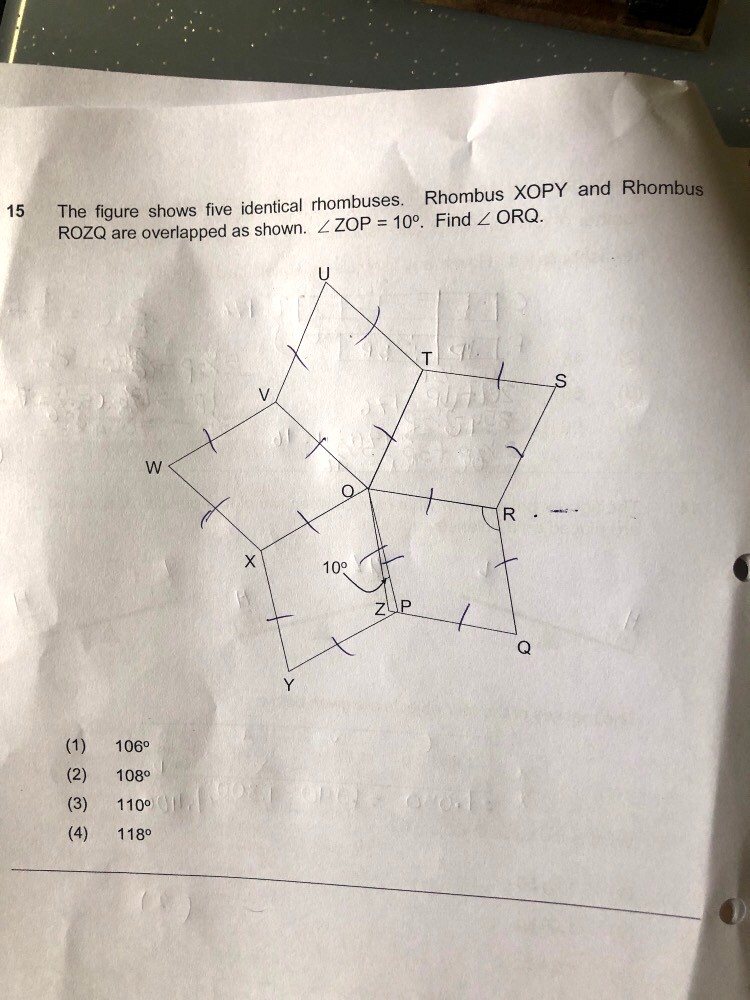
Sum of angles at a point = 360°. That's the total of 5 acute angles in the middle.
Now there is an overlap of 10° for the bottom two rhombuses. So it's not two full identical acute angles there.
Add 10° to get two full identical angles for the bottom part.
360° + 10° = 370°
Now this is the total of 5 identical acute angles.
370° ÷ 5 = 74° (1 of those acute angles)
So angle ZOR = 74°
∠ ORP = 180° - 74° = 106°
Reason : interior angles , QR//ZQ
Or
Angles between parallel lines add up to 180°

Alternative way of thinking :
If the 5 rhombuses had fit perfectly into the middle, then each acute angle would only be :
360° ÷ 5 = 72°
But there is an overlap of 10°
So this means that each rhombus' acute angle must be wider than 72° to cause this overlap.
Since there are 5 identical rhombuses, each rhombus' acute angle has to be increased by the sme amount.
We can divide this 10° overlap equally amomg them.
10° ÷ 5 = 2°
So each rhombus must be 2° more than 72°
i.e it would cause a 2° overlap, so 5 rhombuses would cause a 10° overlap altogether.
Rhombus angle = 72° + 2° = 74°
Angle ORQ = 180° - 74° = 106°
Or
Since each acute angle must be widened by 2°, the obtuse angle must be narrowed by 2°
180° - 72° = 108°
108° - 2° = 106°
Alternative way of thinking :
If the 5 identical rhombuses had fit perfectly into the middle, then each acute angle would only be :
360° ÷ 5 = 72°
But there is an overlap of 10°
So this means that each rhombus' acute angle must be wider than 72° to cause this overlap.
Since there are 5 identical rhombuses, each rhombus' acute angle has to be increased by the sme amount.
We can divide this 10° overlap equally among them.
10° ÷ 5 = 2°
So each rhombus' acute angle must be 2° more than 72°
i.e one rhombus would cause a 2° overlap, so 5 identical rhombuses would cause a 10° overlap altogether.
Rhombus angle = 72° + 2° = 74°
Angle ORQ = 180° - 74° = 106°
Or
Since each acute angle must be widened by 2°, the obtuse angle must be narrowed by 2°
180° - 72° = 108°
108° - 2° = 106°


 360 Tutoring Program