Ask Singapore Homework?
Upload a photo of a Singapore homework and someone will email you the solution for free.

Question
primary 6 | Maths
3 Answers Below
Anyone can contribute an answer, even non-tutors.

Thank you
Date Posted: 5 years ago
Views: 504
See 3 Answers
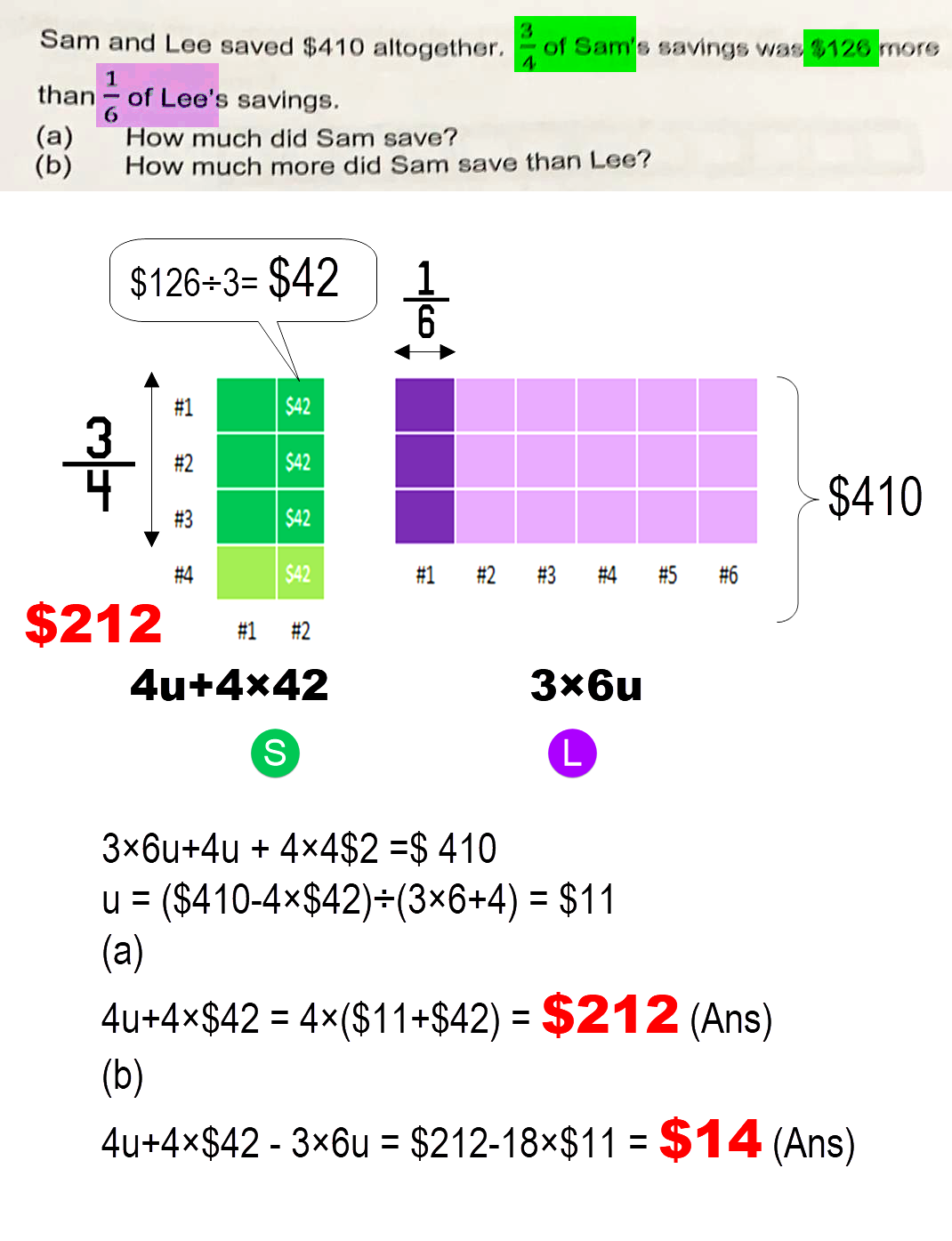
Easy. Idea is to make the units of one size only.
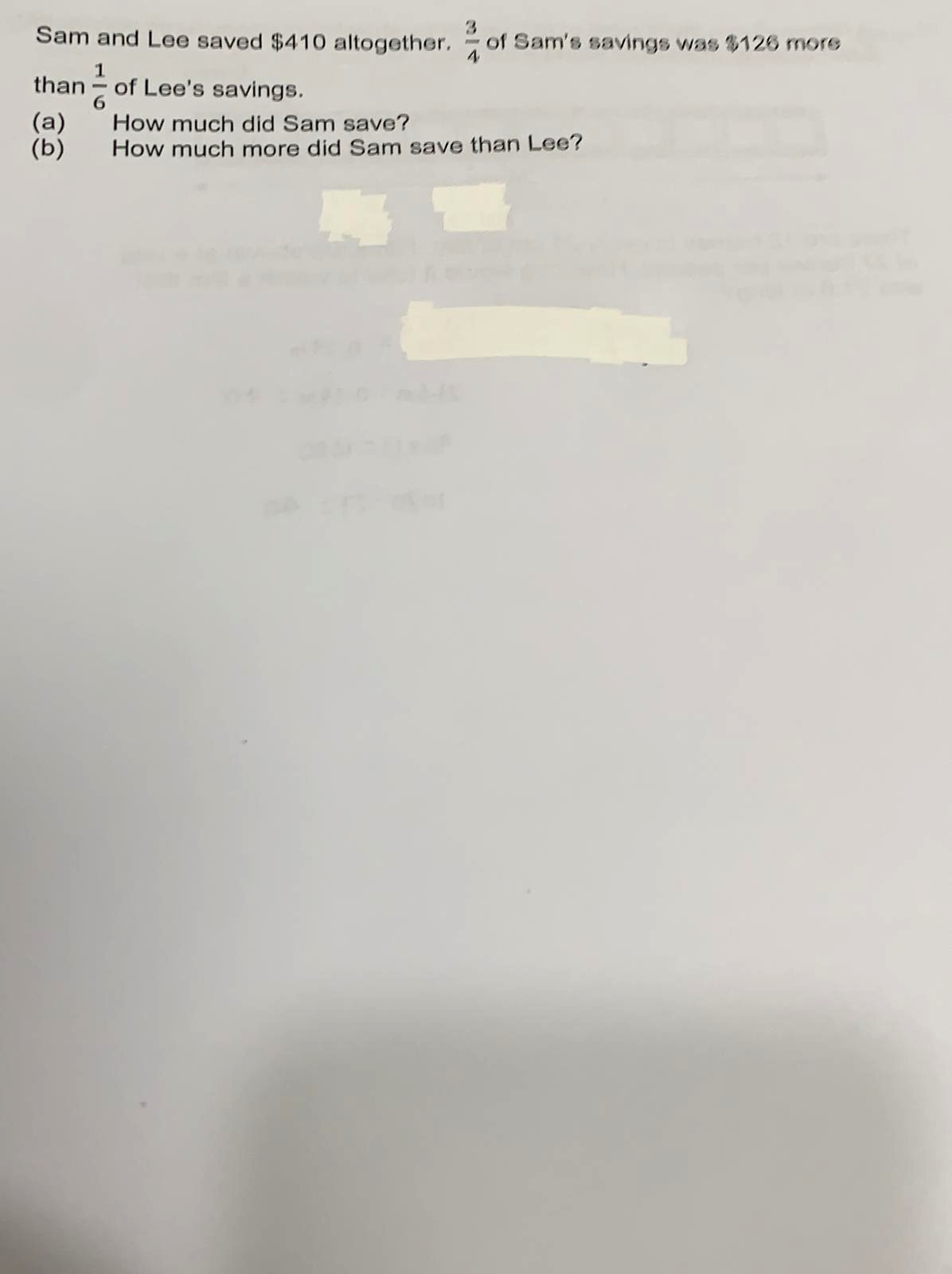
Since 3/4 of Sam's savings = 1/6 of Lee's savings + $126,
We want to change this 1 unit for Lee's to 3 such that we can then add $126. Then, this can be divided exactly by 3 to get 1/4 of Sam's savings, followed by multiplying by 4 to get Sam's total.
1/6 = 3/18 (multiply both numerator and denominator by 6)
So we can let Lee's savings be 18 units
Then, 3/4 of Sam's savings = 3 units + $126 = 3 × (1 unit + $42)
(Because $126 ÷ 3 = $42. It is exactly divisible by 3)
Sam's savings = 4 × (1 unit + $42) = 4 units + $168
Their total savings = 4 units + $168 + 18 units = 22 units + $168
So 22 units + $168 = $410
22 units = $410 - $168 = $242
1 unit = $242 ÷ 22 = $11
Sam's savings = 4 × $11 + $168 = $44 + $168 = $212
b) Lee's savings = 18 × $11 = $198
Difference = $212 - $198 = $14
Sam saved $14 more than Lee.
Thanks for the answer. But don't really understand...

I will upload a diagram in about 20 min.
you see if you can understand it.
you see if you can understand it.
Thank you so much for going extra mile!!
Just uploaded (it's another method)
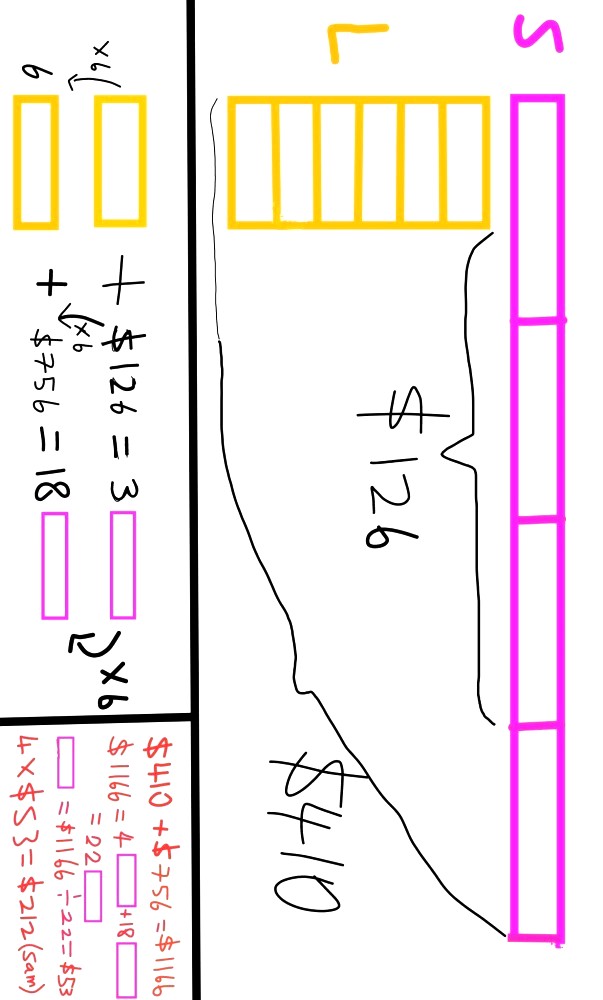
For the approach here, you can see Sstrike's model, which basically illustrates what I was talking about.
For the approach here, you can see Sstrike's model, which basically illustrates what I was talking about.

done
{{ upvoteCount }} Upvotes
clear
{{ downvoteCount * -1 }} Downvotes
This is another approach. Basically by adding $126, you can convert 1 of Lee's unit to 3 of Sam's units.
Converting all gives 18 of Sam's, and add to Sam's 4 units gives a total of 22 units. This is equal to $410 + $126 × 6 = $1166. The rest follow the working.
b) Lee's savings = $410 - $212 = $198
Their difference = $212 - $198 = $14
Converting all gives 18 of Sam's, and add to Sam's 4 units gives a total of 22 units. This is equal to $410 + $126 × 6 = $1166. The rest follow the working.
b) Lee's savings = $410 - $212 = $198
Their difference = $212 - $198 = $14
Date Posted:
5 years ago
Thanks much. I think this way is easier to comprehend by taking 126x6 to make it same. Appreciate with thanks
Yea, I think it's easier too. Welcome


 360 Tutoring Program