Ask Singapore Homework?
Upload a photo of a Singapore homework and someone will email you the solution for free.


Question
secondary 3 | A Maths
2 Answers Below
Anyone can contribute an answer, even non-tutors.

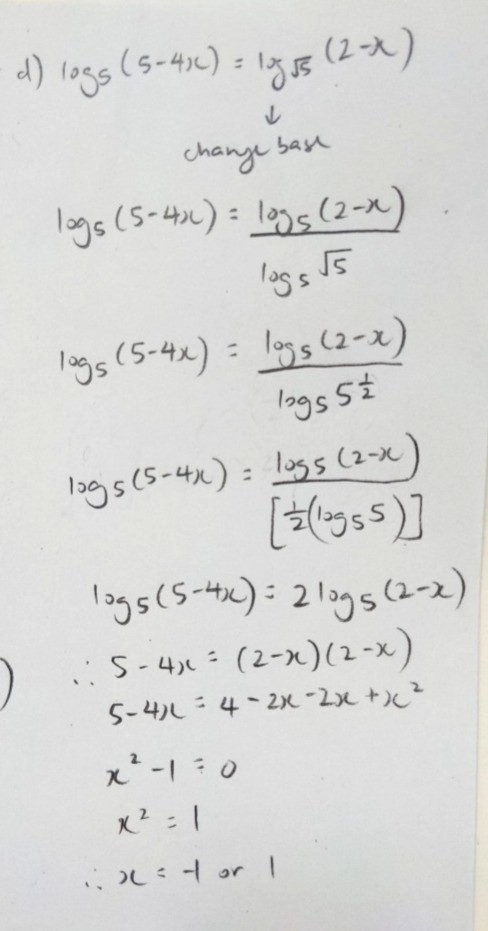
Need help for this question. Thank You
Date Posted: 5 years ago
Views: 243
See 2 Answers
Change the base to a common one, eg. ln for both sides first.
ln (5 - 4x) / ln 5 = ln (2 - x) / ln √5
ln (5 - 4x) / ln 5 = ln (2 - x) / ln 5¹/²
ln (5 - 4x) / ln 5 = ln (2 - x) / ½ln 5 = 2ln (2 - x) / ln 5
ln (5 - 4x) = 2 ln (2 - x)
ln (5 - 4x) = ln (2 - x)²
Since both sides are single terms and have the same log base, then their arguments/values are equal.
5 - 4x = (2 - x)²
5 - 4x = 4 - 4x + x²
x² = 1
x = 1 or - 1
But is there any alternative way to solve, like without changing to ln?

You can change it to any base, not just ln.
Alternatively, you could immediately recognise that log√5 (2 - x) = log5 (2 - x)² and rewrite the former as the latter,
i.e
log5 (5 - 4x) = log√5 (2 - x) = log5 (2 - x)²
Then compare the arguments/values since both sides have the same base.
Why can we rewrite this?
Because,
Let log√5 (2 - x) = n
2 - x = (√5)ⁿ = (5¹/²)ⁿ = 5ⁿ/²
Square both sides,
(2 - x)² = (5ⁿ/²)²
(2 - x)² = 5ⁿ
Bring down the exponent, you get
log5 (2 - x)² = n
So the two terms are equal.
Ok. Thank You
This also means one thing :
log√5 (2 - x) = 2 log5 (2 - x)
So, if we change the base by squaring, we multiply the expression by 2.
Likewise,
log³√5 (2 - x) = 3 log5 (2 - x)
Cubing the base, and multiplying the expression by 3.
In essence, this is a shortcut.
Changing the base by changing the power/exponent means we also
①multiply the expression by the same coefficient as the power,
or
② changing the power/exponent of the argument by the same number.
done
{{ upvoteCount }} Upvotes
clear
{{ downvoteCount * -1 }} Downvotes

Hope this helps!
Date Posted:
5 years ago
Thank You


 360 Tutoring Program