Ask Singapore Homework?
Upload a photo of a Singapore homework and someone will email you the solution for free.


Question
secondary 4 | E Maths
One Answer Below
Anyone can contribute an answer, even non-tutors.

Hi can someone pls help me understand why even tho (x^2+1)^-1/2 has been factored out (x^2+1)^1/2 still remains in the equation?
Also, after factoring out (x^2+1)^-1/2 shouldn’t the power become -1 since 1/2 divide -1/2 is -1
I’m really confused do help me understand this thank u so much!!
Date Posted: 5 years ago
Views: 320

Law of indices.
(aᵐ)(aⁿ) = aᵐ⁺ⁿ
aᵐ/aⁿ = aᵐ⁻ⁿ
(aᵐ)(aⁿ) = aᵐ⁺ⁿ
aᵐ/aⁿ = aᵐ⁻ⁿ
So here, factoring out (x²+1)⁻¹/² is basically writing the factor and then dividing the original term by it.
Eg. If you were to factor out 5 from 10 ,
10
= 5 (10 ÷ 5)
= 5(2) or 5 × 2
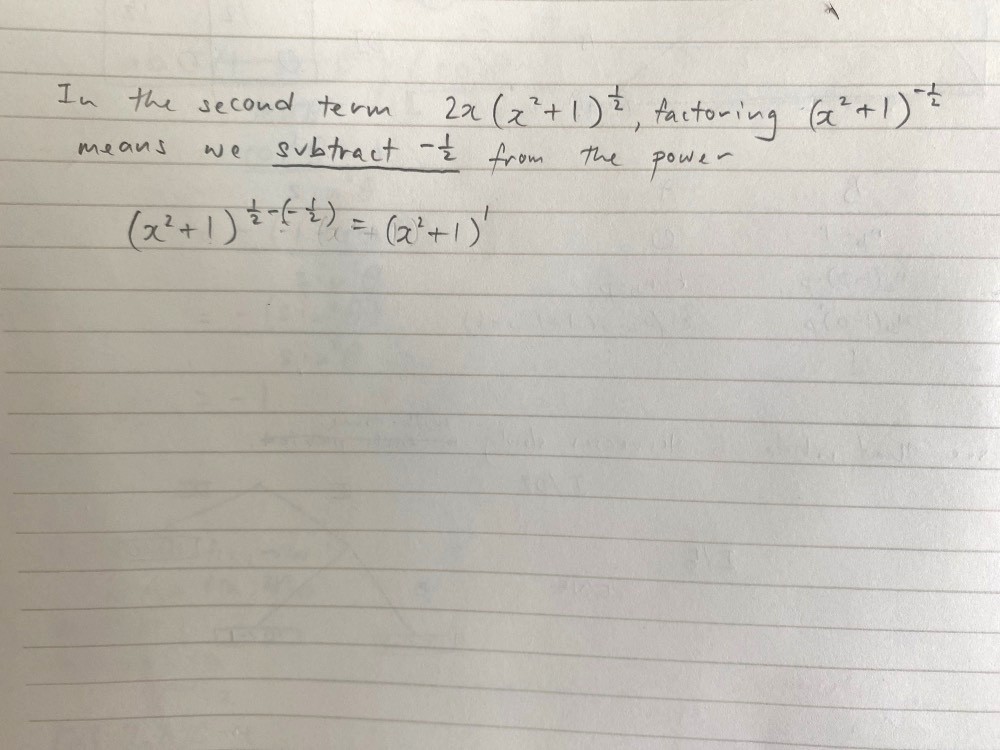
This means that the term 2x(x² + 1)¹/² becomes :
2x(x² + 1)⁻¹/² [ (x² + 1)¹/² ÷ (x² + 1)⁻¹/²⁾ ]
And when you divide by a term with the same base, the power/index is subtracted.
= 2x(x² + 1)⁻¹/² (x² + 1)¹/² ⁻ ⁽⁻¹/²⁾
= 2x(x² + 1)⁻¹/² (x² + 1)¹
= 2x(x² + 1)⁻¹/² (x² + 1)
If you apply back the law of indices (the addition one) back on this final expression you will get back the original expression.
We don't divide ½ by -½ here.
Dividing powers or multiplying powers is done when you are finding higher powers or finding roots.
(aᵐ)ⁿ = aᵐ×ⁿ = aᵐⁿ
ⁿ√aᵐ = aᵐ÷ⁿ = aᵐ/ⁿ
Dividing powers or multiplying powers is done when you are finding higher powers or finding roots.
(aᵐ)ⁿ = aᵐ×ⁿ = aᵐⁿ
ⁿ√aᵐ = aᵐ÷ⁿ = aᵐ/ⁿ
See 1 Answer
done
{{ upvoteCount }} Upvotes
clear
{{ downvoteCount * -1 }} Downvotes

Jiayou
Date Posted:
5 years ago
U literally just enlightened me thank you sooo much


 360 Tutoring Program