Ask Singapore Homework?
Upload a photo of a Singapore homework and someone will email you the solution for free.

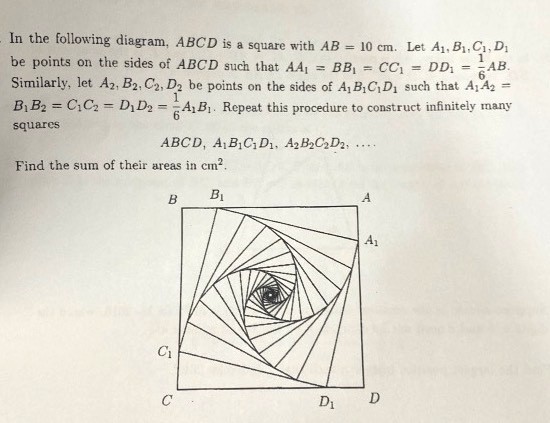
Question
secondary 4 | A Maths
One Answer Below
Anyone can contribute an answer, even non-tutors.

please help, thank you!!
Date Posted: 5 years ago
Views: 224

AB1
= AB - BB1
= AB - 1/6 AB
= 5/6 AB
Area of A1B1C1D1
= Area of ABCD - 4 triangles
= (AB)² - 4 × ½ × base × height of 1 triangle
= (AB)² - 2 × AB1 × AA1
= AB² - 2 × 5/6 AB × 1/6 AB
= AB² - 5/18 AB²
= 13/18 AB²
(13/18 of ABCD)
Likewise,
Area of A2B2C2D2
= 13/18 of A1B1C1D1
= 13/18 × 13/18 AB²
= (13/18)² AB²
Similarly,
Area of A3B3C3D3
= 13/18 of A2B2C2D2
= 13/18 × (13/18)² AB²
= (13/18)³ AB²
This shows that each square always has an area that is 13/18 of the previous square's area.
Summing up all the squares, we have :
AB² + 13/18 AB² + (13/18)² AB² + (13/18)³ AB² + ...
all the way to infinity.
= AB² (1 + 13/18 + (13/18)² + (13/18)³ + ...)
= (10cm)² (1 + 13/18 + (13/18)² + (13/18)³ + ...)
= (100cm²) (1 + 13/18 + (13/18)² + (13/18)³ + ...)
The terms in the brackets make up the sum to infinity of a geometric series, with first term a = 1 and common ratio r = 13/18
Using the formula for sum to infinity S∞ = a/(1 - r),
We have the total area
= (100cm²)(1/(1 - 13/18))
= (100cm²)(1 / 5/18)
= 100cm² × 18/5
= 360cm²
Alternatively, use Pythagoras Theorem on one of the triangles.
(AB1)² + (AA1)² = (A1B1)²
(5/6 AB)² + (1/6 AB)² = area of A1B1C1D1
25/36 AB² + 1/36 AB² = area of A1B1C1D1
26/36 AB² = 13/18 AB² = area of A1B1C1D1
Then, the pattern goes the same way as before.
(AB1)² + (AA1)² = (A1B1)²
(5/6 AB)² + (1/6 AB)² = area of A1B1C1D1
25/36 AB² + 1/36 AB² = area of A1B1C1D1
26/36 AB² = 13/18 AB² = area of A1B1C1D1
Then, the pattern goes the same way as before.
See 1 Answer
Explanation in main comments.


 360 Tutoring Program