Ask Singapore Homework?
Upload a photo of a Singapore homework and someone will email you the solution for free.

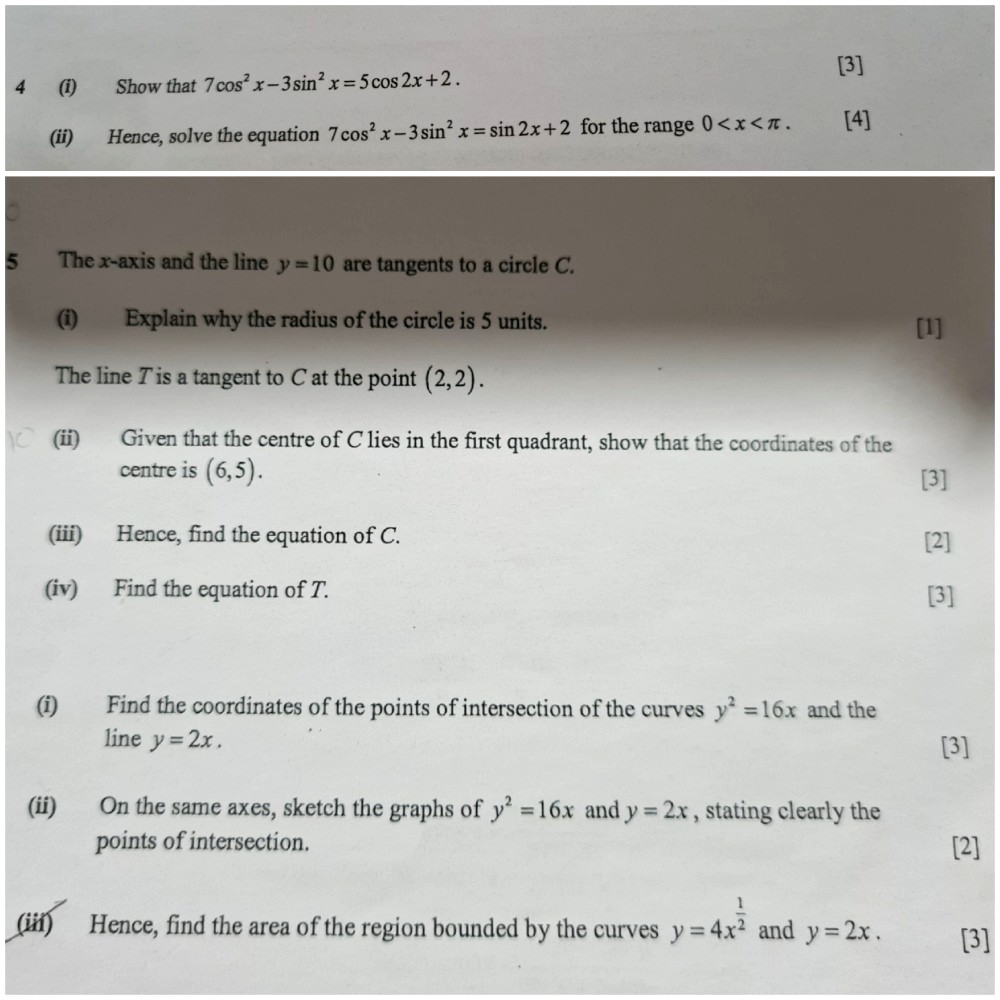
Question
secondary 4 | A Maths
No Answers Yet
Anyone can contribute an answer, even non-tutors.

need help with 4(ii),5(ii) and 6(ii)
Date Posted: 5 years ago
Views: 454

5ii
Clearly (2, 2) is the centre of the circle while (x, 5) is the centre of the circle of radius 5 units, since the lines y = 0 and y = 10 are tangents to the circle
The length of the radius is 5 cm, so
(x - 2)² + (5 - 2)² = 5²
(x - 2)² + 9 = 25
(x - 2)² = 16
x - 2 = 4 or -4
x = 6 or -2
Since the centre of C lies in the first quadrant, x = 6 so the centre of the circle is (6, 5).
4ii
7 cos²x - 3 sin²x = sin 2x + 2
Using part i results, we can replace 7 cos²x - 3 sin²x by 5 cos 2x + 2, so
5 cos 2x + 2 = sin 2x + 2
5 cos 2x = sin 2x
5 = sin 2x / cos 2x
tan 2x = 5
0 < x < π implies 0 < 2x < 2π, so we are looking for angles of 2π between 0 and 2π.
Basic angle, alpha
= taninv 5
= 1.373400767
~ 1.37 rad
2x = 1st quad or 3rd quad
2x = alpha or π + alpha
2x = 1.373400767 or 4.514993421
x = 0.6867003835 or 2.25749671
x ~ 0.687 rad or 2.26 rad
6ii not in syllabus
I won't be answering questions for some time from now
I won't be answering questions for some time from now
thx :) for 5(ii) what do they mean when they say "centre of circle lies in first quadrant" tho
and what can we infer from the info
and what can we infer from the info
This means that the x- and y- coordinates of the centre are both positive
And once you find the centre, you are able to find the equation of the circle and the gradient of the line connecting (2, 2) and the centre (6, 5).
hi mr eric , may i ask whether you are able to recommend any good study tips? as i am unable to handle the heavy workload in secondary 4...
Sec 4 workload is indeed tough as the topics are more difficult than Sec 3 topics. There is no right or wrong method to deal with the workload, but then there are better ones and there are not as good ones.
If you are taking mother tongue in school (I cannot assume this since I have three students who do not take mother tongue), I suggest you clear it early with a good score when the O Level exams come at the end of this month. In this way, you do not have to retake it as a subject for the end of year exams since you would have fulfilled the mother tongue requirement for the O Levels.
If you are taking mother tongue in school (I cannot assume this since I have three students who do not take mother tongue), I suggest you clear it early with a good score when the O Level exams come at the end of this month. In this way, you do not have to retake it as a subject for the end of year exams since you would have fulfilled the mother tongue requirement for the O Levels.
Once this is settled, you might have other subjects. Supposing you take 7 subjects including mother tongue (the norm is 7 subjects, students in better schools take 8 subjects).
- English
- Combined or Pure Humanities
- A Maths
- E Maths
- Chemistry
- One other science
- Mother Tongue
You need to allocate some days to study. Since it’s the HBL period (unless somehow you are not enrolled in a government school) and then it’s the June holidays next month, you would have more time at home.
You might be looking at six days of studying a week and one rest day.
Depending on whether you study as minimally as possible or you spend the whole day studying, you might have different needs. I recommend studying around 3 hours a day during school days and 5 hours a day on other days , where you might be looking at two subjects on a given day. Give yourself one rest day as well.
A typical schedule that could happen is this. Let’s say you are taking English, Combined History, E Maths, A Maths, Chemistry, Physics and another Tongue.
Of course, put focus on mother tongue first (O Level exams come at the end of the month). After that, this could happen, for example. Try not to study two maths, two sciences or english/humanities subjects on the same day where possible, so that it will not be too boring studying similar subjects.
Day 1: English + E Maths + Chemistry
Day 2: History + Physics
Day 3: SS + A Maths
Day 4: English + E Maths + Chemistry
Day 5: History + Physics
Day 6: SS + A Maths
Day 7: Rest Day
This is just a typical schedule for the June holidays, and you might tweak them here and there depending on your needs.
For A Maths, review the chapters which you have studied so far, and create notes on small pieces of say A6-sized papers. Keep these notes concise. Try to lump similar topics together, and connect ideas between chapters rather than learn them as separate, independent chapters. For my stronger students, I ask them to study A Maths and E Maths together as a combined Maths subject.
At the moment, review simpler topics like polynomials and partial fractions, discriminant of roots, equations and inequalities, binomial theorem, surds, indices, exponentials and logarithms. This will form the first major branch of A Maths, that is, Algebra and Numbers (as a whole).
Once you are confident, proceed to topics under Geometry (Coordinate Geometry, Linear Law, Equations of Circles, Properties of Circles). However, I recommend studying the E Maths version of properties of circles first, and you might not have reached this topic yet in A Maths, so skip properties of circles first.
Only after you are confident, proceed to Trigonometry and Calculus.
thank you :)!!! is it better to use the holidays to study ahead of school first or fully use the time to revise? dont really know how to manage my time on school days due to the amount of homework given and i have to stayback till late afternoon tho...
by the way whats the difference between scalar and vector quantities? dont really understand what it means when they say the difference between them is that vector quantities have direction
Depends on your workload and your performance in school.
- If you have been scoring A1 all along consistently and you have understood concepts thoroughly, I advise my students to proceed to future topics
- For all other grades including A2, I suggest reviewing past topics first. This is because an A1 in maths for school exams does not automatically translate to A1 in the O Level, especially if the A1 scorer actually scores consistently between 75 and 80 marks and the O Level’s A1 score is set to say 85.
- If the workload is too great, then I suggest not overburdening yourself, so you should prioritise homework.
A scalar quantity is basically a quantity which only depends on numbers. For example, regardless of where a person lives, walking 1 km means walking that much distance - you are using your feet, step by step, to walk 1 km.
A vector quantity depends on direction too - the direction could be the difference between you walking to school and you ending up in a stadium.
A vector quantity depends on direction too - the direction could be the difference between you walking to school and you ending up in a stadium.
thx :) what is the best way to study for chemistry and geography tho
Chemistry you cannot ignore topics because the topics are all interlinked together. Grasp the basic knowledge of chemistry first, and this includes the following.
- Balancing Equations
- Ionic Equations
- Solubility List
- Reactivity Series
- Atomic Structure
- Chemical Bonding
From there, start looking deeper into others such as acids bases salts, speed of reaction, redox etc.
- Balancing Equations
- Ionic Equations
- Solubility List
- Reactivity Series
- Atomic Structure
- Chemical Bonding
From there, start looking deeper into others such as acids bases salts, speed of reaction, redox etc.
Geography I am not sure as I am not a geography tutor.
thx :)
btw how do you do this vector question?
QR + RS + _ = PS (not sure how to insert the arrow on top of the letters...)
btw how do you do this vector question?
QR + RS + _ = PS (not sure how to insert the arrow on top of the letters...)
QR + RS + ? = PS
QR + RS means “going from Q to R, and then from R to S”. This is as good as “going from Q to S directly”, so QR + RS = QS in vector addition.
QS + ? = PS
If I rearrange this, it’s easier to see.
? + QS = PS
Clearly the end points are S, so the start point must be ... P.
? must have been PQ.
QR + RS means “going from Q to R, and then from R to S”. This is as good as “going from Q to S directly”, so QR + RS = QS in vector addition.
QS + ? = PS
If I rearrange this, it’s easier to see.
? + QS = PS
Clearly the end points are S, so the start point must be ... P.
? must have been PQ.
thx :) when to use subtraction and addition of vectors tho, i dont really understand whats the difference between them when solving triangle questions...
If you subtract a vector PQ, you can count i as adding the vector QP instead.
For some reason, this is what I always do when I see negative vectors.
For some reason, this is what I always do when I see negative vectors.

 360 Tutoring Program