Ask Singapore Homework?
Upload a photo of a Singapore homework and someone will email you the solution for free.

Question
secondary 3 | A Maths
One Answer Below
Anyone can contribute an answer, even non-tutors.
I need help with part (ii)
Date Posted: 5 years ago
Views: 456

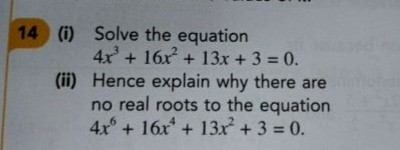
From i) you would have gotten :
(x + 3)(2x + 1)² = 0
x = -3 or x = -½
(x + 3)(2x + 1)² = 0
x = -3 or x = -½
For ii),
4x6 + 16x⁴ + 13x² + 3 = 0
Realise that this can be rewritten as :
4(x²)³ + 16(x²)² + 13x² + 3 = 0
The equation is very similar to i), just that we have x² instead of x.
4x6 + 16x⁴ + 13x² + 3 = 0
Realise that this can be rewritten as :
4(x²)³ + 16(x²)² + 13x² + 3 = 0
The equation is very similar to i), just that we have x² instead of x.
oh I think I got it, thank you!
So all we have to do is to replace the variable x with x² to solve the equation.
This works out to be :
(x² + 3)(2x² + 1)² = 0
x² = -3 or x² = -½
(Rejected as x² ≥ 0 for real values of x. The square of a real value can only be 0 or positive)
Therefore, there are no real roots
This works out to be :
(x² + 3)(2x² + 1)² = 0
x² = -3 or x² = -½
(Rejected as x² ≥ 0 for real values of x. The square of a real value can only be 0 or positive)
Therefore, there are no real roots
Alternately,
Once you have gotten that :
(x² + 3)(2x² + 1)² = 0
Explain with the following :
x² ≥ 0 for all real values of x
So 2x² + 1 ≥ 1 and x² + 3 ≥ 3 for all real values of x
Which means 2x² + 1 > 0 and x² + 3 > 0 for all real values of x
Since both terms are always positive, their product has to be positive and can never equal 0.
i.e
(x² + 3)(2x² + 1)² > 0 for all real values of x
The entire graph is above the x-axis (on which y = 0) for all real values of x.and does not intersect it.
So there is no real root for (x² + 3)(2x² + 1)² = 0
thank youu :)

Woah I had the exact same qn thanks!!!!!!

Thanks this helped so much
See 1 Answer
See main comments for working and explanation


 360 Tutoring Program