Ask Singapore Homework?
Upload a photo of a Singapore homework and someone will email you the solution for free.

Question
secondary 4 | A Maths
One Answer Below
Anyone can contribute an answer, even non-tutors.

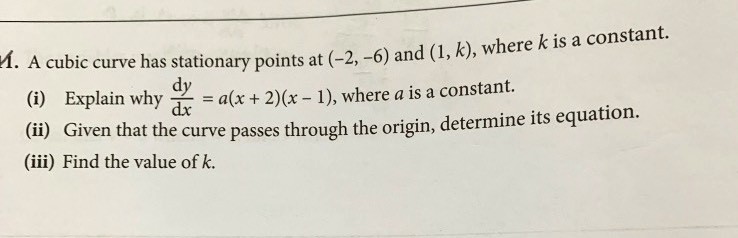
Can anyone help me with this question please? Thankss!
Date Posted: 5 years ago
Views: 314

Since there are two stationary points at x = -2 and x = 1, the solutions to the equation dy/dx = 0 are
x = -2 or x = 1
x + 2 = 0 or x - 1 = 0
(x + 2) (x - 1) = 0
a (x + 2) (x - 1) = 0 since there are multiple equations giving rise to the solutions x = -2 or x = 1
The original equation for dy/dx did not equate to zero (it was made zero just to simply locate the coordinates of the stationary points)
dy/dx = a (x + 2) (x - 1)
dy/dx = a (x + 2) (x - 1)
dy/dx = a (x² - x + 2x - 2)
dy/dx = a (x² + x - 2)
Integrating,
y = a (⅓ x³ + ½ x² - 2x) + c where c is a constant of integration
Since the curve passes through the origin (0, 0),
0 = a (0 + 0 - 0) + c
c = 0
y = a (⅓ x³ + ½ x² - 2x)
Since the curve also passes through the stationary point (-2, -6),
-6 = a [⅓ (-2)³ + ½ (-2)² - 2(-2)]
-6 = a [⅓ (-8) + ½ (4) + 4)
-6 = a [-8/3 + 2 + 4]
-6 = a (10/3)
-18 = 10a
a = -9/5
Thus, the equation of the curve is given by
y = -9/5 (⅓ x³ + ½ x² - 2x)
y = -3/5 x³ - 9/10 x² + 18/5 x
Since the curve also passes through the stationary point (1, k),
k = -3/5 (1)³ - 9/10 (1)² + 18/5 (1)
k = 21/10
Thanks alot!
See 1 Answer


 360 Tutoring Program