Ask Singapore Homework?
Upload a photo of a Singapore homework and someone will email you the solution for free.

Question
secondary 4 | A Maths
One Answer Below
Anyone can contribute an answer, even non-tutors.

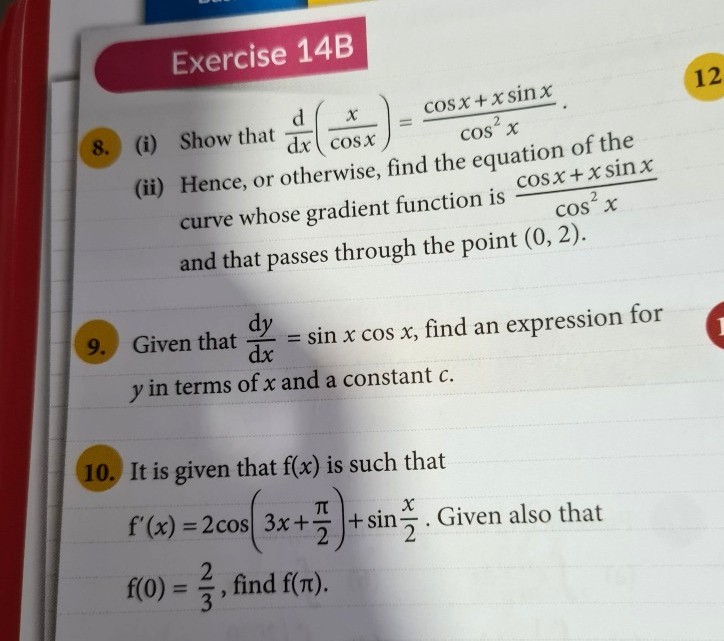
need help with these qns, pls explain too
Date Posted: 5 years ago
Views: 252

For Q9, use double angle formula
I lost track of which questions I have yet to do, so I won’t be doing them anymore for now
I lost track of which questions I have yet to do, so I won’t be doing them anymore for now
are you able to see the notification comments i made on the previous answers? as i recently asked some questions about the answers
but for question 9 why cant it be dy/dx = sinxcosx
y= -cosxsinx tho
y= -cosxsinx tho
Because integration does not work that way.
Try differentiating the result.
Try differentiating the result.
if we are integrating en exponential function without an x (eg e^-pi/2), will it equate to 0 as it is a constant?
It will be the same function, with an x behind.
Integrating 4 gives us 4x
Integrating 7.5 gives us 7.5x
Integrating cos 7 gives us (cos 7) x
And so on.
Integrating 4 gives us 4x
Integrating 7.5 gives us 7.5x
Integrating cos 7 gives us (cos 7) x
And so on.
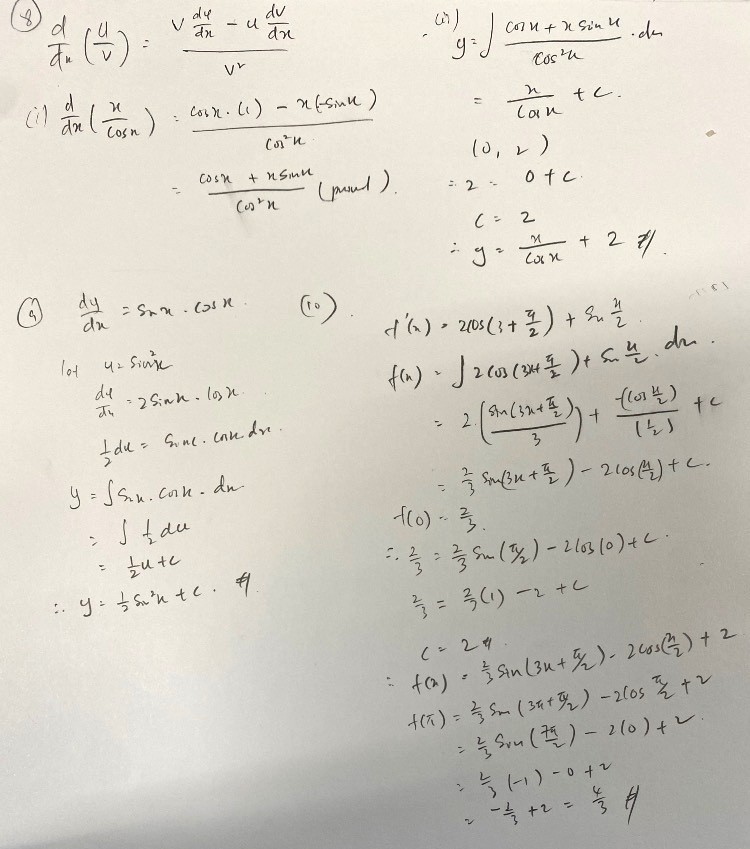
for qn8(ii), i dont really know how to integrate the expression there..
also dont understand what is the tutor doing at qn9
also dont understand what is the tutor doing at qn9
are you able to see the notification comments i made on the previous answers? as i recently asked some questions about the answers
I could not find which ones for the moment
I could not find which ones for the moment
8ii
Because of the result in part (i), the expression in part (ii) integrates back to the result in part i. Look carefully, the expressions are identical.
This type of question is what I call "differentiate hence integrate".
9
I would rather you use double-angle formula before you integrate the expression. Do not do what the tutor did at your level as it requires you to foresee the result in advance (this is more suitable for JC).
thx :) btw why is this factorisation not acceptable :
e^3x(3cos3x-3sin3x)+(sin3x+cos3x)(3e^3x)
= (e^3x)(sin3x+cos3x)(3-3+3)
e^3x(3cos3x-3sin3x)+(sin3x+cos3x)(3e^3x)
= (e^3x)(sin3x+cos3x)(3-3+3)
Because factorisation does not work that way.
It’s like saying
(x + y) + (x - y)
does not become
(x + y) (1 - 1)
It’s like saying
(x + y) + (x - y)
does not become
(x + y) (1 - 1)
still dont really understand the part for factorising sinx and cosx tho...
btw for 3/5ln(2x+3)-3/5ln(x-1), will the 3/5 cancel out each other and equate to ln(2x+3/x-1)
What you are doing is similar to doing
3x + 3y + x - y
= (x + y) (3 - 1)
which is not the case.
Because of the + and the -, both expressions (sin 3x + cos 3x) and (sin 3x - cos 3x) are not the same thing - we cannot factor out the sin 3x and cos 3x in such a manner.
Try expanding your factorised expression and you will find that the expanded form is probably not what it should be.
You can only factor out 3/5.
You cannot cancel the 3/5 because this is an expression.
Cancelling 3/5 would be like doing this.
8x + 12y
= 4 (2x) + 4 (3y)
= 2x + 3y
You cannot cancel the 3/5 because this is an expression.
Cancelling 3/5 would be like doing this.
8x + 12y
= 4 (2x) + 4 (3y)
= 2x + 3y
thx :)
how to integrate a function which has x^-1 tho, because the function if integrate it will become x^0 which equates to 1...
for example integrating ∫^4 1 (5/ sqrt1) dx
for example integrating ∫^4 1 (5/ sqrt1) dx
This one is power -1/2, not -1.
If the power is -1, it’s a little special.
Think of something you have learned before in differentiation: what thing differentiates to become 1/x?
If the power is -1, it’s a little special.
Think of something you have learned before in differentiation: what thing differentiates to become 1/x?
See 1 Answer
done
{{ upvoteCount }} Upvotes
clear
{{ downvoteCount * -1 }} Downvotes

Please check
Date Posted:
5 years ago


 360 Tutoring Program