Ask Singapore Homework?
Upload a photo of a Singapore homework and someone will email you the solution for free.


Question
secondary 4 | A Maths
3 Answers Below
Anyone can contribute an answer, even non-tutors.

help tyssmm
Date Posted: 5 years ago
Views: 266

are there any limits to c? or x or y?

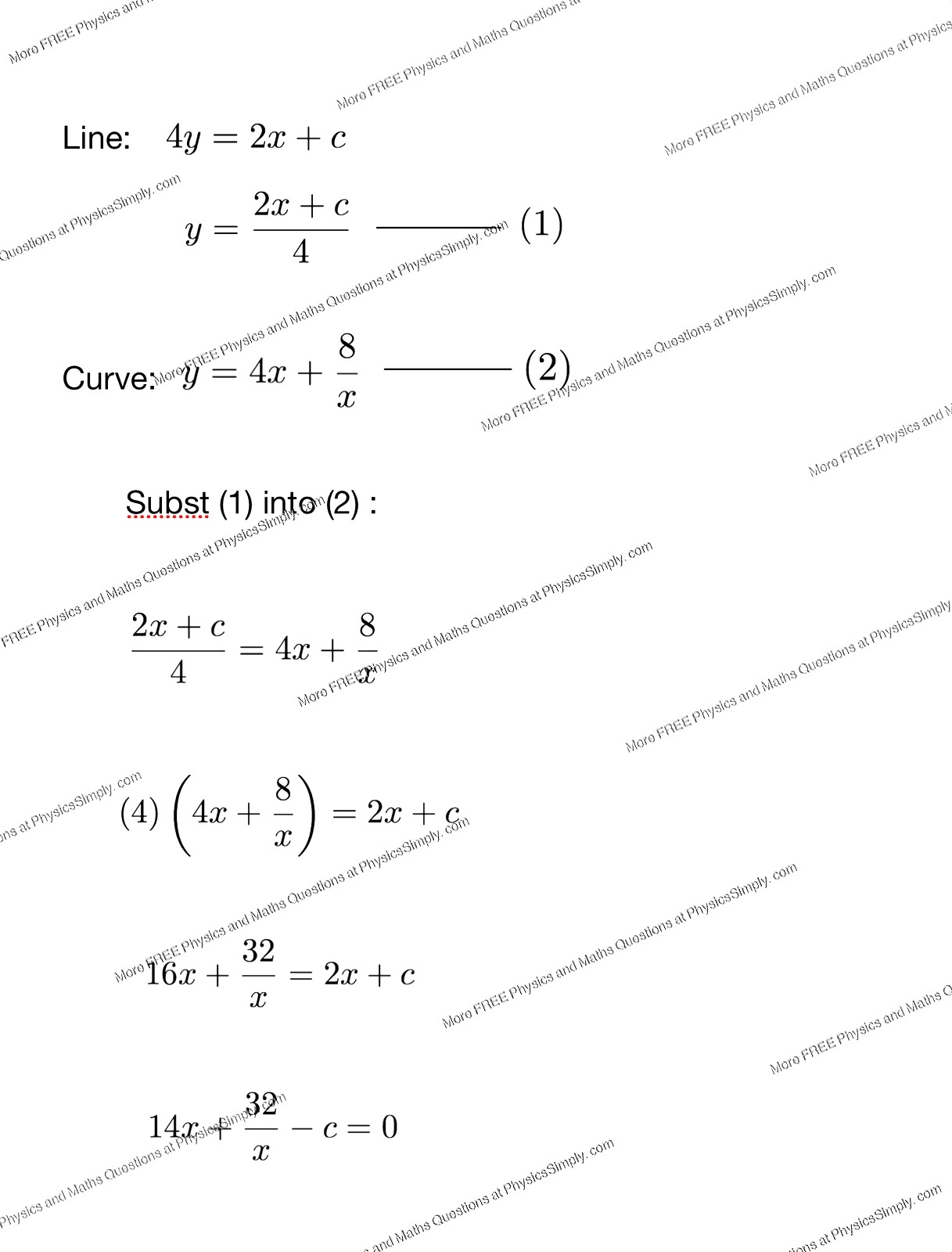
If the line is to be a tangent to the curve, it means the line intersects the curve at only 1 point.
4y = 2x + c ①
y = 4x + 8/x ②
Sub ② into ①,
4(4x + 8/x) = 2x + c
16x + 32/x = 2x + c
Multiply throughout by x,
16x² + 32 = 2x² + cx
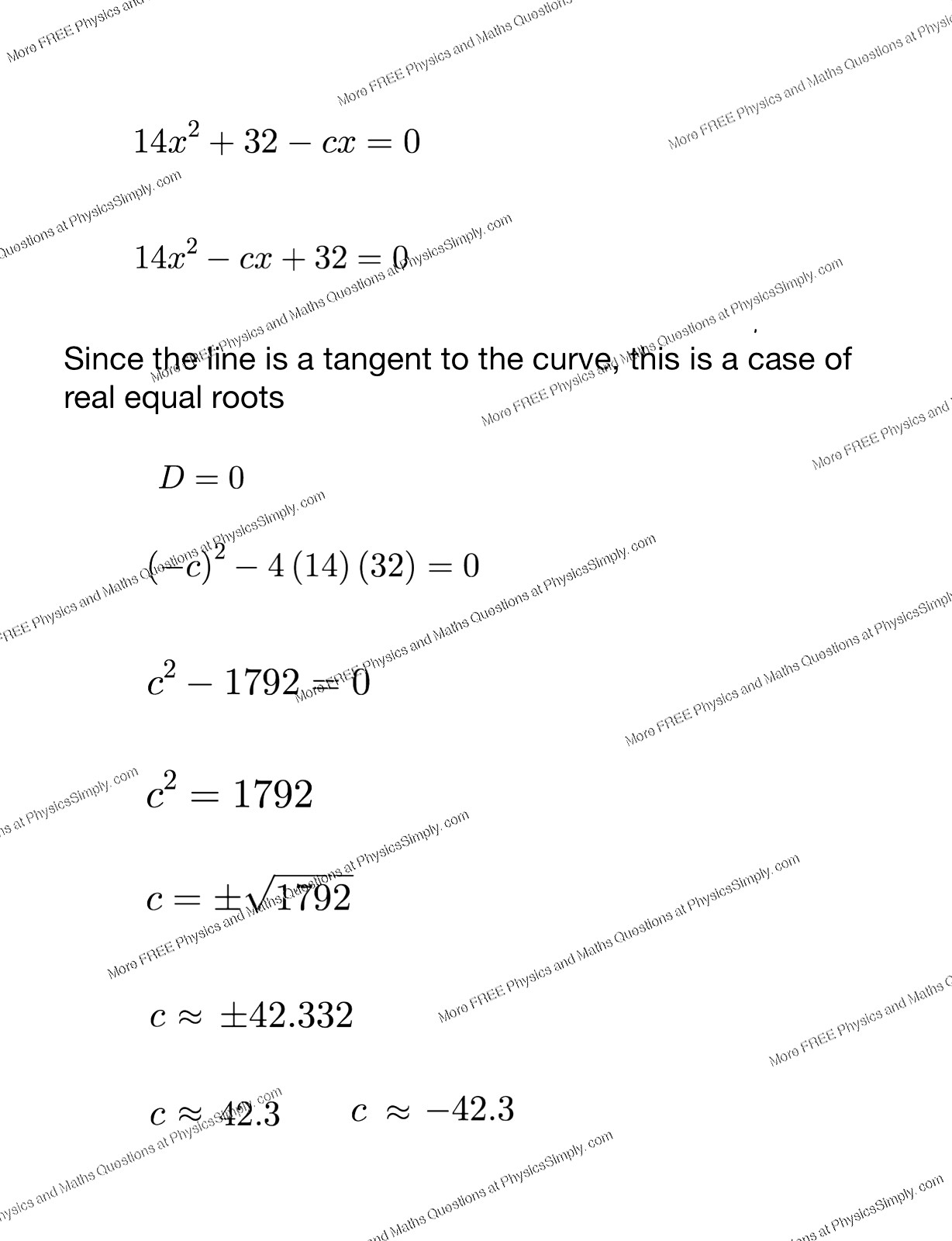
14x² - cx + 32 = 0
When we solve quadratic equations, intersection at 1 point means the roots are real and repeated.
The discriminant 'b² - 4ac' = 0
So,
(-c)² - 4(14)(32) = 0
c² - 1792 = 0
c² = 1792
c = ± √1792
c = ± √(256 × 7)
c = ± √256 √7
c = ± 16√7
Alternatively,
16x + 32/x = 2x + c
14x + c + 32/x = 0
From the original equations, x cannot be 0 as that would make 8/x undefined, since division by 0 is undefined.
This means that y = 4x + 8/x would be undefined and so it tells us that there are no points on the curve where x = 0
Then, since x is non-zero, multiplying 14x + c + 32/x (which = 0) by x will still be 0
x(14x + c + 32/x) = 0
14x² - cx + 32 = 0
Solve accordingly.
See 3 Answers
done
{{ upvoteCount }} Upvotes
clear
{{ downvoteCount * -1 }} Downvotes
Page 2 of 2
Hope this helps!
Hope this helps!
Date Posted:
5 years ago
Answer in main comments
done
{{ upvoteCount }} Upvotes
clear
{{ downvoteCount * -1 }} Downvotes
Page 1 of 2
Date Posted:
5 years ago


 360 Tutoring Program